Squamata

Thomas H. Fritts and Dawn Leasman-Tanner/U.S. Geological Survey · Public Domain · via Wikidata/Commons. May be a photograph of a specimen, or an artist’s reconstruction — an interpretation of a skeleton, since colour and soft tissue are almost never preserved.
On record
Recorded, not inferred- Also called
- squamatesPBDB
- Sits inside
- ReptiliaPBDB
- Motility
- actively mobilePBDB, for Osteichthyes
- Environment
- terrestrialPBDB, for Amniota
Time the record covers
At least 251 million years on record.
The record covers at least 251.902 Mya to 11.7 ka. No occurrence read is dated outside 259.857 Mya to 0 Mya.
9,818 occurrences of Squamata on record, most of them in the Late Cretaceous. The Paleobiology Database records this as a living group. Bar height is expected occurrences, not a count: each fossil is spread across the span it is dated to, so a tall narrow bar means tight dating and a low wide one means loose.
When
9,818 occurrences- Permianunder 1%
- Early Triassicunder 1%
- Middle Triassicunder 1%
- Late Triassicunder 1%
- Early Jurassicunder 1%
- Middle Jurassicunder 1%
- Late Jurassicunder 1%
- Early Cretaceous2%
- Late Cretaceous22%
- Paleocene2%
- Eocene17%
- Oligocene6%
- Miocene21%
- Pliocene6%
- Pleistocene18%
- Holocene4%
These are dates about fossils, not the animal: the record can only begin after it arose and end before it died out, so either end may reach further. Shares are expected occurrences: a fossil dated to a span is counted partly in each period it straddles. More on what this infers.
Found in
791 formations
- Willwood Formation136
- Lance Formation96
- Upper Freshwater Molasse Formation · Molasse Group95
- Bridger Formation91
- Wasatch Formation85
- Brule Formation · White River Group84
Loading coastlines…
The named rock units Squamata has been recovered from, largest first. Drawn where the rock is now, not where it formed. 767 further formations hold fewer occurrences each and are not listed. 4,473 occurrences have no formation on record, which is common for older literature.
Squamata and its relatives
Late CretaceousWhere Squamata and its relatives were recorded in the Late Cretaceous.
Found in the same rock
3,783 taxa- Aves32 sites
- Lepisosteus31 sites
- Rana27 sites
- Bovidae26 sites
- Crocodylia24 sites
- Trionychidae24 sites
- Thamnophis23 sites
- Mammalia22 sites
- Anura21 sites
- Equus21 sites
- Reptilia21 sites
- Serpentes18 sites
- Gazella17 sites
- Suidae17 sites
- Theropoda17 sites
- Canis16 sites
- Hyaenidae15 sites
- Lacertilia15 sites
- Testudines15 sites
- Bufo14 sites
- Ophidia14 sites
- Osteichthyes14 sites
- Amphibia13 sites
- Emydidae13 sites
The Paleobiology Database records at least 786 sites for Squamata, and this reads 240 of them. The number is how many of those sites it was catalogued from too. The 24 sharing the most are listed.
This is not a list of everything alive at the time. It is only what has come out of the same ground as this animal and been written down.
Entered from
2,058 references- Evolution des lézards du Paléogène en Europe325
- Pleistocene Amphibians and Reptiles in Britain and Europe196
- Summary of known occurrences of terrestrial vertebrates from Eocene strata of southern California102
- A succession of Pliocene and Pleistocene snake faunas from the High Plains of the United States98
- Fossil lizards of North America86
- Lizards and snakes from the Cenomanian through Campanian of southern Utah: filling the gap in the fossil record of Squamata from the Late Cretaceous of the Western Interior of North America80
- Late Cainozoic localities of snakes and lizards of Ukraine77
- Vertebrate microsite assemblages (exclusive of mammals) from the Foremost and Oldman Formations of the Judith River Group (Campanian) of southeastern Alberta: an illustrated guide74
- Les nouvelles faunes de vertebres anterieurs a la "Grande Coupure" decouvertes dans les phosphorites du Quercy66
- Revision of the Paleogene genus Glyptosaurus (Reptilia, Anguidae)66
- Stratigraphy and mammalian paleontology of the McCullough Peaks, northern Bighorn Basin, Wyoming: Implications for biochronology, basin development, and community reorganization across the Paleocene-Eocene boundary63
- Body size estimation from isolated fossil bones reveals deep time evolutionary trends in North American lizards62
Each of the 9,818 occurrences read was entered from one of these publications, ordered by how many each accounts for. This is not a search for papers mentioning the name. 2,046 further references are not listed. Entries link to doi.org where the Paleobiology Database holds an identifier, and to its own record where it does not. Relayed as the Paleobiology Database holds them, not checked against what they resolve to.
Media and terms
Media content2
Picture of Squamata
- Source
- Wikidata/Commons
- Credit
- Thomas H. Fritts and Dawn Leasman-Tanner/U.S. Geological Survey
- Licence
- Public Domain
- Commercial use
- the licence allows it
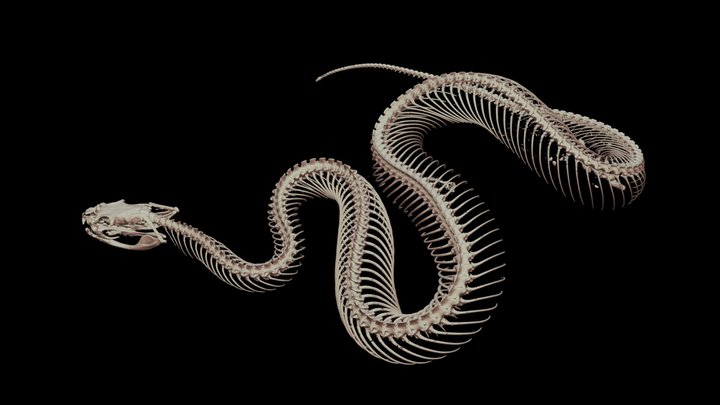
3D model
- Source
- Sketchfab
- Licence
- CC Attribution-NonCommercial-ShareAlike
- Commercial use
- the licence does not allow it
Smithsonian Open Access and MorphoSource were not reached for this taxon, so this list is what the others held rather than everything there is.
This is what the site found, which is not the same as what exists.
Keep going
What may have been alongside itReptilia through timeFormations of the Late CretaceousThe world it lived on
Occurrence data from the Paleobiology Database, CC BY 4.0. (Oppel 1811)