Heteromyidae
Heteromyidae is a family of rodents consisting of kangaroo rats, kangaroo mice, pocket mice and spiny pocket mice. Most heteromyids live in complex burrows within the deserts and grasslands of western North America, though species within the genus Heteromys are also found in forests and their range extends as far south as northern South America. They feed mostly on seeds and other plant parts, which they carry in their fur-lined cheek pouches to their burrows.

National Park Service · Public Domain · via Wikipedia/Commons. May be a photograph of a specimen, or an artist’s reconstruction — an interpretation of a skeleton, since colour and soft tissue are almost never preserved.
On record
Recorded, not inferred- Sits inside
- CastorimorphiPBDB
- Diet
- granivore, browserPBDB
- Life habit
- ground dwellingPBDB
- Motility
- actively mobilePBDB, for Osteichthyes
- Environment
- terrestrialPBDB, for Eutheria
Time the record covers
At least 29 million years on record.
The record covers at least 29.5 Mya to 11.7 ka. No occurrence read is dated outside 31.8 Mya to 0 Mya.
921 occurrences of Heteromyidae on record, most of them in the Miocene. The Paleobiology Database records this as a living group. Bar height is expected occurrences, not a count: each fossil is spread across the span it is dated to, so a tall narrow bar means tight dating and a low wide one means loose.
When
921 occurrences- Oligocene6%
- Miocene53%
- Pliocene12%
- Pleistocene27%
- Holocene2%
These are dates about fossils, not the animal: the record can only begin after it arose and end before it died out, so either end may reach further. Shares are expected occurrences: a fossil dated to a span is counted partly in each period it straddles. More on what this infers.
Found in
107 formations
- Barstow Formation109
- "unnamed sandstone" Formation62
- Palm Spring Formation58
- Valentine Formation · Ogallala Group40
- Runningwater Formation · Hemingford Group25
- San Timoteo Formation24
Loading coastlines…
The named rock units Heteromyidae has been recovered from, largest first. Drawn where the rock is now, not where it formed. 83 further formations hold fewer occurrences each and are not listed. 186 occurrences have no formation on record, which is common for older literature.
Heteromyidae and its relatives
MioceneWhere Heteromyidae and its relatives were recorded in the Miocene.
Found in the same rock
1,633 taxa- Archaeolaginae51 sites
- Camelidae40 sites
- Mylagaulidae39 sites
- Copemys longidens33 sites
- Geomyoidea30 sites
- Cupidinimus halli28 sites
- Perognathus minutus27 sites
- Cupidinimus lindsayi26 sites
- Marmotini26 sites
- Perognathus furlongi26 sites
- Cupidinimus nebraskensis25 sites
- Mioheteromyinae25 sites
- Parvericius montanus25 sites
- Teleoceras25 sites
- Perognathinae23 sites
- Copemys21 sites
- Mustelidae21 sites
- Hipparionini20 sites
- Hypolagus fontinalis20 sites
- Miospermophilus20 sites
- Spermophilus19 sites
- Cupidinimus18 sites
- Gomphotheriidae18 sites
- Leptocyon vafer18 sites
The Paleobiology Database records 508 sites for Heteromyidae, and this reads 240 of them. The number is how many of those sites it was catalogued from too. The 24 sharing the most are listed.
This is not a list of everything alive at the time. It is only what has come out of the same ground as this animal and been written down.
Entered from
206 references- Synonymies and reidentifications of North American fossil mammals201
- A review of the biostratigraphy of Pliocene and Pleistocene sediments in the Elsinore Fault Zone, Riverside County, California39
- Biostratigraphy of Blancan and Irvingtonian mammals in the Fish Creek-Vallecito Creek section, southern California, and a review of the Blancan-Irvingtonian boundary36
- Biostratigraphy and biochronology of early Arikareean through late Hemingfordian small mammal faunas from the Nebraska Panhandle and adjacent areas34
- Vertebrate biostratigraphy of the Ogallala Group in Nebraska31
- Small mammal fossils from the Barstow Formation, California25
- New Late Uintan to Early Hemingfordian Land Mammal Assemblages from the Undifferentiated Sespe and Vaqueros Formations, Orange County, and from the Sespe and Equivalent Marine Formations in Los Angeles, Santa Barbara, and Ventura Counties, Southern California24
- New Species of the Miocene Rodent Cupidinimus (Heteromyidae) and Some Evolutionary Relationships within the Genus22
- Biostratigraphic relationships of Tertiary small vertebrates from Cajon Valley, San Bernardino County, California15
- Biostratigraphy and Vertebrate Paleontology of the San Timoteo Badlands, Southern California14
- A new subfamily of primitive pocket mice (Rodentia, Heteromyidae) from the middle Tertiary of North America14
- Miocene mammals of the Split Rock area, Granite Mountains basin, central Wyoming13
Each of the 921 occurrences read was entered from one of these publications, ordered by how many each accounts for. This is not a search for papers mentioning the name. 194 further references are not listed. Entries link to doi.org where the Paleobiology Database holds an identifier, and to its own record where it does not. Relayed as the Paleobiology Database holds them, not checked against what they resolve to.
Media and terms
Media content1
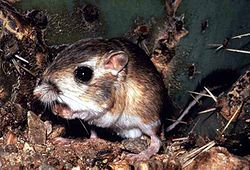
Picture of Heteromyidae
- Source
- Wikipedia/Commons
- Credit
- National Park Service
- Licence
- Public Domain
- Commercial use
- the licence allows it
No 3D scan was found. Smithsonian Open Access, MorphoSource and Sketchfab were all searched.
The description on this site
- Licence
- CC BY-SA 4.0
This is what the site found, which is not the same as what exists.
Keep going
What may have been alongside itCastorimorphi through timeFormations of the MioceneThe world it lived on
Occurrence data from the Paleobiology Database, CC BY 4.0. Gray 1868