Hystricognathi
The Hystricognathi are an infraorder of rodents, distinguished from other rodents by the bone structure of their skulls. The masseter medialis passes partially through a hole below each eye socket and connects to the bone on the opposite side. This, together with their lack of an infraorbital plate and the relative size of the infraorbital foramen, distinguishes hystricognaths from other rodent groups. The infraorder's name comes from Ancient Greek ὕστριξ (hústrix), meaning "porcupine", and γνάθος (gnáthos), meaning "jaw".

Jensflorian · CC BY-SA 3.0 · via Wikipedia/Commons. May be a photograph of a specimen, or an artist’s reconstruction — an interpretation of a skeleton, since colour and soft tissue are almost never preserved.
On record
Recorded, not inferred- Sits inside
- HystricomorphaPBDB
- Diet
- herbivorePBDB, for Rodentia
- Life habit
- ground dwellingPBDB, for Rodentia
- Motility
- actively mobilePBDB, for Osteichthyes
- Environment
- terrestrialPBDB, for Eutheria
Time the record covers
At least 37 million years on record.
The record covers at least 37.71 Mya to 11.7 ka. No occurrence read is dated outside 48.07 Mya to 0 Mya.
3,418 occurrences of Hystricognathi on record, most of them in the Miocene. The Paleobiology Database records this as a living group. Bar height is expected occurrences, not a count: each fossil is spread across the span it is dated to, so a tall narrow bar means tight dating and a low wide one means loose.
When
3,418 occurrencesThese are dates about fossils, not the animal: the record can only begin after it arose and end before it died out, so either end may reach further. Shares are expected occurrences: a fossil dated to a span is counted partly in each period it straddles. More on what this infers.
Found in
245 formations
- Santa Cruz Formation281
- Sarmiento Formation146
- Cerro Azul Formation144
- Pinturas Formation115
- Ituzaingo Formation100
- Hsanda Gol Formation99
Loading coastlines…
The named rock units Hystricognathi has been recovered from, largest first. Drawn where the rock is now, not where it formed. 221 further formations hold fewer occurrences each and are not listed. 931 occurrences have no formation on record, which is common for older literature.
Hystricognathi and its relatives
MioceneWhere Hystricognathi and its relatives were recorded in the Miocene.
Found in the same rock
2,384 taxa- Bovidae71 sites
- Equus65 sites
- Hystrix58 sites
- Mammalia47 sites
- Gazella43 sites
- Hystrix africaeaustralis42 sites
- Alcelaphini40 sites
- Hipparion39 sites
- Canis37 sites
- Suidae35 sites
- Taurotragus oryx35 sites
- Ceratotherium simum34 sites
- Reptilia34 sites
- Aves33 sites
- Cercopithecidae32 sites
- Phacochoerus aethiopicus32 sites
- Tragelaphus strepsiceros31 sites
- Panthera pardus30 sites
- Tragelaphus30 sites
- Lupulella mesomelas29 sites
- Alcelaphus buselaphus28 sites
- Equus quagga burchelli28 sites
- Hylochoerus euilus28 sites
- Rhinocerotidae28 sites
The Paleobiology Database records at least 925 sites for Hystricognathi, and this reads 240 of them. The number is how many of those sites it was catalogued from too. The 24 sharing the most are listed.
This is not a list of everything alive at the time. It is only what has come out of the same ground as this animal and been written down.
Entered from
779 references- Revision of the Miocene caviomorph rodents from the Río Santa Cruz (Argentinean Patagonia)106
- Imigrantes em um continente perdido: O registro fossilífero de roedores Caviomorpha (Mammalia: Rodentia: Ctenohystrica) do Cenozoico do Brasil105
- Tsaganomyidae (Rodentia, Mammalia) from the Oligocene of Mongolia (Valley of Lakes)67
- Octodontoids and erethizontoids (Rodentia, Hystricognathi) from the Pinturas Formation, Early-Middle Miocene of Patagonia, Argentina58
- Systematics, phylogeny and evolutionary pattern of the hystricognath rodent Eumysops (Echimyidae) from the Plio–Pleistocene of southern South America54
- Caviomorphs (Rodentia, Hystricognathi) from Pampa Castillo, Chile: new octodontoid records and biochronological implications49
- Los roedores del “Mesopotamiense” (Mioceno tardío, Formación Ituzaingó) de la provincia de Entre Ríos (Ar- gentina)49
- Cronobioestratigrafía del Mioceno tardío – Plioceno temprano, Puerta de Corral Quemado y Villavil, provincia de Catamarca, Argentina48
- Rodents of the La Venta Fauna, Miocene, Colombia: Biostratigraphy and Paleoenvironmentl implications48
- Colhuehuapian rodents from Gran Barranca and other Patagonian localities: the state of the art44
- Bioestratigrafía de la Formación Santa Cruz (Mioceno Inferior) en el extremo sudeste de la Patagonia43
- Reassesment of the Pliocene-Pleistocene continental time scale of Southern South America. Correlation of the type Chapadmalalan with Bolivian sections40
Each of the 3,418 occurrences read was entered from one of these publications, ordered by how many each accounts for. This is not a search for papers mentioning the name. 767 further references are not listed. Entries link to doi.org where the Paleobiology Database holds an identifier, and to its own record where it does not. Relayed as the Paleobiology Database holds them, not checked against what they resolve to.
Media and terms
Media content1
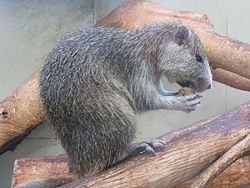
Picture of Hystricognathi
- Source
- Wikipedia/Commons
- Credit
- Jensflorian
- Licence
- CC BY-SA 3.0
- Commercial use
- the licence allows it
No 3D scan of Hystricognathi was found in Sketchfab.
Smithsonian Open Access and MorphoSource were not reached for this taxon, so this list is what the others held rather than everything there is.
The description on this site
- Licence
- CC BY-SA 4.0
This is what the site found, which is not the same as what exists.
Keep going
What may have been alongside itHystricomorpha through timeFormations of the MioceneThe world it lived on
Occurrence data from the Paleobiology Database, CC BY 4.0. (Tullberg 1899)