Kronosaurus
Kronosaurus is an extinct genus of large short-necked pliosaur that lived during the Aptian to Albian stages of the Early Cretaceous in what is now Australia. The first known specimen was received in 1899 and consists of a partially preserved mandibular symphysis, which was first thought to come from an ichthyosaur according to Charles De Vis. However, it was in 1924 that Albert Heber Longman formally described this specimen as the holotype of an imposing pliosaurid, to which he gave the scientific name K. queenslandicus, which is still the only recognized species nowadays. The genus name, meaning "lizard of Kronos", refers to its large size and possible ferocity reminiscent of the Titan of the Greek mythology, while the species name alludes to Queensland, the Australian state of its discovery. In the early 1930s, the Harvard Museum of Comparative Zoology sent an organized expedition to Australia that recovered two specimens historically attributed to the taxon, including a well known skeleton that is now massively restored in plaster. Several attributed fossils were subsequently discovered, including two large, more or less partial skeletons. As the holotype specimen does not present diagnostics to concretely distinguish Kronosaurus from other pliosaurids, these same two skeletons are proposed as potential neotypes for future redescriptions. Two additional species were proposed, but these are now seen as unlikely or belonging to another genus.

Stephen F. Poropat, Phil R. Bell, Lachlan J. Hart, Steven W. Salisbury, & Benjamin P. Kear · CC BY-SA 4.0 · via Wikipedia/Commons. May be a photograph of a specimen, or an artist’s reconstruction — an interpretation of a skeleton, since colour and soft tissue are almost never preserved.
On record
Recorded, not inferred- Sits inside
- BrachaucheninaePBDB
- Diet
- carnivorePBDB, for Pliosauroidea
- Life habit
- nektonicPBDB, for Pliosauroidea
- Motility
- actively mobilePBDB, for Pliosauroidea
- Environment
- marinePBDB, for Pliosauroidea
- Length
- 11 mWikidata
- Mass
- 12.1 tonneWikidata
Time the record covers
At least 6.9 million years on record.
The record covers at least 113.2 Mya to 106.3 Mya. No occurrence read is dated outside 121.4 Mya to 100.5 Mya.
4 occurrences of Kronosaurus on record, most of them in the Early Cretaceous. Bar height is expected occurrences, not a count: each fossil is spread across the span it is dated to, so a tall narrow bar means tight dating and a low wide one means loose.
When
4 occurrences- Early Cretaceous100%
These are dates about fossils, not the animal: the record can only begin after it arose and end before it died out, so either end may reach further. Shares are expected occurrences: a fossil dated to a span is counted partly in each period it straddles. More on what this infers.
Found in
3 formations
- Wallumbilla Formation · Rolling Downs Group2
- Toolebuc Formation · Rolling Downs Group1
- Paja Formation1
Loading coastlines…
The named rock units Kronosaurus has been recovered from, largest first. Drawn where the rock is now, not where it formed.
Kronosaurus and its relatives
Early CretaceousWhere Kronosaurus and its relatives were recorded in the Early Cretaceous.
Found in the same rock
9 taxa- Bouliachelys suteri1 site
- Chelonioidea indet.1 site
- Cimoliasaurus1 site
- Platypterygius1 site
- Platypterygius australis1 site
- Plesiosauria1 site
- Polycotylidae1 site
- Testudines1 site
- Theropoda1 site
The Paleobiology Database records 4 sites for Kronosaurus, and this reads all of them. The number is how many of those sites it was catalogued from too.
This is not a list of everything alive at the time. It is only what has come out of the same ground as this animal and been written down.
Entered from
4 references- Marine reptiles from the Lower Cretaceous (Aptian) deposits of White Cliffs, southeastern Australia: implications of a high latitude, cold water assemblage1
- Ein großwüchsiger Pliosauride (Reptilia: Plesiosauria) aus der Unterkreide (oberes Aptium) von Kolumbien1
- Fossil reptiles in Australia1
- Some Queensland fossil vertebrates1
Each of the 4 occurrences read was entered from one of these publications, ordered by how many each accounts for. This is not a search for papers mentioning the name. Entries link to doi.org where the Paleobiology Database holds an identifier, and to its own record where it does not. Relayed as the Paleobiology Database holds them, not checked against what they resolve to.
Media and terms
Media content3

Picture of Kronosaurus
- Source
- Wikipedia/Commons
- Credit
- Stephen F. Poropat, Phil R. Bell, Lachlan J. Hart, Steven W. Salisbury, & Benjamin P. Kear
- Licence
- CC BY-SA 4.0
- Commercial use
- the licence allows it
Structured light scan
- Source
- MorphoSource
- Licence
- not stated by the source
- Commercial use
- cannot be read from the licence given — check the record
- Specimen
- Kronosaurus queenslandicus · sama:paleontology:40022
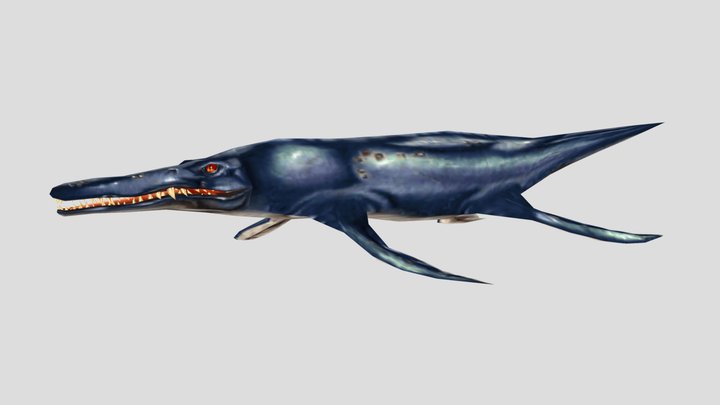
3D model
- Source
- Sketchfab
- Credit
- Ziggertron
- Licence
- CC Attribution
- Commercial use
- cannot be read from the licence given — check the record
Smithsonian Open Access was not reached for this taxon, so this list is what the others held rather than everything there is.
The description on this site
- Source
- Wikipedia, “Kronosaurus”
- Licence
- CC BY-SA 4.0
This is what the site found, which is not the same as what exists.
Keep going
What may have been alongside itBrachaucheninae through timeFormations of the Early CretaceousThe world it lived on
Occurrence data from the Paleobiology Database, CC BY 4.0. Longman 1924