Polycotylidae
Polycotylidae is a family of plesiosaurs from the Cretaceous. Polycotylids first appeared during the Albian stage of the Early Cretaceous, before becoming abundant and widespread during the early Late Cretaceous. Several species survived into the final stage of the Cretaceous, the Maastrichtian, around 72-66 million years ago. The possible latest surviving member Rarosaurus from the late Maastrichtian is more likely a crocodylomorph.

MCDinosaurhunter · CC BY-SA 3.0 · via Wikipedia/Commons. May be a photograph of a specimen, or an artist’s reconstruction — an interpretation of a skeleton, since colour and soft tissue are almost never preserved.
On record
Recorded, not inferred- Sits inside
- PlesiosauroideaPBDB
- Diet
- carnivorePBDB, for Plesiosauria
- Life habit
- aquatic, depth=surfacePBDB, for Plesiosauria
- Motility
- actively mobilePBDB, for Plesiosauria
- Environment
- marinePBDB, for Plesiosauria
Time the record covers
At least 77 million years on record.
The record covers at least 149.2 Mya to 72.2 Mya. No occurrence read is dated outside 152.21 Mya to 66 Mya.
100 occurrences of Polycotylidae on record, most of them in the Late Cretaceous. Bar height is expected occurrences, not a count: each fossil is spread across the span it is dated to, so a tall narrow bar means tight dating and a low wide one means loose.
When
100 occurrencesThese are dates about fossils, not the animal: the record can only begin after it arose and end before it died out, so either end may reach further. Shares are expected occurrences: a fossil dated to a span is counted partly in each period it straddles. More on what this infers.
Found in
37 formations
- Niobrara Formation · Colorado Group8
- Pierre Shale Formation · Montana Group8
- Greenhorn Limestone Formation · Colorado Group6
- Conway Formation · Eyre Group6
- Tropic Shale Formation5
- Carlile Shale Formation · Colorado Group5
Loading coastlines…
The named rock units Polycotylidae has been recovered from, largest first. Drawn where the rock is now, not where it formed. 13 further formations hold fewer occurrences each and are not listed. 20 occurrences have no formation on record, which is common for older literature.
Polycotylidae and its relatives
Late CretaceousWhere Polycotylidae and its relatives were recorded in the Late Cretaceous.
Found in the same rock
326 taxa- Elasmosauridae14 sites
- Trinacromerum bentonianum14 sites
- Plesiosauria12 sites
- Dolichorhynchops osborni7 sites
- Polycotylus latipinnis7 sites
- Dolichorhynchops6 sites
- Protosphyraena5 sites
- Theropoda5 sites
- Bivalvia4 sites
- Enchodus4 sites
- Mosasauridae4 sites
- Platecarpus4 sites
- Sulcusuchus erraini4 sites
- Teleostei4 sites
- Testudines4 sites
- Archaeolamna kopingensis3 sites
- Aristonectinae3 sites
- Bananogmius3 sites
- Chondrichthyes3 sites
- Cretalamna appendiculata3 sites
- Cretoxyrhina mantelli3 sites
- Dinosauria3 sites
- Enchodus petrosus3 sites
- Enchodus shumardi3 sites
The Paleobiology Database records 96 sites for Polycotylidae, and this reads all of them. The number is how many of those sites it was catalogued from too. The 24 sharing the most are listed.
This is not a list of everything alive at the time. It is only what has come out of the same ground as this animal and been written down.
Entered from
65 references- A stratigraphic and taxonomic review of plesiosaurs from the old "Fort Benton Group" of central Kansas: a new assessment of old records10
- A new genus of small polycotylid plesiosaur from the Upper Cretaceous of the Western Interior Seaway and a clarification of the genus Dolichorhynchops6
- Late Cretaceous marine reptiles of New Zealand6
- A review of short-necked plesiosaurs of the Western Interior, North America5
- Plesiosaurs from the Upper Cretaceous (Cenomanian-Turonian) Tropic Shale of southern Utah, part 2: Polycotylidae3
- Reptiles from the Senonian (U Cret) of Scania (S Sweden)3
- Saurierreste aus der baltischen oberen Kreide [Saurian remains from the Baltic Upper Cretaceous]3
- The end of the dinosaur era in Patagonia (NatGeo Project)2
- Northernmost occurrences of plesiosaurs and turtles in the Upper Cretaceous of Eurasia2
- Cranial anatomy and taxonomy of Dolichorhynchops bonneri new combination, a polycotylid (Sauropteryga: Plesiosauria) from the Pierre Shale of Wyoming and South Dakota2
- Short-necked plesiosaurs of the Family Polycotylidae from the Campanian of the Saratov Region2
- Fossil vertebrates from the marine Cretaceous of Manitoba2
Each of the 100 occurrences read was entered from one of these publications, ordered by how many each accounts for. This is not a search for papers mentioning the name. 53 further references are not listed. Entries link to doi.org where the Paleobiology Database holds an identifier, and to its own record where it does not. Relayed as the Paleobiology Database holds them, not checked against what they resolve to.
Media and terms
Media content2
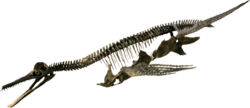
Picture of Polycotylidae
- Source
- Wikipedia/Commons
- Credit
- MCDinosaurhunter
- Licence
- CC BY-SA 3.0
- Commercial use
- the licence allows it
Laser scan
- Source
- MorphoSource
- Licence
- not stated by the source
- Commercial use
- cannot be read from the licence given — check the record
- Specimen
- Polycotylidae indet. · qm:f:18041
Smithsonian Open Access was not reached for this taxon, so this list is what the others held rather than everything there is.
The description on this site
- Licence
- CC BY-SA 4.0
This is what the site found, which is not the same as what exists.
Keep going
What may have been alongside itPlesiosauroidea through timeFormations of the Late CretaceousThe world it lived on
Occurrence data from the Paleobiology Database, CC BY 4.0. Williston 1908