Lamellaptychus
No picture of Lamellaptychus was found. Wikidata and iDigBio were searched and had none. Wikipedia and Smithsonian Open Access did not answer, so this is what the others held rather than everything there is. GBIF was asked, and what came back is not recorded: nothing, or a picture this site could not tie to Lamellaptychus, or no answer at all. This entry cannot say which.
On record
Recorded, not inferred- Also called
- ammonoid aptychusPBDB
- Sits inside
- CephalopodaPBDB
- Diet
- carnivorePBDB, for Cephalopoda
- Life habit
- nektonicPBDB, for Cephalopoda
- Motility
- fast-movingPBDB, for Cephalopoda
- Vision
- well-developedPBDB, for Cephalopoda
- Environment
- marinePBDB, for Cephalopoda
Time the record covers
At least 35 million years on record.
The record covers at least 161.5 Mya to 125.77 Mya. No occurrence read is dated outside 165.3 Mya to 100.5 Mya.
51 occurrences of Lamellaptychus on record, most of them in the Early Cretaceous. Bar height is expected occurrences, not a count: each fossil is spread across the span it is dated to, so a tall narrow bar means tight dating and a low wide one means loose.
When
51 occurrencesThese are dates about fossils, not the animal: the record can only begin after it arose and end before it died out, so either end may reach further. Shares are expected occurrences: a fossil dated to a span is counted partly in each period it straddles. More on what this infers.
Found in
16 formations
- Rossfeld Formation11
- Mraznica Formation5
- Pieniny Limestone Formation5
- Kaliste Formation4
- Artemisa Formation2
- Luckovska Formation1
Loading coastlines…
The named rock units Lamellaptychus has been recovered from, largest first. Drawn where the rock is now, not where it formed. 13 occurrences have no formation on record, which is common for older literature.
Lamellaptychus and its relatives
Early CretaceousWhere Lamellaptychus and its relatives were recorded in the Early Cretaceous.
Found in the same rock
317 taxa- Haploceras10 sites
- Lytoceras8 sites
- Neolissoceras grasianum8 sites
- Phylloceras7 sites
- Bochianites neocomiensis5 sites
- Olcostephanus5 sites
- Duvalia4 sites
- Eleniceras tchechitevi4 sites
- Hibolites4 sites
- Neocomites4 sites
- Rodighieroites cardulus4 sites
- Crioceratites3 sites
- Duvalia binervia3 sites
- Duvalia dilatata3 sites
- Eleniceras3 sites
- Laevaptychus3 sites
- Lytoceras subfimbriatum3 sites
- Partschiceras3 sites
- Acrioceras2 sites
- Anahamulina2 sites
- Anahamulina subcylindrica2 sites
- Balearites pseudothurmannii2 sites
- Barremites2 sites
- Braarudosphaera2 sites
The Paleobiology Database records 35 sites for Lamellaptychus, and this reads all of them. The number is how many of those sites it was catalogued from too. The 24 sharing the most are listed.
This is not a list of everything alive at the time. It is only what has come out of the same ground as this animal and been written down.
Entered from
21 references- Die Cephalopoden aus den Rossfeldschichten der Reichraminger Decke (Obervalanginium, oberösterreichische Kalkalpen) [Cephalopods from the Rossfeld Formation of the Reichraming Nappe (Late Valanginian, Northern Calcareous Alps, Upper Austria)]11
- Lower Cretaceous Stratigraphy and Paleogeography of the Czechoslovakian Western Carpathians10
- On the boreal genus Buchia (Bivalvia) from the Tithonian of the lesser Caucasus5
- Ammonite-supported microfossil and nannoconid stratigraphy of the Tithonian–Hauterivian limestones in selected sections of the Branisko Succession, Pieniny Klippen Belt (Poland)5
- Ammonite biostratigraphy of the Tithonian of Western Cuba3
- The biostratigraphy of the Hauterivian/Barremian Boundary Beds in the Krížna Nappe, Western Carpathians (Czechoslovakia)2
- New halecomorph (Actinopterygii, Neopterygii) from the Nusplingen Lithographic Limestone (Upper Jurassic, Late Kimmeridgian), Germany1
- Upper Jurassic Reefs from the Russian Western Caucasus: Implications for the Eastern Black Sea1
- Les "Marnes à theoi" de Pamproux (Deux-Sèvres, France), Sous-Zone à Antecedens (Oxfordien moyen, Zone à Plicatilis): diversité des faunes et découverte de nouvelles espèces d'ammonites [The "Theoi Marls" of Pamproux (Deux-Sèvres department, France), Antecedens Sub-zone (Middle Oxfordian, Plicatilis Zone): faunal diversity and discovery of new ammonite species]1
- The Wattendorf Plattenkalk (Upper Kimmeridgian) - a new conservation lagerstätte from the northern Franconian Alb, southern Germany1
- Klein, 20051
- Early Cretaceous Trigonids of the Crimea1
Each of the 51 occurrences read was entered from one of these publications, ordered by how many each accounts for. This is not a search for papers mentioning the name. 9 further references are not listed. Entries link to doi.org where the Paleobiology Database holds an identifier, and to its own record where it does not. Relayed as the Paleobiology Database holds them, not checked against what they resolve to.
Media and terms
Media content1
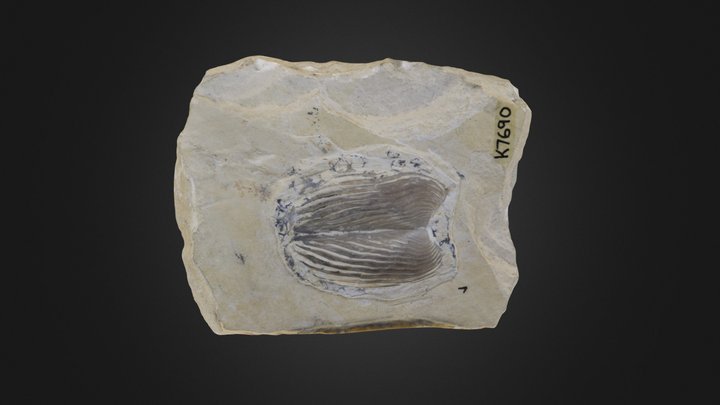
3D model
- Source
- Sketchfab
- Licence
- CC0 Public Domain
- Commercial use
- the licence allows it
No picture of Lamellaptychus was found. Wikidata and iDigBio were searched and had none.
Wikipedia and Smithsonian Open Access did not answer, so this is what the others held rather than everything there is.
GBIF was asked, and what came back is not recorded: nothing, or a picture this site could not tie to Lamellaptychus, or no answer at all. This entry cannot say which.
Smithsonian Open Access was not reached for this taxon, so this list is what the others held rather than everything there is.
This is what the site found, which is not the same as what exists.
Keep going
What may have been alongside itCephalopoda through timeFormations of the Early CretaceousThe world it lived on
Occurrence data from the Paleobiology Database, CC BY 4.0. Trauth 1927