Leptodactylidae
The southern frogs form the Leptodactylidae, a name that comes from Greek meaning a bird or other animal having slender toes. They are a diverse family of frogs that most likely diverged from other hyloids during the Cretaceous. The family has undergone major taxonomic revisions in recent years, including the reclassification of the former subfamily Eleutherodactylinae into its own family the Eleutherodactylidae; the Leptodactylidae now number 206 species in 13 genera distributed throughout Mexico, the Caribbean, and Central and South America. The family includes terrestrial, burrowing, aquatic, and arboreal members, inhabiting a wide range of habitats.

Uncredited · Public Domain · via Wikipedia/Commons. May be a photograph of a specimen, or an artist’s reconstruction — an interpretation of a skeleton, since colour and soft tissue are almost never preserved.
On record
Recorded, not inferred- Sits inside
- HyloideaPBDB
- Diet
- carnivorePBDB, for Temnospondyli
- Life habit
- amphibiousPBDB, for Temnospondyli
- Motility
- actively mobilePBDB, for Temnospondyli
- Environment
- brackish,freshwater,terrestrialPBDB, for Tetrapoda
Time the record covers
At least 65 million years on record.
The record covers at least 66 Mya to 11.7 ka. No occurrence read is dated outside 72.2 Mya to 0 Mya.
33 occurrences of Leptodactylidae on record, most of them in the Pleistocene. The Paleobiology Database records this as a living group. Bar height is expected occurrences, not a count: each fossil is spread across the span it is dated to, so a tall narrow bar means tight dating and a low wide one means loose.
When
33 occurrences- Late Cretaceous10%
- Paleocene12%
- Eocene11%
- Oligocene9%
- Miocene21%
- Pliocene6%
- Pleistocene27%
- Holocene3%
These are dates about fossils, not the animal: the record can only begin after it arose and end before it died out, so either end may reach further. Shares are expected occurrences: a fossil dated to a span is counted partly in each period it straddles. More on what this infers.
Found in
11 formations
- Sarmiento Formation2
- Sheep Pass Formation2
- Monte Hermoso Formation2
- Santa Cruz Formation2
- Muñani Formation · Puno Group1
- Lance Formation1
Loading coastlines…
The named rock units Leptodactylidae has been recovered from, largest first. Drawn where the rock is now, not where it formed. 18 occurrences have no formation on record, which is common for older literature.
Leptodactylidae and its relatives
PleistoceneWhere Leptodactylidae and its relatives were recorded in the Pleistocene.
Found in the same rock
802 taxa- Serpentes6 sites
- Leptodactylus5 sites
- Siluriformes4 sites
- Anura3 sites
- Aves3 sites
- Boidae3 sites
- Phareodus3 sites
- Squamata3 sites
- Theropoda3 sites
- Allognathosuchus2 sites
- Anguidae2 sites
- Bettongia lesueur2 sites
- Caimaninae2 sites
- Caudiverbera2 sites
- Ceratophrys2 sites
- Cercartetus nanus2 sites
- Chelidae2 sites
- Colubridae2 sites
- Colubrinae2 sites
- Conilurus2 sites
- Corvus2 sites
- Crocodylia2 sites
- Dasyurus viverrinus2 sites
- Deccanolestes2 sites
The Paleobiology Database records 25 sites for Leptodactylidae, and this reads all of them. The number is how many of those sites it was catalogued from too. The 24 sharing the most are listed.
This is not a list of everything alive at the time. It is only what has come out of the same ground as this animal and been written down.
Entered from
24 references- Pleistocene frogs from caves at Naracoorte, South Australia4
- Anurans from the early Tertiary of Patagonia3
- Pleistocene fossil vertebrate sites of the South East region of South Australia II2
- The Encore Local Fauna, a late Miocene assemblage from Riversleigh, northwestern Queensland2
- Fossil mammals of Riversleigh, northwestern Queensland; preliminary overview of biostratigraphy, correlation and environmental change2
- A small Pleistocene herpetofauna from Tamaulipas2
- New vertebrates from the Ituzaingó Formation (Late Miocene of Entre Ríos Province, Argentina), including first records of Leptodactylus (Amphibia, Anura) and Chelonoidis (Testudines, Cryptodira)1
- The end of the dinosaur era in Patagonia (NatGeo Project)1
- Anuran Lissamphibian and Squamate Reptiles from the Upper Cretaceous (Maastrichtian) Deccan Intertrappean Sites in Central India, with a Review of Lissamphibian and Squamate Diversity in the Northward Drifting Indian Plate1
- Late Cenozoic vertebrates from the Southern Pampean region: systematic and bio-chronostratigraphic update1
- Mesozoic and Palaeocene lissamphibian assemblages of North America: a comprehensive review1
- Oldest record of Leptodactylus Fitzinger, 1826 (Anura, Leptodactylidae) from the early Pliocene of the south american pampas1
Each of the 33 occurrences read was entered from one of these publications, ordered by how many each accounts for. This is not a search for papers mentioning the name. 12 further references are not listed. Entries link to doi.org where the Paleobiology Database holds an identifier, and to its own record where it does not. Relayed as the Paleobiology Database holds them, not checked against what they resolve to.
Media and terms
Media content1
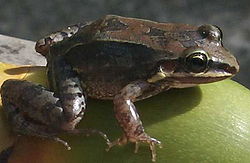
Picture of Leptodactylidae
- Source
- Wikipedia/Commons
- Credit
- nobody named on the record
- Licence
- Public Domain
- Commercial use
- the licence allows it
No 3D scan of Leptodactylidae was found in MorphoSource and Sketchfab.
Smithsonian Open Access was not reached for this taxon, so this list is what the others held rather than everything there is.
The description on this site
- Licence
- CC BY-SA 4.0
This is what the site found, which is not the same as what exists.
Keep going
What may have been alongside itHyloidea through timeFormations of the PleistoceneThe world it lived on
Occurrence data from the Paleobiology Database, CC BY 4.0. Stirton 1953