Limulidae
Horseshoe crabs are arthropods of the family Limulidae and the only surviving xiphosurans. Despite their name, they are not crabs or even crustaceans; they are chelicerates, more closely related to arachnids like spiders, ticks, and scorpions. The body of a horseshoe crab is divided into three main parts: the cephalothorax, abdomen, and telson. The largest of these, the cephalothorax, houses most of the animal's eyes, limbs, and internal organs. It is also where the animal gets its name, as its shape somewhat resembles that of a horseshoe. Horseshoe crabs have been described as "living fossils", having changed little since they first appeared in the Triassic around 250 million years ago, and similar-looking fossil xiphosurans extend back to the Ordovician around 445 million years ago.

Shubham Chatterjee · CC BY-SA 3.0 · via Wikipedia/Commons. May be a photograph of a specimen, or an artist’s reconstruction — an interpretation of a skeleton, since colour and soft tissue are almost never preserved.
On record
Recorded, not inferred- Also called
- horseshoe crabPBDB
- Sits inside
- LimuloideaPBDB
- Diet
- carnivorePBDB, for Xiphosura
- Life habit
- nektobenthicPBDB, for Xiphosura
- Motility
- actively mobilePBDB, for Xiphosura
- Vision
- limitedPBDB, for Xiphosurida
Time the record covers
At least 308 million years on record.
The record covers at least 346.7 Mya to 37.71 Mya. No occurrence read is dated outside 358.86 Mya to 33.9 Mya.
51 occurrences of Limulidae on record, most of them in the Middle Triassic. The Paleobiology Database records this as a living group, and the chart stops with its fossils rather than at the present. Bar height is expected occurrences, not a count: each fossil is spread across the span it is dated to, so a tall narrow bar means tight dating and a low wide one means loose.
When
51 occurrences- Carboniferous2%
- Early Triassic10%
- Middle Triassic35%
- Late Triassic2%
- Early Jurassic4%
- Middle Jurassic2%
- Late Jurassic27%
- Early Cretaceous4%
- Late Cretaceous12%
- Eocene2%
These are dates about fossils, not the animal: the record can only begin after it arose and end before it died out, so either end may reach further. Shares are expected occurrences: a fossil dated to a span is counted partly in each period it straddles. More on what this infers.
Found in
26 formations
- Solnhofen Formation9
- Grès à Voltzia Formation7
- Muschelkalk Formation3
- Rybinsk Formation2
- Akrabou Formation1
- Liegende Bankkalk Formation1
Loading coastlines…
The named rock units Limulidae has been recovered from, largest first. Drawn where the rock is now, not where it formed. 2 further formations hold fewer occurrences each and are not listed. 8 occurrences have no formation on record, which is common for older literature.
Limulidae and its relatives
Middle TriassicWhere Limulidae and its relatives were recorded in the Middle Triassic.
Found in the same rock
447 taxa- Limulitella bronnii9 sites
- Mesolimulus walchi6 sites
- Diplostraca4 sites
- Eoscorpiidae4 sites
- Euestheria minuta4 sites
- Euthycarcinus kessleri4 sites
- Lingularia tenuissima4 sites
- Palaeoxyris regularis4 sites
- Actinopterygii3 sites
- Antrimpos atavus3 sites
- Chondrostei3 sites
- Clytiopsis argentoratense3 sites
- Halicyne ornata3 sites
- Palaeolimnadia alsatica3 sites
- Schimperella beneckei3 sites
- Tachypleus syriacus3 sites
- Anisaeger atavus2 sites
- Bivalvia2 sites
- Coelacanthidae2 sites
- Coleoptera2 sites
- Glyphiteuthis libanotica2 sites
- Homomya impressa2 sites
- Insecta2 sites
- Isaura2 sites
The Paleobiology Database records 42 sites for Limulidae, and this reads all of them. The number is how many of those sites it was catalogued from too. The 24 sharing the most are listed.
This is not a list of everything alive at the time. It is only what has come out of the same ground as this animal and been written down.
Entered from
39 references- Planche VII. Limules fossiles des couches supérieures du Jura7
- Faunes et paysages du Grès à Voltzia du Nord des Vosges: Essai paléoécologique sur le Buntsandstein supérieur4
- Tachypleus syriacus (Woodward) - a sexually dimorphic Cretaceous crown limulid reveals underestimated horseshoe crab divergence times2
- King crabs and eurypterids from the Permian and Mesozoic of the USSR2
- Über Crustaceen aus dem Voltziensandstein des Elsasses2
- A new limulid (Chelicerata, Xiphosurida) from the Late Cretaceous (Cenomanian-Turonian) of Gara Sbaa, southeast Morocco1
- Xiphosurid from the Tournaisian (Carboniferous) of Scotland confirms deep origin of Limuloidea1
- A new limulid genus from the Strelovec Formation (Middle Triassic, Anisian) of northern Slovenia1
- Limulitella tejraensis, a new species of limulid (Chelicerata, Xiphosura) from the Middle Triassic of southern Tunisia (Saharan Platform)1
- Middle Triassic (Anisian-Ladinian) Tejra red beds and Late Triassic (Carnian) carbonate sedimentary records of southern Tunisia, Saharan Platform: Biostratigraphy, sedimentology and implication on regional stratigraphic correlations1
- The horseshoe crab of the genus Limulus: living fossil or stabilomorph?1
- Im Reich der Meerengel. Der Nusplinger Plattenkalk und seine Fossilien1
Each of the 51 occurrences read was entered from one of these publications, ordered by how many each accounts for. This is not a search for papers mentioning the name. 27 further references are not listed. Entries link to doi.org where the Paleobiology Database holds an identifier, and to its own record where it does not. Relayed as the Paleobiology Database holds them, not checked against what they resolve to.
Media and terms
Media content1
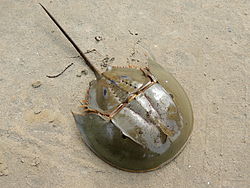
Picture of Limulidae
- Source
- Wikipedia/Commons
- Credit
- Shubham Chatterjee
- Licence
- CC BY-SA 3.0
- Commercial use
- the licence allows it
No 3D scan of Limulidae was found in Sketchfab.
Smithsonian Open Access and MorphoSource were not reached for this taxon, so this list is what the others held rather than everything there is.
The description on this site
- Licence
- CC BY-SA 4.0
This is what the site found, which is not the same as what exists.
Keep going
What may have been alongside itLimuloidea through timeFormations of the Middle TriassicThe world it lived on
Occurrence data from the Paleobiology Database, CC BY 4.0. Leach 1819