Lunatia
Euspira is a genus of medium-sized sea snails, marine gastropod molluscs in the subfamily Polinicinae of the family Naticidae, the moon snails.

Hans Hillewaert · CC BY-SA 4.0 · via Wikipedia/Commons. May be a photograph of a specimen, or an artist’s reconstruction — an interpretation of a skeleton, since colour and soft tissue are almost never preserved.
On record
Recorded, not inferred- Sits inside
- NaticidaePBDB
- Diet
- carnivorePBDB, for Naticidae
- Life habit
- semi-infaunalPBDB, for Naticidae
- Motility
- actively mobilePBDB, for Naticidae
- Vision
- limitedPBDB, for Gastropoda
Time the record covers
At least 118 million years on record.
The record covers at least 121.4 Mya to 2.58 Mya. No occurrence read is dated outside 125.77 Mya to 774 ka.
131 occurrences of Lunatia on record, most of them in the Oligocene. The Paleobiology Database records this as a living group, and the chart stops with its fossils rather than at the present. Bar height is expected occurrences, not a count: each fossil is spread across the span it is dated to, so a tall narrow bar means tight dating and a low wide one means loose.
When
131 occurrences- Early Cretaceous7%
- Late Cretaceous17%
- Paleocene16%
- Eocene15%
- Oligocene25%
- Miocene15%
- Pliocene4%
- Pleistocene1%
These are dates about fossils, not the animal: the record can only begin after it arose and end before it died out, so either end may reach further. Shares are expected occurrences: a fossil dated to a span is counted partly in each period it straddles. More on what this infers.
Found in
55 formations
- Falun de Jeurs Formation12
- Lellinge Greensand Formation10
- Falun de Morigny Formation6
- Pirabas Formation6
- Kirkwood Formation5
- Falun de Pierrefitte Formation4
Loading coastlines…
The named rock units Lunatia has been recovered from, largest first. Drawn where the rock is now, not where it formed. 31 further formations hold fewer occurrences each and are not listed. 17 occurrences have no formation on record, which is common for older literature.
Lunatia and its relatives
OligoceneWhere Lunatia and its relatives were recorded in the Oligocene.
Found in the same rock
1,730 taxa- Glycymeris41 sites
- Polinices36 sites
- Lucina35 sites
- Calyptraea34 sites
- Cylichna31 sites
- Bittium30 sites
- Odostomia30 sites
- Tympanotonos30 sites
- Parvicardium29 sites
- Cordiopsis incrassata28 sites
- Ctena28 sites
- Cytherea (Callista) splendida28 sites
- Granulolabium plicatum28 sites
- Lentidium (Ajanssenium) nitidum28 sites
- Turboella turbinata28 sites
- Arcopagia27 sites
- Paralucinella undulata27 sites
- Tivelina27 sites
- Veneridae27 sites
- Habecardium tenuisulcatum26 sites
- Parvilucina26 sites
- Saxolucina26 sites
- Corbula25 sites
- Bayania semidecussata24 sites
The Paleobiology Database records 111 sites for Lunatia, and this reads all of them. Of that, one read hit the database's own return limit, so every count below is a floor rather than a total. The number is how many of those sites it was catalogued from too. The 24 sharing the most are listed.
This is not a list of everything alive at the time. It is only what has come out of the same ground as this animal and been written down.
Entered from
57 references- Biostratigraphie et paleoecologie des gisements types du Stampian de la region d''Etampes (Essonne)28
- Depositional dynamics and the record of ecosystem stability: early Eocene faunal gradients in the Pyrenean foreland, Spain12
- The Selandian (Paleocene) mollusc fauna from Copenhagen, Denmark: the Poul Harder 1920 collection8
- Miocene invertebrate fauna of New Jersey5
- Localidades fossiliferas da Formacao Pirabas (Mioceno Inferior)4
- Lower Aptian Ammonitina Pseudohaploceras liptoviense (Zeuschner) in the Cumburindio Formation (Southwestern Mexico)3
- Paleocene gastropods from Nûgssuaq, West Greenland3
- Paleogene and Early Neogene molluscan faunae in West Japan3
- New Vicksburg (Oligocene) Mollusks From Mexico3
- The Cretaceous formations3
- Computer-based mollusc stratigraphy - a case study from the Eggenburgian (Lower Miocene) type region (NE Austria)2
- Molluscos del Terciario marino2
Each of the 131 occurrences read was entered from one of these publications, ordered by how many each accounts for. This is not a search for papers mentioning the name. 45 further references are not listed. Entries link to doi.org where the Paleobiology Database holds an identifier, and to its own record where it does not. Relayed as the Paleobiology Database holds them, not checked against what they resolve to.
Media and terms
Media content1
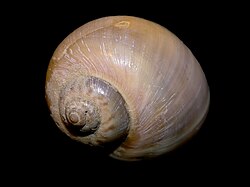
Picture of Lunatia
- Source
- Wikipedia/Commons
- Credit
- Hans Hillewaert
- Licence
- CC BY-SA 4.0
- Commercial use
- the licence allows it
No 3D scan of Lunatia was found in MorphoSource and Sketchfab.
Smithsonian Open Access was not reached for this taxon, so this list is what the others held rather than everything there is.
The description on this site
- Source
- Wikipedia, “Euspira”
- Licence
- CC BY-SA 4.0
This is what the site found, which is not the same as what exists.
Keep going
What may have been alongside itNaticidae through timeFormations of the OligoceneThe world it lived on
Occurrence data from the Paleobiology Database, CC BY 4.0. (Gray 1847)