Macrotis lagotis
The greater bilby or often simply bilby, is a long-eared, rabbit-like marsupial found in Australia. It lives in burrows and is active at night, feeding on insects, fruit, or fungi. Formerly widespread, bilbies are now restricted to parts of northwestern and central Australia due to threats like habitat loss, disease, and introduced predators such as foxes.

Dcoetzee · Public Domain · via Wikipedia/Commons. May be a photograph of a specimen, or an artist’s reconstruction — an interpretation of a skeleton, since colour and soft tissue are almost never preserved.
On record
Recorded, not inferred- Also called
- bilbyPBDB
- Sits inside
- MacrotisPBDB
- Diet
- insectivore, carnivorePBDB, for Thylacomyidae
- Life habit
- ground dwellingPBDB, for Macrotis
- Motility
- actively mobilePBDB, for Osteichthyes
- Environment
- terrestrialPBDB, for Mammalia
- Length
- 300 mmWikidata
- Mass
- 2.25 kgWikidata
Time the record covers
At most 2.6 million years on record.
Every occurrence read is dated to somewhere between 2.58 Mya and 0 Mya, and nothing in the dating separates them, so that window is what the record shows rather than a span.
4 occurrences of Macrotis lagotis on record, most of them in the Pleistocene. The Paleobiology Database records this as a living group. Bar height is expected occurrences, not a count: each fossil is spread across the span it is dated to, so a tall narrow bar means tight dating and a low wide one means loose.
When
4 occurrences- Pleistocene100%
These are dates about fossils, not the animal: the record can only begin after it arose and end before it died out, so either end may reach further. Shares are expected occurrences: a fossil dated to a span is counted partly in each period it straddles. More on what this infers.
Macrotis lagotis and its relatives
PleistoceneWhere Macrotis lagotis and its relatives were recorded in the Pleistocene.
Found in the same rock
46 taxa- Dasycercus cristicauda4 sites
- Leporillus conditor4 sites
- Lagorchestes hirsutus3 sites
- Leggandina hermannsburgensis3 sites
- Macropus3 sites
- Perameles3 sites
- Antechinomys2 sites
- Bettongia2 sites
- Bettongia penicillata2 sites
- Dasyurus2 sites
- Leporillus2 sites
- Phascogale calura2 sites
- Pseudomys2 sites
- Sminthopsis crassicaudata2 sites
- Bettongia lesueur1 site
- Caloprymnus campestris1 site
- Cercartetus concinnus1 site
- Dasyurus geoffroii1 site
- Dasyurus viverrinus1 site
- Diprotodon optatum1 site
- Hydromys1 site
- Isoodon obesulus1 site
- Lagorchestes1 site
- Lasiorhinus krefftii1 site
The Paleobiology Database records 4 sites for Macrotis lagotis, and this reads all of them. The number is how many of those sites it was catalogued from too. The 24 sharing the most are listed.
This is not a list of everything alive at the time. It is only what has come out of the same ground as this animal and been written down.
Entered from
2 references- Vertebrate remains from the Nullarbor caves, Western Australia3
- Fossiliferous deposits at Lake Tandou, New South Wales, Australia1
Each of the 4 occurrences read was entered from one of these publications, ordered by how many each accounts for. This is not a search for papers mentioning the name. Each entry links to the Paleobiology Database's own record for the work.
Media and terms
Media content3

Picture of Macrotis lagotis
- Source
- Wikipedia/Commons
- Credit
- Dcoetzee
- Licence
- Public Domain
- Commercial use
- the licence allows it
CT scan
- Source
- MorphoSource
- Licence
- In Copyright
- Commercial use
- cannot be read from the licence given — check the record
- Specimen
- Macrotis lagotis · SAMA:Mammalogy:M3602
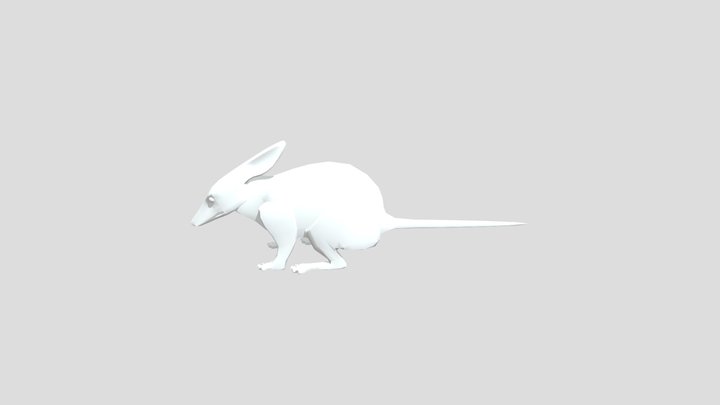
3D model
- Source
- Sketchfab
- Credit
- wannabewyvern
- Licence
- CC Attribution-NonCommercial
- Commercial use
- the licence does not allow it
Smithsonian Open Access was not reached for this taxon, so this list is what the others held rather than everything there is.
The description on this site
- Licence
- CC BY-SA 4.0
This is what the site found, which is not the same as what exists.
Keep going
What may have been alongside itMacrotis through timeFormations of the PleistoceneThe world it lived on
Occurrence data from the Paleobiology Database, CC BY 4.0. (Reid 1837)