Madtsoiidae
Madtsoiidae is an extinct family of mostly Gondwanan snakes with a fossil record extending from early Cenomanian to late Pleistocene strata located in South America, Africa, India, Australia and Southern Europe. Madtsoiidae include very primitive snakes, which like extant boas and pythons would likely dispatch their prey by constriction. Genera include some of the longest snakes known such as Vasuki, measuring at least 11–15 metres (36–49 ft) long, and the Australian Wonambi and Yurlunggur. As a grouping of basal forms the composition and even the validity of Madtsoiidae is in a state of flux as new pertinent finds are described, with more recent evidence suggesting that it is paraphyletic or polyphyletic as previously defined.

Ghedoghedo · Public Domain · via Wikipedia/Commons. May be a photograph of a specimen, or an artist’s reconstruction — an interpretation of a skeleton, since colour and soft tissue are almost never preserved.
On record
Recorded, not inferred- Sits inside
- SerpentesPBDB
- Motility
- actively mobilePBDB, for Osteichthyes
- Environment
- terrestrialPBDB, for Amniota
Time the record covers
At least 93 million years on record.
The record covers at least 93.9 Mya to 129 ka. No occurrence read is dated outside 100.5 Mya to 0 Mya.
112 occurrences of Madtsoiidae on record, most of them in the Late Cretaceous. Bar height is expected occurrences, not a count: each fossil is spread across the span it is dated to, so a tall narrow bar means tight dating and a low wide one means loose.
When
112 occurrences- Late Cretaceous50%
- Paleocene5%
- Eocene15%
- Oligocene3%
- Miocene19%
- Plioceneunder 1%
- Pleistocene8%
- Holoceneunder 1%
These are dates about fossils, not the animal: the record can only begin after it arose and end before it died out, so either end may reach further. Shares are expected occurrences: a fossil dated to a span is counted partly in each period it straddles. More on what this infers.
Found in
34 formations
- Maevarano Formation20
- La Colonia Formation4
- Los Alamitos Formation4
- Allen Formation · Malargüe Group4
- Vitoria Formation3
- Sarmiento Formation3
Loading coastlines…
The named rock units Madtsoiidae has been recovered from, largest first. Drawn where the rock is now, not where it formed. 10 further formations hold fewer occurrences each and are not listed. 34 occurrences have no formation on record, which is common for older literature.
Madtsoiidae and its relatives
Late CretaceousWhere Madtsoiidae and its relatives were recorded in the Late Cretaceous.
Found in the same rock
973 taxa- Anura18 sites
- Madtsoia madagascariensis15 sites
- Serpentes11 sites
- Wonambi naracoortensis10 sites
- Yurlunggur10 sites
- Gastropoda8 sites
- Lacertilia8 sites
- Simosuchus clarki8 sites
- Varanus8 sites
- Beelzebufo ampinga7 sites
- Majungasaurus crenatissimus7 sites
- Testudines7 sites
- Titanosauridae7 sites
- Aves6 sites
- Boidae6 sites
- Calyptocephalellidae6 sites
- Cookeroo hortusensis6 sites
- Dromaeosauridae6 sites
- Masiakasaurus knopfleri6 sites
- Metasthenurus newtonae6 sites
- Osteichthyes6 sites
- Theropoda6 sites
- Cercartetus nanus5 sites
- Chelidae5 sites
The Paleobiology Database records 87 sites for Madtsoiidae, and this reads all of them. The number is how many of those sites it was catalogued from too. The 24 sharing the most are listed.
This is not a list of everything alive at the time. It is only what has come out of the same ground as this animal and been written down.
Entered from
59 references- A Late Cretaceous (Maastrichtian) snake assemblage from the Maevarano Formation, Mahajanga Basin, Madagascar14
- Cranial morphology of the Plio-Pleistocene giant madtsoiid snake Wonambi naracoortensis9
- Nanowana gen. nov., small madtsoiid snakes from the Miocene of Riversleigh: sympatric species with divergently specialised dentition.7
- Skull of the large non-macrostomatan snake Yurlunggur from the Australian Oligo-Miocene.4
- A new Late Cretaceous snake from Patagonia: Phylogeny and trends in body size evolution of madtsoiid snakes3
- Australia's oldest known snakes: Patagoniophis, Alamitophis, and Cf. Madtsoia (Squamata: Madtsoiidae) from the Eocene of Queensland.3
- Late Cretaceous vertebrates from Bajo de Santa Rosa (Allen Formation), Río Negro province, Argentina, with the description of a new sauropod dinosaur (Titanosauridae)3
- Pleistocene fossil vertebrate sites of the South East region of South Australia3
- Nuevos Boidae Madtsoiinae en el Cretácico Tardio de Patagonia (Formación Los Alamitos, Río Negro, Argentina) [New Madtsoiinae Boinae in the Late Cretaceous of Patagonia (Los Alamitos Formation, Río Negro, Argentina)]3
- Noveaux restes d’un serpent Boidé (Madtsoia madagascariensis nov. sp.) dans le Crétacé Supérieur de Madagascar3
- Freshwater amphibians and squamates from Villeveyrac (lower Campanian; Hérault, France): palaeodiversity, palaeoenvironment and implications for the Late Cretaceous palaeobiogeography of the European herpetofauna2
- New early Eocene vertebrate assemblage from western India reveals a mixed fauna of European and Gondwana affinities2
Each of the 112 occurrences read was entered from one of these publications, ordered by how many each accounts for. This is not a search for papers mentioning the name. 47 further references are not listed. Entries link to doi.org where the Paleobiology Database holds an identifier, and to its own record where it does not. Relayed as the Paleobiology Database holds them, not checked against what they resolve to.
Media and terms
Media content2
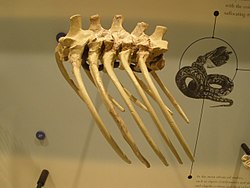
Picture of Madtsoiidae
- Source
- Wikipedia/Commons
- Credit
- Ghedoghedo
- Licence
- Public Domain
- Commercial use
- the licence allows it
CT scan
- Source
- MorphoSource
- Licence
- not stated by the source
- Commercial use
- cannot be read from the licence given — check the record
- Specimen
- Madtsoiidae indet. · sama:paleontology:30178A
Smithsonian Open Access was not reached for this taxon, so this list is what the others held rather than everything there is.
The description on this site
- Source
- Wikipedia, “Madtsoiidae”
- Licence
- CC BY-SA 4.0
This is what the site found, which is not the same as what exists.
Keep going
What may have been alongside itSerpentes through timeFormations of the Late CretaceousThe world it lived on
Occurrence data from the Paleobiology Database, CC BY 4.0. (Hoffstetter 1961)