Mammuthus
A mammoth is a member of the extinct elephantid genus Mammuthus. They lived from the late Miocene epoch into the Holocene until about 4,000 years ago, with mammoth species at various times inhabiting Africa, Asia, Europe and North America. Mammoths are distinguished from living elephants by their spirally twisted tusks and in some later species, the development of numerous adaptions to living in cold environments, including a thick layer of fur.

Jonathan Chen · CC BY-SA 4.0 · via Wikipedia/Commons. May be a photograph of a specimen, or an artist’s reconstruction — an interpretation of a skeleton, since colour and soft tissue are almost never preserved.
On record
Recorded, not inferred- Also called
- mammothPBDB
- Sits inside
- ElephantiniPBDB
- Diet
- grazerPBDB
- Life habit
- ground dwellingPBDB, for Elephantidae
- Motility
- actively mobilePBDB, for Osteichthyes
- Environment
- terrestrialPBDB, for Eutheria
- Mass
- 6 tonneWikidata
Time the record covers
At least 5 million years on record.
The record covers at least 5.09 Mya to 11.7 ka. No occurrence read is dated outside 23.04 Mya to 0 Mya.
693 occurrences of Mammuthus on record, most of them in the Pleistocene. Bar height is expected occurrences, not a count: each fossil is spread across the span it is dated to, so a tall narrow bar means tight dating and a low wide one means loose.
When
693 occurrences- Miocene1%
- Pliocene11%
- Pleistocene88%
- Holoceneunder 1%
These are dates about fossils, not the animal: the record can only begin after it arose and end before it died out, so either end may reach further. Shares are expected occurrences: a fossil dated to a span is counted partly in each period it straddles. More on what this infers.
Found in
74 formations
- Walanae Formation8
- "unnamed sandstone" Formation6
- Sagantole Formation · Awash Group6
- Varswater Formation6
- Cromer Forest Bed Formation5
- Ocotillo Formation4
Loading coastlines…
The named rock units Mammuthus has been recovered from, largest first. Drawn where the rock is now, not where it formed. 50 further formations hold fewer occurrences each and are not listed. 550 occurrences have no formation on record, which is common for older literature.
Mammuthus and its relatives
PleistoceneWhere Mammuthus and its relatives were recorded in the Pleistocene.
Found in the same rock
1,549 taxa- Equus104 sites
- Bison35 sites
- Camelops34 sites
- Stephanorhinus etruscus33 sites
- Lepus30 sites
- Cervus29 sites
- Paramylodon harlani28 sites
- Canis latrans24 sites
- Microtus24 sites
- Odocoileus virginianus24 sites
- Equus mexicanus22 sites
- Eucladoceros21 sites
- Allohippus stenonis20 sites
- Mimomys20 sites
- Camelops hesternus19 sites
- Cervidae17 sites
- Hemiauchenia17 sites
- Holmesina septentrionalis17 sites
- Odocoileus17 sites
- Aenocyon dirus16 sites
- Bison latifrons16 sites
- Hemiauchenia macrocephala16 sites
- Hipparion16 sites
- Mammut americanum16 sites
The Paleobiology Database records 671 sites for Mammuthus, and this reads 240 of them. The number is how many of those sites it was catalogued from too. The 24 sharing the most are listed.
This is not a list of everything alive at the time. It is only what has come out of the same ground as this animal and been written down.
Entered from
350 references- Pleistocene proboscidean sites in Michigan: New records and an update on published sites36
- McKenna and Bell, 199723
- Late Pleistocene Mammuthus and Cuvieronius (proboscidea) from Térapa, Sonora, Mexico21
- Mittelpleistozane Saugetierfaunen aus Mitteleuropa - der Versuch einer biostratigraphischen Zuordnung15
- I paleositi a vertebrati fossili della Provinia di Pisa12
- A catalogue of late Quaternary Vertebrates from California: Part Two, Mammals12
- Fossil and subfossil mammals from the Quaternary of British Columbia12
- The fossil elephants of Minnesota12
- Synonymies and reidentifications of North American fossil mammals11
- The Late Neogene elephantoid-bearing faunas of Indonesia and their palaeozoogeographic implications. A study of the terrestrial faunal succession of Sulawesi, Flores and Java, including evidence for early hominid dispersal east of Wallace's Line11
- Elephant Teeth from the Atlantic Continental Shelf10
- The Plio-Pleistocene mammalian succession of the Oltet Valley, Dacic Basin, Romania9
Each of the 693 occurrences read was entered from one of these publications, ordered by how many each accounts for. This is not a search for papers mentioning the name. 338 further references are not listed. Entries link to doi.org where the Paleobiology Database holds an identifier, and to its own record where it does not. Relayed as the Paleobiology Database holds them, not checked against what they resolve to.
Media and terms
Media content4

Picture of Mammuthus
- Source
- Wikipedia/Commons
- Credit
- Jonathan Chen
- Licence
- CC BY-SA 4.0
- Commercial use
- the licence allows it

3D scan
- Source
- Smithsonian
- Licence
- CC0 — this site’s default, not the record’s
- Commercial use
- the licence allows it
- Specimen
- Mammuthus primigenius (Blumbach)
Photogrammetry
- Source
- MorphoSource
- Licence
- In Copyright
- Commercial use
- cannot be read from the licence given — check the record
- Specimen
- Mammuthus meridionalis · msn_fir:mgp:Mammuthus meridionalis mandible
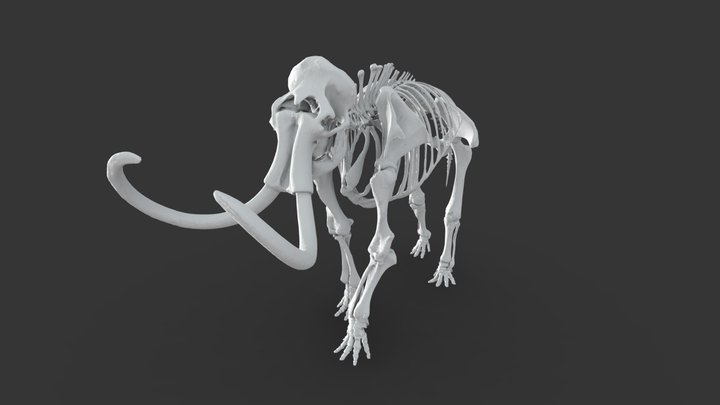
3D model
- Source
- Sketchfab
- Licence
- CC0 Public Domain
- Commercial use
- the licence allows it
The description on this site
- Source
- Wikipedia, “Mammoth”
- Licence
- CC BY-SA 4.0
This is what the site found, which is not the same as what exists.
Keep going
What may have been alongside itElephantini through timeFormations of the PleistoceneThe world it lived on
Occurrence data from the Paleobiology Database, CC BY 4.0. Brookes 1828