Cervidae
A deer or true deer is a hoofed ruminant ungulate of the family Cervidae. Cervidae is divided into subfamilies Cervinae and Capreolinae. Male deer of almost all species, as well as female reindeer, grow and shed new antlers each year. These antlers are bony extensions of the skull and are often used for combat between males.

This image is a derivative work of the following images: File:White-tailed deer.jpg (USDA photo by Scott Bauer) File:… · CC BY-SA 3.0 · via Wikipedia/Commons. May be a photograph of a specimen, or an artist’s reconstruction — an interpretation of a skeleton, since colour and soft tissue are almost never preserved.
On record
Recorded, not inferred- Also called
- deerPBDB
- Sits inside
- CervoideaPBDB
- Diet
- grazer, browserPBDB
- Life habit
- ground dwellingPBDB
- Motility
- actively mobilePBDB, for Osteichthyes
- Environment
- terrestrialPBDB, for Artiodactyla
Time the record covers
At least 33 million years on record.
The record covers at least 33.9 Mya to 11.7 ka. No occurrence read is dated outside 37.71 Mya to 0 Mya.
2,335 occurrences of Cervidae on record, most of them in the Pleistocene. The Paleobiology Database records this as a living group. Bar height is expected occurrences, not a count: each fossil is spread across the span it is dated to, so a tall narrow bar means tight dating and a low wide one means loose.
When
2,335 occurrencesThese are dates about fossils, not the animal: the record can only begin after it arose and end before it died out, so either end may reach further. Shares are expected occurrences: a fossil dated to a span is counted partly in each period it straddles. More on what this infers.
Found in
184 formations
- Cromer Forest Bed Formation26
- Palm Spring Formation15
- Hsanda Gol Formation14
- Yuanmou Formation13
- Unterer Travertin Formation12
- facies à Congeria Formation11
Loading coastlines…
The named rock units Cervidae has been recovered from, largest first. Drawn where the rock is now, not where it formed. 160 further formations hold fewer occurrences each and are not listed. 1,894 occurrences have no formation on record, which is common for older literature.
Cervidae and its relatives
PleistoceneWhere Cervidae and its relatives were recorded in the Pleistocene.
Found in the same rock
2,170 taxa- Equus117 sites
- Odocoileus66 sites
- Odocoileus virginianus57 sites
- Camelops45 sites
- Hemiauchenia macrocephala37 sites
- Hemiauchenia36 sites
- Dasypus bellus34 sites
- Sylvilagus34 sites
- Canis latrans32 sites
- Platygonus31 sites
- Mammuthus30 sites
- Lepus29 sites
- Paramylodon harlani28 sites
- Bison27 sites
- Neotoma26 sites
- Cervus25 sites
- Sylvilagus floridanus25 sites
- Lynx rufus24 sites
- Mammut americanum24 sites
- Holmesina septentrionalis23 sites
- Megalonyx23 sites
- Microtus22 sites
- Aenocyon dirus21 sites
- Thomomys21 sites
The Paleobiology Database records at least 1,242 sites for Cervidae, and this reads 240 of them. The number is how many of those sites it was catalogued from too. The 24 sharing the most are listed.
This is not a list of everything alive at the time. It is only what has come out of the same ground as this animal and been written down.
Entered from
804 references- I giacimenti Quaternari di vertebrati fossili nell'Italia Nord-Orientale64
- Mittelpleistozane Saugetierfaunen aus Mitteleuropa - der Versuch einer biostratigraphischen Zuordnung62
- Uniformity in variety: Antler morphology and evolution in a predator-free environment43
- From tortoises to elephants: the impact of elephants in the broad spectrum diet at Bolomor Cave (MIS 9–5 Spain)36
- Catalogue of Tertiary Fossil Sites of the Land Mammals in the U.S.S.R.36
- The Villafranchian mammalian faunas and biochronology of Greece32
- Pleistocene vertebrate faunas of Hungary30
- Principaux gisements villafranchiens de France: Listes fauniques et biostratigraphie28
- Large mammal fossil occurrences and associated archaeological evidence in Pleistocene contexts of peninsular India and Sri Lanka24
- Mammal fauna with Elephas (Palaeoloxodon) antiquus from the lower levels of Ambrona (Soria, Spain)22
- Polar bear fossil and archaeological records from the Pleistocene and Holocene in relation to sea ice extent and open water polynyas21
- Mitochondrial DNA phylogeography of red deer (Cervus elaphus)21
Each of the 2,335 occurrences read was entered from one of these publications, ordered by how many each accounts for. This is not a search for papers mentioning the name. 792 further references are not listed. Entries link to doi.org where the Paleobiology Database holds an identifier, and to its own record where it does not. Relayed as the Paleobiology Database holds them, not checked against what they resolve to.
Media and terms
Media content2

Picture of Cervidae
- Source
- Wikipedia/Commons
- Credit
- This image is a derivative work of the following images: File:White-tailed deer.jpg (USDA photo by Scott Bauer) File:…
- Licence
- CC BY-SA 3.0
- Commercial use
- the licence allows it
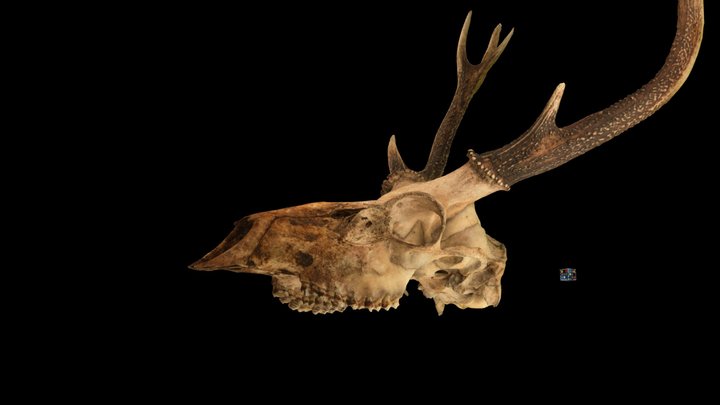
3D model
- Source
- Sketchfab
- Licence
- CC0 Public Domain
- Commercial use
- the licence allows it
Smithsonian Open Access and MorphoSource were not reached for this taxon, so this list is what the others held rather than everything there is.
The description on this site
- Source
- Wikipedia, “Deer”
- Licence
- CC BY-SA 4.0
This is what the site found, which is not the same as what exists.
Keep going
What may have been alongside itCervoidea through timeFormations of the PleistoceneThe world it lived on
Occurrence data from the Paleobiology Database, CC BY 4.0. Gray 1821