Marmota
Marmots are large ground squirrels in the genus Marmota, with 15 species living in Asia, Europe, and North America. These herbivores are active during the summer, when they can often be found in groups, but are not seen during the winter, when they hibernate underground. They are the heaviest and largest members of the squirrel family.

Photography captured by Giles Laurent · CC BY-SA 4.0 · via Wikipedia/Commons. May be a photograph of a specimen, or an artist’s reconstruction — an interpretation of a skeleton, since colour and soft tissue are almost never preserved.
On record
Recorded, not inferred- Also called
- marmotPBDB
- Sits inside
- MarmotiniPBDB
- Diet
- granivore, frugivorePBDB, for Sciuridae
- Life habit
- semifossorialPBDB
- Motility
- actively mobilePBDB, for Osteichthyes
- Environment
- terrestrialPBDB, for Eutheria
Time the record covers
At least 4.6 million years on record.
The record covers at least 4.7 Mya to 11.7 ka. No occurrence read is dated outside 9.4 Mya to 0 Mya.
118 occurrences of Marmota on record, most of them in the Pleistocene. The Paleobiology Database records this as a living group. Bar height is expected occurrences, not a count: each fossil is spread across the span it is dated to, so a tall narrow bar means tight dating and a low wide one means loose.
When
118 occurrences- Miocene4%
- Pliocene1%
- Pleistocene81%
- Holocene14%
These are dates about fossils, not the animal: the record can only begin after it arose and end before it died out, so either end may reach further. Shares are expected occurrences: a fossil dated to a span is counted partly in each period it straddles. More on what this infers.
Found in
5 formations
- Ogallala Formation1
- Thousand Creek Formation1
- Verde Formation1
- Cape Deceit Formation1
- Don Beds Formation1
Loading coastlines…
The named rock units Marmota has been recovered from, largest first. Drawn where the rock is now, not where it formed. 113 occurrences have no formation on record, which is common for older literature.
Marmota and its relatives
PleistoceneWhere Marmota and its relatives were recorded in the Pleistocene.
Found in the same rock
1,245 taxa- Microtus40 sites
- Peromyscus33 sites
- Microtus pennsylvanicus31 sites
- Odocoileus virginianus31 sites
- Neotoma floridana30 sites
- Synaptomys cooperi29 sites
- Castor canadensis28 sites
- Procyon lotor28 sites
- Ursus americanus28 sites
- Erethizon dorsatum27 sites
- Tamias striatus27 sites
- Equus26 sites
- Tamiasciurus hudsonicus26 sites
- Sorex25 sites
- Clethrionomys gapperi24 sites
- Myotis24 sites
- Eptesicus fuscus22 sites
- Sylvilagus22 sites
- Vulpes vulpes22 sites
- Neotoma21 sites
- Blarina brevicauda20 sites
- Mephitis mephitis20 sites
- Ondatra zibethicus20 sites
- Neogale frenata19 sites
The Paleobiology Database records 118 sites for Marmota, and this reads all of them. The number is how many of those sites it was catalogued from too. The 24 sharing the most are listed.
This is not a list of everything alive at the time. It is only what has come out of the same ground as this animal and been written down.
Entered from
72 references- Quaternary vertebrate localities of Virginia and their avian and mammalian fauna15
- A late Pleistocene and early Holocene mammalian fauna from Little Beaver Cave, Central Ozarks, Missouri.6
- I giacimenti Quaternari di vertebrati fossili nell'Italia Nord-Orientale5
- Paleontology and historic field trip of the John Guilday Cave Preserve (Trout Rock)4
- Sciurid rodents from Porcupine Cave, Park Co., Colorado: Irvingtonian diversity and faunal dynamics4
- Animal remains from Ohio rock shelters4
- Biochronological implications of the Arvicolidae (Rodentia, Mammalia) from the Lower Pleistocene hominid-bearing level of Trinchera Dolina 6 (TD6, Atapuerca, Spain)3
- Biochronology of the Pleistocene deposits at Betfia (Bihor, Romania)3
- Pleistocene Paleontological Sites in Appalachian Caves3
- Ecological Significance of Displaced Boreal Mammals in West Virginia Caves3
- The jaguar - Panthera onca gombaszoegensis (Kretzoi, 1938) (Carnivora: Felidae) in the late Lower Pleistocene Akhalkalaki (South Georgia: Transcaucasia) and its evolutionary and ecological significance.2
- Vertebrate biostratigraphy of the Ogallala Group in Nebraska2
Each of the 118 occurrences read was entered from one of these publications, ordered by how many each accounts for. This is not a search for papers mentioning the name. 60 further references are not listed. Entries link to doi.org where the Paleobiology Database holds an identifier, and to its own record where it does not. Relayed as the Paleobiology Database holds them, not checked against what they resolve to.
Media and terms
Media content2

Picture of Marmota
- Source
- Wikipedia/Commons
- Credit
- Photography captured by Giles Laurent
- Licence
- CC BY-SA 4.0
- Commercial use
- the licence allows it
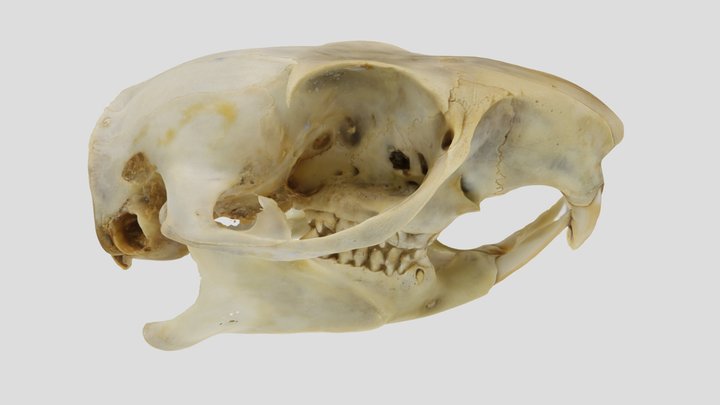
3D model
- Source
- Sketchfab
- Licence
- CC Attribution
- Commercial use
- cannot be read from the licence given — check the record
Smithsonian Open Access and MorphoSource were not reached for this taxon, so this list is what the others held rather than everything there is.
The description on this site
- Source
- Wikipedia, “Marmot”
- Licence
- CC BY-SA 4.0
This is what the site found, which is not the same as what exists.
Keep going
What may have been alongside itMarmotini through timeFormations of the PleistoceneThe world it lived on
Occurrence data from the Paleobiology Database, CC BY 4.0. Frisch 1775