Melanerpes carolinus
The red-bellied woodpecker is a medium-sized woodpecker of the family Picidae. It breeds mainly in the eastern United States, ranging as far south as Florida and as far north as Canada. Though it has a vivid orange-red crown and nape it is not to be confused with the red-headed woodpecker, a separate species of woodpecker in the same genus with an entirely red head and neck that sports a solid black back and white belly. The red-bellied earns its name from the pale reddish tint on its lower underside.

Ken Thomas · Public Domain · via Wikipedia/Commons. May be a photograph of a specimen, or an artist’s reconstruction — an interpretation of a skeleton, since colour and soft tissue are almost never preserved.
On record
Recorded, not inferred- Also called
- red-bellied woodpeckerPBDB
- Sits inside
- MelanerpesPBDB
- Diet
- insectivorePBDB, for Picidae
- Life habit
- volantPBDB, for Picidae
- Motility
- actively mobilePBDB, for Theropoda
- Environment
- terrestrialPBDB, for Picidae
- Mass
- 63.6 gWikidata
Time the record covers
At most 118 thousand years on record.
Every occurrence read is dated to somewhere between 129 ka and 11.7 ka, and nothing in the dating separates them, so that window is what the record shows rather than a span.
6 occurrences of Melanerpes carolinus on record, most of them in the Pleistocene. The Paleobiology Database records this as a living group. Bar height is expected occurrences, not a count: each fossil is spread across the span it is dated to, so a tall narrow bar means tight dating and a low wide one means loose.
When
6 occurrences- Pleistocene100%
These are dates about fossils, not the animal: the record can only begin after it arose and end before it died out, so either end may reach further. Shares are expected occurrences: a fossil dated to a span is counted partly in each period it straddles. More on what this infers.
Found in
1 formation
Loading coastlines…
The named rock units Melanerpes carolinus has been recovered from, largest first. Drawn where the rock is now, not where it formed. 5 occurrences have no formation on record, which is common for older literature.
Melanerpes carolinus and its relatives
PleistoceneWhere Melanerpes carolinus and its relatives were recorded in the Pleistocene.
Found in the same rock
380 taxa- Cyanocitta cristata5 sites
- Bonasa umbellus4 sites
- Colaptes auratus4 sites
- Ectopistes migratorius4 sites
- Falco sparverius4 sites
- Meleagris gallopavo4 sites
- Microtus pennsylvanicus4 sites
- Odocoileus virginianus4 sites
- Podilymbus podiceps4 sites
- Scolopax minor4 sites
- Turdus migratorius4 sites
- Accipiter striatus3 sites
- Aenocyon dirus3 sites
- Agelaius phoeniceus3 sites
- Amblystoma3 sites
- Bufo3 sites
- Clethrionomys gapperi3 sites
- Colinus virginianus3 sites
- Glaucomys sabrinus3 sites
- Glaucomys volans3 sites
- Megascops asio3 sites
- Microtus pinetorum3 sites
- Microtus xanthognathus3 sites
- Neogale frenata3 sites
The Paleobiology Database records 6 sites for Melanerpes carolinus, and this reads all of them. The number is how many of those sites it was catalogued from too. The 24 sharing the most are listed.
This is not a list of everything alive at the time. It is only what has come out of the same ground as this animal and been written down.
Entered from
6 references- A late Pleistocene avifauna from northwestern Alabama1
- Additions to the late Pleistocene avifauna of Bradenton, Manatee County, Florida1
- Evidence of a Boreal Avifauna in Middle Tennessee during the Late Pleistocene1
- The Clark's Cave bone deposit and the Late Pleistocene paleoecology of the central Appalachian Mountains of Virginia1
- Notes on fossil and subfossil birds1
- The Pleistocene avifauna of Arredondo, Florida1
Each of the 6 occurrences read was entered from one of these publications, ordered by how many each accounts for. This is not a search for papers mentioning the name. Entries link to doi.org where the Paleobiology Database holds an identifier, and to its own record where it does not. Relayed as the Paleobiology Database holds them, not checked against what they resolve to.
Media and terms
Media content2
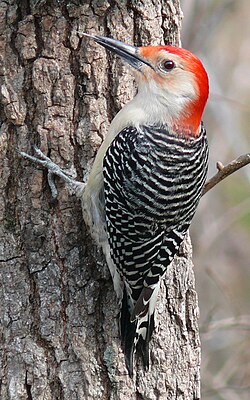
Picture of Melanerpes carolinus
- Source
- Wikipedia/Commons
- Credit
- Ken Thomas
- Licence
- Public Domain
- Commercial use
- the licence allows it
CT scan
- Source
- MorphoSource
- Licence
- In Copyright
- Commercial use
- cannot be read from the licence given — check the record
- Specimen
- Melanerpes carolinus · FMNH:Birds:477746
Smithsonian Open Access was not reached for this taxon, so this list is what the others held rather than everything there is.
The description on this site
- Licence
- CC BY-SA 4.0
This is what the site found, which is not the same as what exists.
Keep going
What may have been alongside itMelanerpes through timeFormations of the PleistoceneThe world it lived on
Occurrence data from the Paleobiology Database, CC BY 4.0. (Linnaeus 1758)