Meleagris
Turkeys are large, heavyset galliforms in the genus Meleagris, indigenous to the Americas. They are among the largest birds in their native ranges, as well as being one of the heaviest birds in the order Galliformes. There are two extant turkey species: the wild turkey of Southern, Central and Eastern North America, and the ocellated turkey of the Yucatán Peninsula in Mexico. Males of both species have a distinctive singular fleshy wattle, called a snood, that hangs from the base of the culmen. Like with other phasianines, the male is bigger and sports fancier plumage than the female.

Frank Schulenburg · CC BY-SA 4.0 · via Wikipedia/Commons. May be a photograph of a specimen, or an artist’s reconstruction — an interpretation of a skeleton, since colour and soft tissue are almost never preserved.
On record
Recorded, not inferred- Also called
- turkeyPBDB
- Sits inside
- PhasianidaePBDB
- Diet
- granivorePBDB, for Phasianidae
- Life habit
- volantPBDB, for Phasianidae
- Motility
- actively mobilePBDB, for Theropoda
- Environment
- terrestrialPBDB, for Phasianidae
Time the record covers
At least 5.3 million years on record.
The record covers at least 5.333 Mya to 11.7 ka. No occurrence read is dated outside 7.246 Mya to 0 Mya.
71 occurrences of Meleagris on record, most of them in the Pleistocene. The Paleobiology Database records this as a living group. Bar height is expected occurrences, not a count: each fossil is spread across the span it is dated to, so a tall narrow bar means tight dating and a low wide one means loose.
When
71 occurrences- Miocene1%
- Pliocene4%
- Pleistocene79%
- Holocene16%
These are dates about fossils, not the animal: the record can only begin after it arose and end before it died out, so either end may reach further. Shares are expected occurrences: a fossil dated to a span is counted partly in each period it straddles. More on what this infers.
Found in
8 formations
- Okeechobee Formation2
- Verde Formation1
- Yorktown Formation · Chesapeake Group1
- American Falls Lake Bed E Formation1
- Tamiami Formation1
- Wicomico Formation1
Loading coastlines…
The named rock units Meleagris has been recovered from, largest first. Drawn where the rock is now, not where it formed. 62 occurrences have no formation on record, which is common for older literature.
Meleagris and its relatives
PleistoceneWhere Meleagris and its relatives were recorded in the Pleistocene.
Found in the same rock
1,745 taxa- Odocoileus virginianus36 sites
- Equus25 sites
- Ursus americanus22 sites
- Podilymbus podiceps20 sites
- Procyon lotor20 sites
- Colinus virginianus19 sites
- Aenocyon dirus18 sites
- Ectopistes migratorius18 sites
- Lynx rufus18 sites
- Buteo jamaicensis17 sites
- Dasypus bellus17 sites
- Falco sparverius17 sites
- Mammut americanum17 sites
- Corvus brachyrhynchos16 sites
- Megascops asio16 sites
- Tapirus (Helicotapirus) veroensis16 sites
- Urocyon cinereoargenteus16 sites
- Castor canadensis15 sites
- Hemiauchenia macrocephala15 sites
- Holmesina septentrionalis15 sites
- Zenaida macroura15 sites
- Accipiter cooperii14 sites
- Bubo virginianus14 sites
- Cathartes aura14 sites
The Paleobiology Database records 69 sites for Meleagris, and this reads all of them. The number is how many of those sites it was catalogued from too. The 24 sharing the most are listed.
This is not a list of everything alive at the time. It is only what has come out of the same ground as this animal and been written down.
Entered from
49 references- Avian community, climate, and sea-level changes in the Plio-Pleistocene of the Florida Peninsula6
- The avifauna of the Pleistocene in Florida6
- Quaternary vertebrate localities of Virginia and their avian and mammalian fauna4
- Animal remains from Ohio rock shelters4
- Geology and biostratigraphy of the Potomac River Cliffs at Stratford Hall, Westmoreland County, Virginia2
- A middle Pleistocene bird community from Saint Lucie County, Florida2
- A comparison of avian assemblages from individual pits at Rancho La Brea, California2
- The Pleistocene avifauna of Arredondo, Florida2
- Pavo californicus, a fossil peacock from the Quaternary asphalt beds of Rancho la Brea2
- An Account of Some Kjoekkenmoeddings, or Shell-Heaps, in Maine and Massachusetts2
- Miocene and Pliocene birds from the Lee Creek Mine, North Carolina1
- Papago Springs Cave revisited, part II: vertebrate paleofauna1
Each of the 71 occurrences read was entered from one of these publications, ordered by how many each accounts for. This is not a search for papers mentioning the name. 37 further references are not listed. Entries link to doi.org where the Paleobiology Database holds an identifier, and to its own record where it does not. Relayed as the Paleobiology Database holds them, not checked against what they resolve to.
Media and terms
Media content2

Picture of Meleagris
- Source
- Wikipedia/Commons
- Credit
- Frank Schulenburg
- Licence
- CC BY-SA 4.0
- Commercial use
- the licence allows it
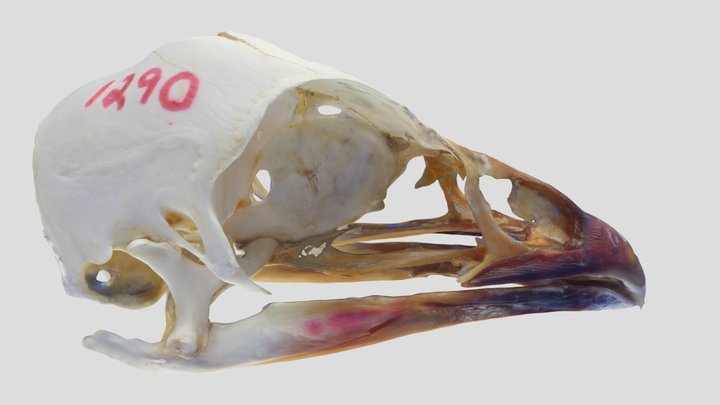
3D model
- Source
- Sketchfab
- Licence
- CC Attribution
- Commercial use
- cannot be read from the licence given — check the record
Smithsonian Open Access and MorphoSource were not reached for this taxon, so this list is what the others held rather than everything there is.
The description on this site
- Licence
- CC BY-SA 4.0
This is what the site found, which is not the same as what exists.
Keep going
What may have been alongside itPhasianidae through timeFormations of the PleistoceneThe world it lived on
Occurrence data from the Paleobiology Database, CC BY 4.0. Linnaeus 1758