Monticulipora
Monticulipora is an extinct genus of Ordovician bryozoans belonging to the family Monticuliporidae. It was first named in 1849, and its description was published the following year by French paleontologist Alcide M. d'Orbigny, making it one of the earliest bryozoans to be recognized in science. It is still one of the most widespread fossil bryozoan genera. Though colonies that grow in masses made of multiple layers are characteristic of the genus, its colonies have varying shapes, able to be encrusting, branching, massive, or frond-like, and are covered in monticules (bumps). Most Monticulipora species have distinctively granular walls, and Monticulipora and can be distinguished from Homotrypa by the presence of axial diaphragms.

via iDigBio · CC0 · via iDigBio. May be a photograph of a specimen, or an artist’s reconstruction — an interpretation of a skeleton, since colour and soft tissue are almost never preserved.
On record
Recorded, not inferred- Sits inside
- MonticuliporidaePBDB
- Diet
- suspension feederPBDB
- Life habit
- intermediate-level epifaunalPBDB
- Motility
- stationary, attachedPBDB
- Vision
- blindPBDB, for Stenolaemata
- Environment
- marinePBDB, for Lophophorata
Time the record covers
At least 68 million years on record.
The record covers at least 468 Mya to 399.5 Mya. No occurrence read is dated outside 477.1 Mya to 393.47 Mya.
63 occurrences of Monticulipora on record, most of them in the Ordovician. Bar height is expected occurrences, not a count: each fossil is spread across the span it is dated to, so a tall narrow bar means tight dating and a low wide one means loose.
When
63 occurrences- Ordovician97%
- Silurian2%
- Devonian2%
These are dates about fossils, not the animal: the record can only begin after it arose and end before it died out, so either end may reach further. Shares are expected occurrences: a fossil dated to a span is counted partly in each period it straddles. More on what this infers.
Found in
33 formations
- Khabt-el-Hajar Formation6
- Leipers Formation5
- Bromide Formation4
- Pierce Limestone Formation3
- San Juan Formation3
- Stonington Formation3
Loading coastlines…
The named rock units Monticulipora has been recovered from, largest first. Drawn where the rock is now, not where it formed. 9 further formations hold fewer occurrences each and are not listed. 6 occurrences have no formation on record, which is common for older literature.
Monticulipora and its relatives
OrdovicianWhere Monticulipora and its relatives were recorded in the Ordovician.
Found in the same rock
746 taxa- Hallopora16 sites
- Homotrypa15 sites
- Heterotrypa14 sites
- Amplexopora11 sites
- Batostoma11 sites
- Peronopora11 sites
- Ceramoporella9 sites
- Conularia9 sites
- Lophospira9 sites
- Nicholsonella9 sites
- Platystrophia9 sites
- Rafinesquina9 sites
- Zygospira9 sites
- Sinuites8 sites
- Ambonychia7 sites
- Bellerophontoidea7 sites
- Bythopora7 sites
- Corynotrypa7 sites
- Dekayia7 sites
- Dermatostroma7 sites
- Escharopora7 sites
- Isotelus7 sites
- Modiolopsis7 sites
- Orthoceras7 sites
The Paleobiology Database records 51 sites for Monticulipora, and this reads all of them. The number is how many of those sites it was catalogued from too. The 24 sharing the most are listed.
This is not a list of everything alive at the time. It is only what has come out of the same ground as this animal and been written down.
Entered from
26 references- Pre-Chattanooga stratigraphy in Central Tennessee11
- Trepostomate bryozoans from the upper Katian (Upper Ordovician) of Morocco: gigantism in high latitude Gondwana platforms6
- Biostratigraphic and paleontological studies4
- Zonation of the Middle and Upper Ordovician strata in northwestern Georgia4
- The fossil fauna of the Ordovician in the Cincinnati Region4
- Upper Ordovician Ecology of the Central Appalachians3
- The Richmond Formation of Michigan3
- The early Paleozoic Bryozoa of the Baltic Provinces3
- Systematic paleontology, biostratigraphy, and paleoecology of Middle Ordovician Bryozoa (Trepostomata) from the Hermitage Formation of east-central Tennessee2
- Bryozoa from Rocklandian (Middle Ordovician) rocks of the Upper Mississippi Valley region2
- Hirnantian (Upper Ordovician) Bryozoa from Baltoscandia2
- Late Ordovician bryozoa from Ringerike, Norway2
Each of the 63 occurrences read was entered from one of these publications, ordered by how many each accounts for. This is not a search for papers mentioning the name. 14 further references are not listed. Entries link to doi.org where the Paleobiology Database holds an identifier, and to its own record where it does not. Relayed as the Paleobiology Database holds them, not checked against what they resolve to.
Media and terms
Media content2
Picture of Monticulipora
- Source
- iDigBio
- Credit
- via iDigBio
- Licence
- CC0
- Commercial use
- the licence allows it
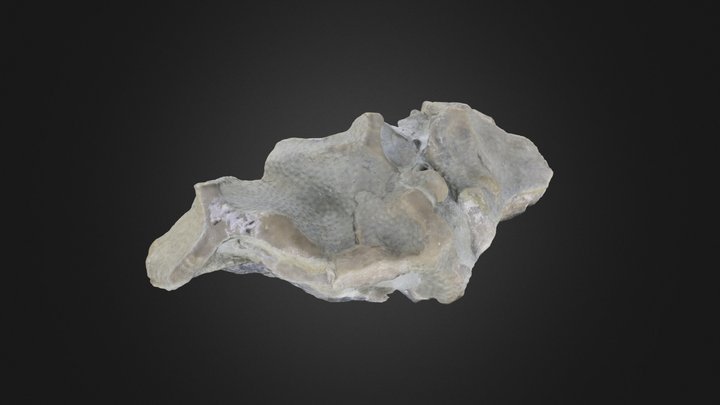
3D model
- Source
- Sketchfab
- Licence
- CC0 Public Domain
- Commercial use
- the licence allows it
Smithsonian Open Access and MorphoSource were not reached for this taxon, so this list is what the others held rather than everything there is.
The description on this site
- Licence
- CC BY-SA 4.0
This is what the site found, which is not the same as what exists.
Keep going
What may have been alongside itMonticuliporidae through timeFormations of the OrdovicianThe world it lived on
Occurrence data from the Paleobiology Database, CC BY 4.0. d'Orbigny 1850