Morus bassanus
The northern gannet is a seabird, the largest species of the gannet family, Sulidae. It is native to the coasts of the North Atlantic Ocean, breeding in Western Europe and Northeastern North America. It is the largest seabird in the northern Atlantic. The sexes are similar in appearance. The adult northern gannet has a mainly white streamlined body with a long neck, and long and slender wings. It is 87–100 cm long with a 170–180 cm (67–71 in) wingspan. The head and nape have a buff tinge that is more prominent in breeding season, and the wings are edged with dark brown-black feathers. The long, pointed bill is blue-grey, contrasting with black, bare skin around the mouth and eyes. Juveniles are mostly grey-brown, becoming increasingly white in the five years it takes them to reach maturity.

Andreas Trepte · CC BY-SA 2.5 · via Wikipedia/Commons. May be a photograph of a specimen, or an artist’s reconstruction — an interpretation of a skeleton, since colour and soft tissue are almost never preserved.
On record
Recorded, not inferred- Also called
- northern gannettPBDB
- Sits inside
- MorusPBDB
- Diet
- carnivorePBDB, for Coelurosauria
- Life habit
- ground dwelling, solitaryPBDB, for Theropoda
- Motility
- actively mobilePBDB, for Theropoda
- Environment
- terrestrialPBDB, for Theropoda
- Mass
- 3 kgWikidata
Time the record covers
At least 117 thousand years on record.
The record covers at least 129 ka to 11.7 ka. No occurrence read is dated outside 2.58 Mya to 0 Mya.
22 occurrences of Morus bassanus on record. The Paleobiology Database records this as a living group. Bar height is expected occurrences, not a count: each fossil is spread across the span it is dated to, so a tall narrow bar means tight dating and a low wide one means loose.
When
22 occurrences- Pleistocene45%
- Holocene55%
These are dates about fossils, not the animal: the record can only begin after it arose and end before it died out, so either end may reach further. Shares are expected occurrences: a fossil dated to a span is counted partly in each period it straddles. More on what this infers.
Found in
3 formations
Loading coastlines…
The named rock units Morus bassanus has been recovered from, largest first. Drawn where the rock is now, not where it formed. 19 occurrences have no formation on record, which is common for older literature.
Found in the same rock
227 taxa- Pinguinus impennis12 sites
- Uria aalge6 sites
- Phalacrocorax auritus4 sites
- Alca torda3 sites
- Branta bernicla3 sites
- Phalacrocorax aristotelis3 sites
- Carcharias2 sites
- Cetacea2 sites
- Gadus2 sites
- Gavia immer2 sites
- Halichoerus grypus2 sites
- Larus hyperboreus2 sites
- Lophius2 sites
- Meleagris gallopavo2 sites
- Myliobatis2 sites
- Odobenus rosmarus2 sites
- Opsanus2 sites
- Phalacrocorax carbo2 sites
- Podiceps auritus2 sites
- Prionotus2 sites
- Puffinus puffinus2 sites
- Sphyraena2 sites
- Acantocardia sp.1 site
- Acteocina canaliculata1 site
The Paleobiology Database records 22 sites for Morus bassanus, and this reads all of them. The number is how many of those sites it was catalogued from too. The 24 sharing the most are listed.
This is not a list of everything alive at the time. It is only what has come out of the same ground as this animal and been written down.
Entered from
13 references- The Great Auk and the Gannet: a Prehistoric Perspective on the Extinction of the Great Auk8
- Seabirds and Late Pleistocene marine environments in the Northeast Atlantic and the Mediterranean3
- A middle Pleistocene bird community from Saint Lucie County, Florida1
- The Northern Gannet (Morus bassanus, Pelecaniformes, Sulidae) in the Black Sea in the Late Holocene1
- A fauna da Idade do Ferro e da Época Romana de Monte Molião (Lagos, Algarve): continuidades e rupturas na dieta alimentar1
- Humans and marine resource interaction reappraised: Archaeofauna remains during the late Pleistocene and Holocene in Cantabrian Spain1
- A catalogue of British Pleistocene birds identified by Colin JO Harrison and stored in the Natural History Museum, London, (Department of Palaeontology)1
- The fauna and paleoecology of the Late Pleistocene marine sediments of southeastern Virginia1
- Quaternary vertebrate localities of Virginia and their avian and mammalian fauna1
- Dwarf deer and other Late Pleistocene fauna of the Simonelli Cave in Crete1
- Fossil vertebrates from the marine Pleistocene of southeastern Virginia1
- Great Auk and Common Murre from a Florida Midden1
Each of the 22 occurrences read was entered from one of these publications, ordered by how many each accounts for. This is not a search for papers mentioning the name. 1 further reference is not listed. Entries link to doi.org where the Paleobiology Database holds an identifier, and to its own record where it does not. Relayed as the Paleobiology Database holds them, not checked against what they resolve to.
Media and terms
Media content3
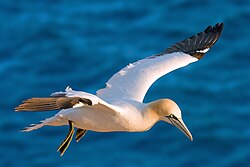
Picture of Morus bassanus
- Source
- Wikipedia/Commons
- Credit
- Andreas Trepte
- Licence
- CC BY-SA 2.5
- Commercial use
- the licence allows it
CT scan
- Source
- MorphoSource
- Licence
- not stated by the source
- Commercial use
- cannot be read from the licence given — check the record
- Specimen
- Morus bassanus · ouvc:10995
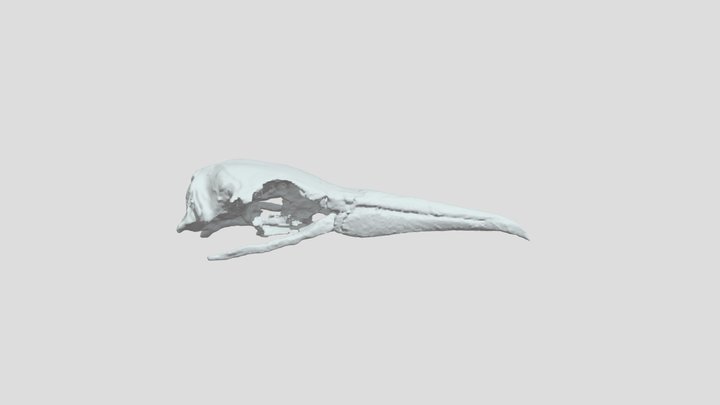
3D model
- Source
- Sketchfab
- Credit
- Chapel_Prints_CO
- Licence
- CC Attribution
- Commercial use
- cannot be read from the licence given — check the record
Smithsonian Open Access was not reached for this taxon, so this list is what the others held rather than everything there is.
The description on this site
- Licence
- CC BY-SA 4.0
This is what the site found, which is not the same as what exists.
Keep going
What may have been alongside itMorus through timeThe world it lived on
Occurrence data from the Paleobiology Database, CC BY 4.0. (Linnaeus 1758)