Mosasaurini
Mosasaurini is an extinct tribe of mosasaurine mosasaurs who lived during the Late Cretaceous and whose fossils have been found in North America, South America, Europe, Africa and Oceania, with questionable occurrences in Asia. They are highly derived mosasaurs, containing genera like Plotosaurus, having unique adaptations to fast swimming speeds, or Mosasaurus, which is among the largest known marine reptiles.

Wilson44691 · Public Domain · via Wikipedia/Commons. May be a photograph of a specimen, or an artist’s reconstruction — an interpretation of a skeleton, since colour and soft tissue are almost never preserved.
On record
Recorded, not inferred- Sits inside
- MosasaurinaePBDB
- Diet
- carnivorePBDB, for Mosasauridae
- Life habit
- aquaticPBDB, for Mosasauridae
- Motility
- actively mobilePBDB, for Osteichthyes
- Vision
- well-developedPBDB, for Mosasauridae
- Environment
- terrestrialPBDB, for Amniota
Time the record covers
At most 18 million years on record.
Every occurrence read is dated to somewhere between 83.6 Mya and 66 Mya, and nothing in the dating separates them, so that window is what the record shows rather than a span.
20 occurrences of Mosasaurini on record, most of them in the Late Cretaceous. Bar height is expected occurrences, not a count: each fossil is spread across the span it is dated to, so a tall narrow bar means tight dating and a low wide one means loose.
When
20 occurrences- Late Cretaceous100%
These are dates about fossils, not the animal: the record can only begin after it arose and end before it died out, so either end may reach further. Shares are expected occurrences: a fossil dated to a span is counted partly in each period it straddles. More on what this infers.
Found in
8 formations
- Moreno Formation · Great Valley Group6
- Phosphates Formation1
- Mishash Formation1
- Isoai Formation · Nakaminato Group1
- Hiraiso Formation · Nakaminato Group1
- Quiriquina Formation1
Loading coastlines…
The named rock units Mosasaurini has been recovered from, largest first. Drawn where the rock is now, not where it formed. 7 occurrences have no formation on record, which is common for older literature.
Mosasaurini and its relatives
Late CretaceousWhere Mosasaurini and its relatives were recorded in the Late Cretaceous.
Found in the same rock
126 taxa- Eremiasaurus heterodontus7 sites
- Cretalamna maroccana6 sites
- Halisaurus arambourgi6 sites
- Plioplatecarpinae6 sites
- Bothremydidae5 sites
- Chelonioidea5 sites
- Ctenopristis nougareti5 sites
- Ganopristis leptodon5 sites
- Globidens phosphaticus5 sites
- Prognathodon currii5 sites
- Squalicorax pristodontus5 sites
- Stratodus apicalis5 sites
- Cretomanta4 sites
- Dalpiazia stromeri4 sites
- Elasmosauridae4 sites
- Mosasaurus beaugei4 sites
- Pachyvaranus crassispondylus4 sites
- Plicatoscyllium gharbii4 sites
- Plotosaurus4 sites
- Rhinobatos4 sites
- Rhombodus meridionalis4 sites
- Serratolamna khderii4 sites
- Squalicorax bassanii4 sites
- Squalicorax microserratus4 sites
The Paleobiology Database records 20 sites for Mosasaurini, and this reads all of them. The number is how many of those sites it was catalogued from too. The 24 sharing the most are listed.
This is not a list of everything alive at the time. It is only what has come out of the same ground as this animal and been written down.
Entered from
9 references- Marine vertebrate faunas from the Maastrichtian phosphates of Benguérir (Ganntour Basin, Morocco): Biostratigraphy, palaeobiogeography and palaeoecology5
- Stratigraphic positions of marine reptile and dinosaur specimens in the Moreno Formation, in the Tumey Hills and Panoche Hills, Fresno County, California3
- A ocorrência de lagartos marinhos (Mosasauridae - Lepidosauria) e sua associação faunística no cretáceo da Bacia Pernambuco Paraíba, nordeste do Brasil3
- Advanced mosasaurs from the Upper Cretaceous Nakaminato Group in Japan2
- A new mosasaurine from the Maastrichtian (Upper Cretaceous) phosphates of Morocco and its implications for mosasaurine systematics2
- California mosasaurs2
- Rediscovery of “Liodon” asiaticum Répelin, 1915, a Mosasaurini (Squamata, Mosasauridae, Mosasaurinae) from the Upper Cretaceous of the vicinity of Jerusalem – Biostratigraphical insights from microfossils1
- A mosasaur, cf. Plotosaurus, from the upper Maastrichtian Quiriquina Formation in Central Chile1
- New data on the postcranial anatomy of the California mosasaur Plotosaurus bennisoni (Camp, 1942) (Upper Cretaceous: Maastrichtian), and the taxonomic status of P. tuckeri (Camp, 1942)1
Each of the 20 occurrences read was entered from one of these publications, ordered by how many each accounts for. This is not a search for papers mentioning the name. Entries link to doi.org where the Paleobiology Database holds an identifier, and to its own record where it does not. Relayed as the Paleobiology Database holds them, not checked against what they resolve to.
Media and terms
Media content1
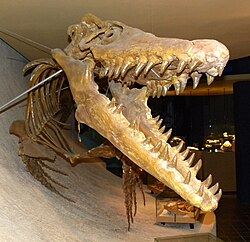
Picture of Mosasaurini
- Source
- Wikipedia/Commons
- Credit
- Wilson44691
- Licence
- Public Domain
- Commercial use
- the licence allows it
No 3D scan was found. Smithsonian Open Access, MorphoSource and Sketchfab were all searched.
The description on this site
- Source
- Wikipedia, “Mosasaurini”
- Licence
- CC BY-SA 4.0
This is what the site found, which is not the same as what exists.
Keep going
What may have been alongside itMosasaurinae through timeFormations of the Late CretaceousThe world it lived on
Occurrence data from the Paleobiology Database, CC BY 4.0. Russell 1967