Squalicorax pristodontus
No picture of Squalicorax pristodontus was found. Wikidata and iDigBio were searched and had none. Wikipedia has a picture filed under this name, but nothing tied it to Squalicorax pristodontus itself, so it was not used. Smithsonian Open Access did not answer, so this is what the others held rather than everything there is. GBIF was asked, and what came back is not recorded: nothing, or a picture this site could not tie to Squalicorax pristodontus, or no answer at all. This entry cannot say which.
On record
Recorded, not inferred- Also called
- crow sharkPBDB
- Sits inside
- SqualicoraxPBDB
- Diet
- carnivorePBDB, for Lamniformes
- Life habit
- nektonicPBDB, for Lamniformes
- Motility
- actively mobilePBDB, for Lamniformes
Time the record covers
At least 89 million years on record.
The record covers at least 161.5 Mya to 72.2 Mya. No occurrence read is dated outside 165.3 Mya to 61.66 Mya.
141 occurrences of Squalicorax pristodontus on record, most of them in the Late Cretaceous. Bar height is expected occurrences, not a count: each fossil is spread across the span it is dated to, so a tall narrow bar means tight dating and a low wide one means loose.
When
141 occurrences- Middle Jurassicunder 1%
- Early Cretaceousunder 1%
- Late Cretaceous98%
- Paleoceneunder 1%
These are dates about fossils, not the animal: the record can only begin after it arose and end before it died out, so either end may reach further. Shares are expected occurrences: a fossil dated to a span is counted partly in each period it straddles. More on what this infers.
Found in
47 formations
- Navesink Formation · Monmouth Group10
- Mount Laurel Formation · Monmouth Group5
- Marshalltown Formation · Matawan Group4
- Mishash Formation4
- Duwi Formation3
- Peedee Formation3
Loading coastlines…
The named rock units Squalicorax pristodontus has been recovered from, largest first. Drawn where the rock is now, not where it formed. 23 further formations hold fewer occurrences each and are not listed. 54 occurrences have no formation on record, which is common for older literature.
Squalicorax pristodontus and its relatives
Late CretaceousWhere Squalicorax pristodontus and its relatives were recorded in the Late Cretaceous.
Found in the same rock
907 taxa- Squalicorax kaupi45 sites
- Cretalamna appendiculata30 sites
- Ischyrhiza mira30 sites
- Carcharias samhammeri25 sites
- Scapanorhynchus texanus23 sites
- Squatina (Cretascyllium) hassei22 sites
- Rhombodus binkhorsti21 sites
- Serratolamna serrata21 sites
- Archaeolamna kopingensis20 sites
- Cretalamna maroccana18 sites
- Brachyrhizodus wichitaensis17 sites
- Enchodus16 sites
- Mosasauridae16 sites
- Odontaspis aculeatus16 sites
- Teleostei15 sites
- Cretolamna lata14 sites
- Elasmosauridae14 sites
- Ganopristis leptodon14 sites
- Rhinobatos14 sites
- Rhombodus levis14 sites
- Squalicorax bassanii14 sites
- Stephanodus14 sites
- Chelonioidea13 sites
- Cretalamna biauriculata13 sites
The Paleobiology Database records 141 sites for Squalicorax pristodontus, and this reads all of them. The number is how many of those sites it was catalogued from too. The 24 sharing the most are listed.
This is not a list of everything alive at the time. It is only what has come out of the same ground as this animal and been written down.
Entered from
73 references- Contribution a l'étude des sélaciens du Groupe Monmouth (Campanien-Maestrichtian) du New Jersey11
- Les sélaciens des terrains néocrétacés and paléocènes de Belgique and des contrées limitrophes. Eléments d'une biostratigraphie intercontinentale10
- The marine vertebrate faunas from the Late Cretaceous phosphates of Syria8
- Les poissons fossiles du Bas-Congo et des régions voisines8
- Sélaciens du Crétacé (Albien-Maastrichtien) d'Angola6
- Senonian elasmobranch teeth from Israel. Biostratigraphic and paleoenvironmental implications6
- The fossil shark genus Squalicorax in north-central Texas6
- Marine vertebrate faunas from the Maastrichtian phosphates of Benguérir (Ganntour Basin, Morocco): Biostratigraphy, palaeobiogeography and palaeoecology5
- A guide to fossil sharks, skates, and rays from the Chesapeake and Delaware Canal area, Delaware4
- The oldest record of the Late Cretaceous anacoracid shark Squalicorax pristodontus (Agassiz), from the Western Interior, with comments on Squalicorax phylogeny3
- Paleoecology of the Delaware Valley region. Part II: Cretaceous to Quartenary3
- Asmodochelys parhami, a new fossil marine turtle from the Campanian Demopolis Chalk and the stratigraphic congruence of competing marine turtle phylogenies2
Each of the 141 occurrences read was entered from one of these publications, ordered by how many each accounts for. This is not a search for papers mentioning the name. 61 further references are not listed. Entries link to doi.org where the Paleobiology Database holds an identifier, and to its own record where it does not. Relayed as the Paleobiology Database holds them, not checked against what they resolve to.
Media and terms
Media content1
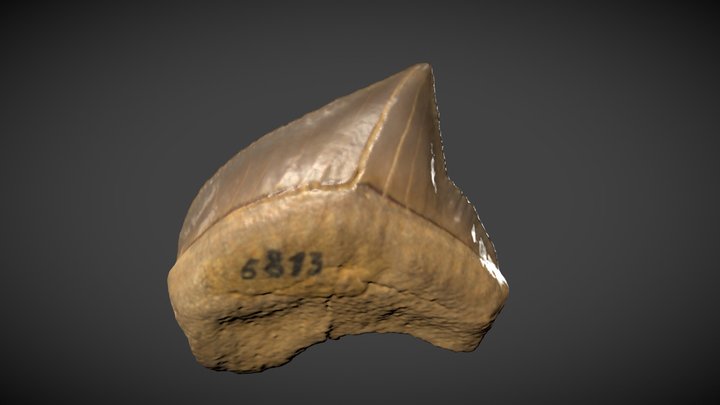
3D model
- Source
- Sketchfab
- Credit
- EDDyLab @ULiege
- Licence
- CC Attribution-NonCommercial
- Commercial use
- the licence does not allow it
No picture of Squalicorax pristodontus was found. Wikidata and iDigBio were searched and had none.
Wikipedia has a picture filed under this name, but nothing tied it to Squalicorax pristodontus itself, so it was not used.
Smithsonian Open Access did not answer, so this is what the others held rather than everything there is.
GBIF was asked, and what came back is not recorded: nothing, or a picture this site could not tie to Squalicorax pristodontus, or no answer at all. This entry cannot say which.
Smithsonian Open Access and MorphoSource were not reached for this taxon, so this list is what the others held rather than everything there is.
This is what the site found, which is not the same as what exists.
Keep going
What may have been alongside itSqualicorax through timeFormations of the Late CretaceousThe world it lived on
Occurrence data from the Paleobiology Database, CC BY 4.0. (Agassiz 1835)