Myophoria
Searched as Myophoria laevigata ovalis. The Paleobiology Database treats Myophoria as the accepted name.
Myophoria is an extinct genus of bivalve mollusk from Europe belonging to the family Myophoriidae. Fossils are mainly found in Triassic rocks.
No picture of Myophoria was found. Wikipedia, Wikidata, iDigBio and Smithsonian Open Access were searched and had none. GBIF was asked, and what came back is not recorded: nothing, or a picture this site could not tie to Myophoria, or no answer at all. This entry cannot say which.
On record
Recorded, not inferred- Sits inside
- MyophoriidaePBDB
- Diet
- suspension feederPBDB, for Trigoniida
- Life habit
- infaunalPBDB, for Trigoniida
- Motility
- facultatively mobilePBDB, for Trigoniida
- Vision
- blindPBDB, for Bivalvia
Time the record covers
At most 5.6 million years on record.
The one occurrence read is dated to somewhere between 247 Mya and 241.464 Mya, which is a dating window rather than a span.
1 occurrence of Myophoria on record, most of them in the Middle Triassic. Bar height is expected occurrences, not a count: each fossil is spread across the span it is dated to, so a tall narrow bar means tight dating and a low wide one means loose.
When
1 occurrences- Middle Triassic100%
These are dates about fossils, not the animal: the record can only begin after it arose and end before it died out, so either end may reach further. Shares are expected occurrences: a fossil dated to a span is counted partly in each period it straddles. More on what this infers.
Myophoria and its relatives
Middle TriassicWhere Myophoria and its relatives were recorded in the Middle Triassic.
Found in the same rock
2,307 taxa- Gastropoda32 sites
- Schafhaeutlia31 sites
- Modiolus24 sites
- Cassianella21 sites
- Gervillia21 sites
- Nuculana21 sites
- Bivalvia18 sites
- Unionites18 sites
- Pecten17 sites
- Septocardia17 sites
- Mysidioptera16 sites
- Neoschizodus laevigatus16 sites
- Pinna16 sites
- Pleuromya16 sites
- Ammonoidea15 sites
- Umbrostrea montiscaprilis15 sites
- Chlamys14 sites
- Echinoidea14 sites
- Entolium14 sites
- Entolium discites14 sites
- Loxonema14 sites
- Parallelodon14 sites
- Bakevellia costata13 sites
- Palaeonucula13 sites
The Paleobiology Database records 205 sites for Myophoria, and this reads all of them. The number is how many of those sites it was catalogued from too. The 24 sharing the most are listed.
This is not a list of everything alive at the time. It is only what has come out of the same ground as this animal and been written down.
Entered from
1 referenceEach of the 1 occurrence read was entered from one of these publications, ordered by how many each accounts for. This is not a search for papers mentioning the name. Each entry links to the Paleobiology Database's own record for the work.
Media and terms
Media content1
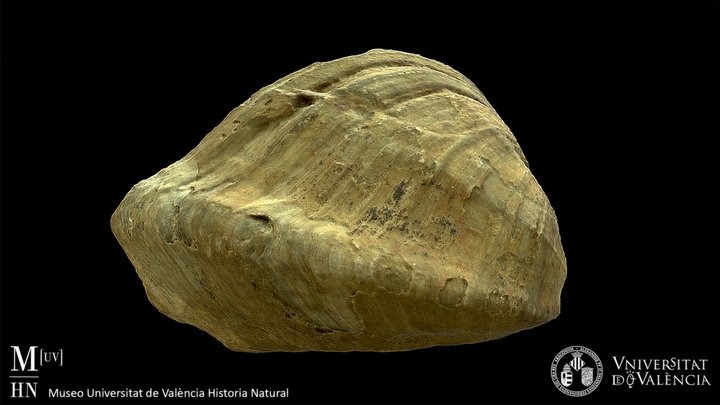
3D model
- Source
- Sketchfab
- Licence
- CC Attribution
- Commercial use
- cannot be read from the licence given — check the record
No picture of Myophoria was found. Wikipedia, Wikidata, iDigBio and Smithsonian Open Access were searched and had none.
GBIF was asked, and what came back is not recorded: nothing, or a picture this site could not tie to Myophoria, or no answer at all. This entry cannot say which.
The description on this site
- Source
- Wikipedia, “Myophoria”
- Licence
- CC BY-SA 4.0
This is what the site found, which is not the same as what exists.
Keep going
What may have been alongside itMyophoriidae through timeFormations of the Middle TriassicThe world it lived on
Occurrence data from the Paleobiology Database, CC BY 4.0. Bronn 1834