Oedipodinae
Bandwings, or band-winged grasshoppers, are the subfamily Oedipodinae of grasshoppers classified under the family Acrididae. They have a worldwide distribution and were originally elevated to full family status as the Oedipodidae. Many species primarily inhabit xeric weedy fields, and some are considered to be important locusts:Locusta migratoria: the migratory locust Chortoicetes terminifera: the Australian plague locust Locustana pardalina the brown locust

JJ Harrison ( https://www.jjharrison.com.au/ ) · CC BY-SA 3.0 · via Wikipedia/Commons. May be a photograph of a specimen, or an artist’s reconstruction — an interpretation of a skeleton, since colour and soft tissue are almost never preserved.
On record
Recorded, not inferred- Also called
- band-winged grasshopperPBDB
- Sits inside
- AcrididaePBDB
- Diet
- grazer, herbivorePBDB, for Caelifera
- Life habit
- ground dwelling, gregariousPBDB, for Caelifera
- Motility
- fast-movingPBDB, for Caelifera
- Vision
- well-developedPBDB, for Caelifera
- Environment
- terrestrialPBDB, for Caelifera
Time the record covers
At least 59 million years on record.
The record covers at least 59.24 Mya to 11.7 ka. No occurrence read is dated outside 61.66 Mya to 0 Mya.
21 occurrences of Oedipodinae on record, most of them in the Miocene. The Paleobiology Database records this as a living group. Bar height is expected occurrences, not a count: each fossil is spread across the span it is dated to, so a tall narrow bar means tight dating and a low wide one means loose.
When
21 occurrencesThese are dates about fossils, not the animal: the record can only begin after it arose and end before it died out, so either end may reach further. Shares are expected occurrences: a fossil dated to a span is counted partly in each period it straddles. More on what this infers.
Found in
4 formations
Loading coastlines…
The named rock units Oedipodinae has been recovered from, largest first. Drawn where the rock is now, not where it formed. 14 occurrences have no formation on record, which is common for older literature.
Oedipodinae and its relatives
MioceneWhere Oedipodinae and its relatives were recorded in the Miocene.
Found in the same rock
656 taxa- Formicidae8 sites
- Acrididae4 sites
- Anisoptera4 sites
- Bibio4 sites
- Zygoptera4 sites
- Aphididae3 sites
- Aphrophora3 sites
- Curculionidae3 sites
- Formicinae3 sites
- Lasius ophthalmicus3 sites
- Braconidae2 sites
- Buprestidae2 sites
- Calosoma maderae2 sites
- Camponotites induratus2 sites
- Camponotus2 sites
- Cerambycidae2 sites
- Coccinellidae2 sites
- Coleoptera2 sites
- Cydnopsis haidingeri2 sites
- Cydnus brevicollis2 sites
- Formica ungeri2 sites
- Ichneumonidae2 sites
- Lasius anthracinus2 sites
- Lasius globularis2 sites
The Paleobiology Database records 16 sites for Oedipodinae, and this reads all of them. The number is how many of those sites it was catalogued from too. The 24 sharing the most are listed.
This is not a list of everything alive at the time. It is only what has come out of the same ground as this animal and been written down.
Entered from
11 references- Insectos del Mioceno inferior de Ribesalbes (Castellón, España). Paleoptera y Neoptera poli- y paraneoptera5
- Zhang et al., 19943
- Zur Heuschrecken-Fauna des Pliozäns von Willershausen3
- The fossil Acrididae (Orth. Salt. ) Part II Oedipodinae2
- Die fossilen Insekten von Ungarn, mit besonderer Berücksichtigung der Entwicklung der europäischen Insekten-fauna2
- A new Miocene band-winged grasshopper (Orthoptera: Acrididae) from Nevada1
- Preserved grasshopper fauna of Knife Point Glacier, Fremont County, Wyoming, USA1
- Zhang, 19891
- Piton, 19401
- Les insectes fossiles des terrains oligocènes de France1
- Die Fossilen Insekten und die Phylogenie der Rezenten Formen, parts V-VII1
Each of the 21 occurrences read was entered from one of these publications, ordered by how many each accounts for. This is not a search for papers mentioning the name. Entries link to doi.org where the Paleobiology Database holds an identifier, and to its own record where it does not. Relayed as the Paleobiology Database holds them, not checked against what they resolve to.
Media and terms
Media content1
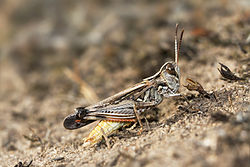
Picture of Oedipodinae
- Source
- Wikipedia/Commons
- Credit
- JJ Harrison ( https://www.jjharrison.com.au/ )
- Licence
- CC BY-SA 3.0
- Commercial use
- the licence allows it
No 3D scan of Oedipodinae was found in MorphoSource and Sketchfab.
Smithsonian Open Access was not reached for this taxon, so this list is what the others held rather than everything there is.
The description on this site
- Source
- Wikipedia, “Bandwing”
- Licence
- CC BY-SA 4.0
This is what the site found, which is not the same as what exists.
Keep going
What may have been alongside itAcrididae through timeFormations of the MioceneThe world it lived on
Occurrence data from the Paleobiology Database, CC BY 4.0. (Walker 1871)