Coccinellidae
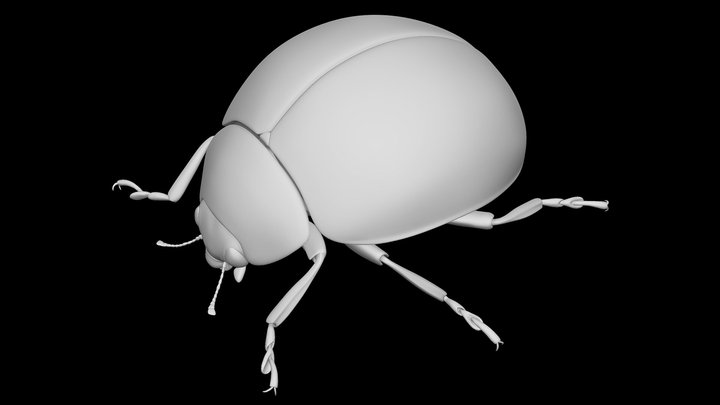
Coccinellidae is a widespread family of small beetles. They are commonly known as ladybugs in North America and ladybirds in the United Kingdom, Australia, New Zealand, Ireland, and other English speaking territories; "lady" refers to Mary, the mother of Jesus. Entomologists use the names ladybird beetles or lady beetles to avoid confusion with true bugs. The more than 6,000 described species have a global distribution and are found in a variety of habitats. They are oval beetles with a domed back and flat underside. Many of the species have conspicuous aposematic (warning) colours and patterns, such as red with black spots, that warn potential predators that they taste bad.

Francisco Welter-Schultes · CC0 · via Wikipedia/Commons. May be a photograph of a specimen, or an artist’s reconstruction — an interpretation of a skeleton, since colour and soft tissue are almost never preserved.
On record
Recorded, not inferred- Also called
- ladybird beetlePBDB
- Sits inside
- CoccinelloideaPBDB
- Motility
- actively mobilePBDB, for Arthropoda
- Environment
- terrestrialPBDB, for Insecta
Time the record covers
At least 165 million years on record.
The record covers at least 165.3 Mya to 129 ka. No occurrence read is dated outside 168.2 Mya to 11.7 ka.
76 occurrences of Coccinellidae on record, most of them in the Eocene. The Paleobiology Database records this as a living group. Bar height is expected occurrences, not a count: each fossil is spread across the span it is dated to, so a tall narrow bar means tight dating and a low wide one means loose.
When
76 occurrences- Middle Jurassic1%
- Eocene36%
- Oligocene18%
- Miocene20%
- Pliocene9%
- Pleistocene16%
These are dates about fossils, not the animal: the record can only begin after it arose and end before it died out, so either end may reach further. Shares are expected occurrences: a fossil dated to a span is counted partly in each period it straddles. More on what this infers.
Found in
13 formations
- Upper Freshwater-Molasse Formation8
- Rott Formation7
- Florissant Formation6
- Kap København Formation4
- Shanwang Formation3
- Argiles d'lignite du Soissonnais Formation3
Loading coastlines…
The named rock units Coccinellidae has been recovered from, largest first. Drawn where the rock is now, not where it formed. 38 occurrences have no formation on record, which is common for older literature.
Coccinellidae and its relatives
EoceneWhere Coccinellidae and its relatives were recorded in the Eocene.
Found in the same rock
3,193 taxa- Curculionidae13 sites
- Chrysomelidae9 sites
- Carabidae8 sites
- Formicidae8 sites
- Bembidion7 sites
- Coleoptera7 sites
- Staphylinidae7 sites
- Agabus6 sites
- Aphodius6 sites
- Polyphaga6 sites
- Apioninae5 sites
- Chironomus5 sites
- Eysarcoris5 sites
- Hydrophilidae5 sites
- Ichneumonidae5 sites
- Lygaeidae5 sites
- Stenus5 sites
- Tipula5 sites
- Aeshnidae4 sites
- Aleocharinae4 sites
- Amara4 sites
- Anisoptera4 sites
- Apidae4 sites
- Bibionidae4 sites
The Paleobiology Database records 41 sites for Coccinellidae, and this reads all of them. The number is how many of those sites it was catalogued from too. The 24 sharing the most are listed.
This is not a list of everything alive at the time. It is only what has come out of the same ground as this animal and been written down.
Entered from
37 references- The first fossil Microweiseini (Coleoptera: Coccinellidae) from the Eocene of Europe and its significance for the reconstruction of the evolution of ladybird beetles7
- Käfer (Coleoptera) aus dem Jungtertiär Norddeutschlands6
- Käfer und Polypen aus der Braunkohle des Siebengebirges5
- The first fossil Sticholotidini ladybird beetle (Coleoptera, Coccinellidae) reveals a transition zone through northern Europe during the Eocene4
- Palaeoentomology of the Kap København Formation, a Plio-Pleistocene sequence in Peary Land, North Greenland4
- Die Insekten der "Plattigen Steinmergels" von Brunstatt4
- Heer, 18474
- New and known extinct species of Rhyzobius Stephens, 1829 shed light on the phylogeny and biogeography of the genus and the tribe Coccidulini (Coleoptera: Coccinellidae)3
- The oldest representatives of the family Coccinellidae (Coleoptera: Polyphaga) from the lowermost Eocene Oise amber (France)3
- A Late Pleistocene fauna and flora from Upton Warren, Worcestershire3
- Heer, 18643
- Have ladybird beetles and whitefies co-existed for at least 40 Mya?2
Each of the 76 occurrences read was entered from one of these publications, ordered by how many each accounts for. This is not a search for papers mentioning the name. 25 further references are not listed. Entries link to doi.org where the Paleobiology Database holds an identifier, and to its own record where it does not. Relayed as the Paleobiology Database holds them, not checked against what they resolve to.
Media and terms
Media content2

Picture of Coccinellidae
- Source
- Wikipedia/Commons
- Credit
- Francisco Welter-Schultes
- Licence
- CC0
- Commercial use
- the licence allows it
The description on this site
- Licence
- CC BY-SA 4.0
This is what the site found, which is not the same as what exists.
Keep going
What may have been alongside itCoccinelloidea through timeFormations of the EoceneThe world it lived on
Occurrence data from the Paleobiology Database, CC BY 4.0. Latreille 1807