Orectolobus
Orectolobus is a genus of carpet sharks in the family Orectolobidae. They are commonly known as wobbegongs, although this name also applies to the other members of the family. They are found in shallow temperate and tropical waters of the western Pacific Ocean and eastern Indian Ocean, chiefly around Australia and Indonesia, although one species occurs as far north as Japan.

Uncredited · CC BY-SA 3.0 · via Wikipedia/Commons. May be a photograph of a specimen, or an artist’s reconstruction — an interpretation of a skeleton, since colour and soft tissue are almost never preserved.
On record
Recorded, not inferred- Sits inside
- OrectolobidaePBDB
- Diet
- carnivorePBDB, for Orectolobiformes
- Life habit
- nektobenthicPBDB, for Orectolobiformes
- Motility
- actively mobilePBDB, for Orectolobiformes
Time the record covers
At least 137 million years on record.
The record covers at least 145.06 Mya to 7.246 Mya. No occurrence read is dated outside 149.2 Mya to 2.58 Mya.
9 occurrences of Orectolobus on record, most of them in the Eocene. The Paleobiology Database records this as a living group, and the chart stops with its fossils rather than at the present. Bar height is expected occurrences, not a count: each fossil is spread across the span it is dated to, so a tall narrow bar means tight dating and a low wide one means loose.
When
9 occurrences- Late Jurassic11%
- Paleocene3%
- Eocene63%
- Miocene16%
- Pliocene7%
These are dates about fossils, not the animal: the record can only begin after it arose and end before it died out, so either end may reach further. Shares are expected occurrences: a fossil dated to a span is counted partly in each period it straddles. More on what this infers.
Found in
6 formations
- Lisbon Formation · Claiborne Group3
- Tallahatta Formation · Claiborne Group2
- Aruma Formation1
- Loxton Formation1
- Batesford Limestone Formation1
- Solnhofen Formation1
Loading coastlines…
The named rock units Orectolobus has been recovered from, largest first. Drawn where the rock is now, not where it formed.
Orectolobus and its relatives
EoceneWhere Orectolobus and its relatives were recorded in the Eocene.
Found in the same rock
198 taxa- Hypotodus verticalis4 sites
- Physogaleus secundus4 sites
- Rhinoptera4 sites
- Scoliodon conecuhensis4 sites
- Sphyraena4 sites
- Sphyrna4 sites
- Striatolamia macrota4 sites
- Abdounia3 sites
- Aetomylaeus3 sites
- Brachycarcharias lerichei3 sites
- Coupatezia3 sites
- Dasyatis charlisae3 sites
- Dasyatis jaekeli3 sites
- Egertonia isodonta3 sites
- Galeorhinus duchaussoisi3 sites
- Jacquhermania duponti3 sites
- Jaekelotodus robustus3 sites
- Leidybatis jugosus3 sites
- Macrorhizodus praecursor3 sites
- Myliobatis3 sites
- Ostraciidae3 sites
- Physogaleus3 sites
- Pristidae3 sites
- Pristis3 sites
The Paleobiology Database records 8 sites for Orectolobus, and this reads all of them. The number is how many of those sites it was catalogued from too. The 24 sharing the most are listed.
This is not a list of everything alive at the time. It is only what has come out of the same ground as this animal and been written down.
Entered from
6 references- A selachian fauna from the middle Eocene (Lutetian, Lisbon Formation) of Andalusia, Covington County, Alabama, USA3
- Taxonomy and biostratigraphy of the elasmobranchs and bony fishes (Chondrichthyes and Osteichthyes) of the lower-to-middle Eocene (Ypresian to Bartonian) Claiborne Group in Alabama, USA, including an analysis of otoliths2
- A review of the Tertiary fossil Cetacea (Mammalia) localities in Australia1
- Late Paleocene to Early Eocene marine vertebrates from the Uppermost Aruma Formation (northern Saudi Arabia): implications for the K-T transition1
- An early Pliocene shark tooth assemblage in South Australia1
- On two new elasmobranch fishes (Crossorhinus jurassicus, sp. nov. and Protospinax annectans, gen. et sp. nov.) from the Upper Jurassic lithographic stone of Bavaria1
Each of the 9 occurrences read was entered from one of these publications, ordered by how many each accounts for. This is not a search for papers mentioning the name. Entries link to doi.org where the Paleobiology Database holds an identifier, and to its own record where it does not. Relayed as the Paleobiology Database holds them, not checked against what they resolve to.
Media and terms
Media content1
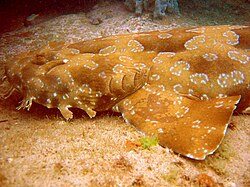
Picture of Orectolobus
- Source
- Wikipedia/Commons
- Credit
- nobody named on the record
- Licence
- CC BY-SA 3.0
- Commercial use
- the licence allows it
No 3D scan of Orectolobus was found in MorphoSource and Sketchfab.
Smithsonian Open Access was not reached for this taxon, so this list is what the others held rather than everything there is.
The description on this site
- Source
- Wikipedia, “Orectolobus”
- Licence
- CC BY-SA 4.0
This is what the site found, which is not the same as what exists.
Keep going
What may have been alongside itOrectolobidae through timeFormations of the EoceneThe world it lived on
Occurrence data from the Paleobiology Database, CC BY 4.0. Bonaparte 1834