Coupatezia
Coupatezia is a prehistoric genus of ray in the family Dasyatidae whose fossils are found in strata dating from the Maastrichtian stage until the last species' extinction during the Middle Eocene. These rays were found shallow seas in Europe, Africa and the eastern United States.
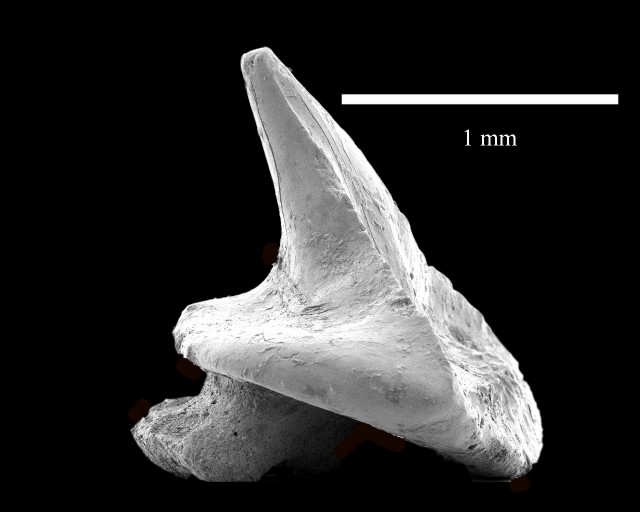
Madsen, Mogens · CC BY 4.0 · via GBIF. May be a photograph of a specimen, or an artist’s reconstruction — an interpretation of a skeleton, since colour and soft tissue are almost never preserved.
On record
Recorded, not inferred- Sits inside
- DasyatoideaPBDB
- Diet
- carnivorePBDB, for Myliobatiformes
- Life habit
- nektobenthicPBDB, for Myliobatiformes
- Motility
- actively mobilePBDB, for Myliobatiformes
Time the record covers
At least 28 million years on record.
The record covers at least 66 Mya to 37.71 Mya. No occurrence read is dated outside 83.6 Mya to 33.9 Mya.
141 occurrences of Coupatezia on record, most of them in the Eocene. Bar height is expected occurrences, not a count: each fossil is spread across the span it is dated to, so a tall narrow bar means tight dating and a low wide one means loose.
When
141 occurrences- Late Cretaceous27%
- Paleocene15%
- Eocene57%
These are dates about fossils, not the animal: the record can only begin after it arose and end before it died out, so either end may reach further. Shares are expected occurrences: a fossil dated to a span is counted partly in each period it straddles. More on what this infers.
Found in
43 formations
- Marnes de Miretrain Formation10
- Matam Formation9
- Marnes de Donzacq Formation7
- Couche III Formation6
- Birket Qarun Formation5
- Qasr el-Sagha Formation5
Loading coastlines…
The named rock units Coupatezia has been recovered from, largest first. Drawn where the rock is now, not where it formed. 19 further formations hold fewer occurrences each and are not listed. 51 occurrences have no formation on record, which is common for older literature.
Coupatezia and its relatives
EoceneWhere Coupatezia and its relatives were recorded in the Eocene.
Found in the same rock
1,068 taxa- Dasyatis37 sites
- Rhinobatos30 sites
- Physogaleus secundus26 sites
- Striatolamia macrota21 sites
- Isurolamna inflata20 sites
- Myliobatis19 sites
- Odontaspis winkleri19 sites
- Scyliorhinus19 sites
- Brachycarcharias lerichei18 sites
- Burnhamia daviesi18 sites
- Heterodontus vincenti17 sites
- Premontreia (Oxyscyllium) gilberti17 sites
- Squatina prima17 sites
- Abdounia beaugei16 sites
- Archaeomanta melenhorsti15 sites
- Burnhamia15 sites
- Abdounia14 sites
- Anoxypristis14 sites
- Dasyatis jaekeli14 sites
- Galeocerdo latidens14 sites
- Gymnura14 sites
- Hypotodus verticalis14 sites
- Abdounia recticona13 sites
- Aetomylaeus dixoni13 sites
The Paleobiology Database records 103 sites for Coupatezia, and this reads all of them. The number is how many of those sites it was catalogued from too. The 24 sharing the most are listed.
This is not a list of everything alive at the time. It is only what has come out of the same ground as this animal and been written down.
Entered from
42 references- Les Orectolobiformes, Carcharhiniformes et Myliobatiformes (Elasmobranchii, Neoselachii) des bassins à phosphate du Maroc (Maastrichtien-Lutétien basal). Systématique, biostratigraphie, évolution et dynamique des faunes44
- Nouvelle faunes de sélaciens (Elasmobranchii, Neoselachii) de l'Eocène moyen des Landes (Sud-Ouest, France). Implication dans la connaissance des communautés de sélaciens d'eau profondes17
- Shark and ray faunas in the Middle and Late Eocene of the Fayum Area, Egypt12
- The selachian fauna (sharks and rays) of the phosphate series of Ndendouri-Ouali Diala (Matam, Western Senegal): Dating and paleoenvironmental interests9
- Marine vertebrate faunas from the Maastrichtian phosphates of Benguérir (Ganntour Basin, Morocco): Biostratigraphy, palaeobiogeography and palaeoecology5
- The Selsey Division (Bracklesham Group) at Lee-on-the-Solent, Gosport, (Hants)5
- A selachian fauna from the middle Eocene (Lutetian, Lisbon Formation) of Andalusia, Covington County, Alabama, USA4
- Neoselachians from the upper Campanian and lower Maatrichtian (Upper Cretaceous) of the southern Pyrenees, northern Spain3
- The marine vertebrate faunas from the Late Cretaceous phosphates of Syria3
- Découverte de nouvelles faunes de sélaciens (Neoselachii) dans les phosphates maastrichtiens de la Mer Rouge, Egypte3
- Taxonomy and biostratigraphy of the elasmobranchs and bony fishes (Chondrichthyes and Osteichthyes) of the lower-to-middle Eocene (Ypresian to Bartonian) Claiborne Group in Alabama, USA, including an analysis of otoliths2
- Elasmobranchs from the Lower Tertiary of the western Tarim Basin, China, and their biostratigraphic significance2
Each of the 141 occurrences read was entered from one of these publications, ordered by how many each accounts for. This is not a search for papers mentioning the name. 30 further references are not listed. Entries link to doi.org where the Paleobiology Database holds an identifier, and to its own record where it does not. Relayed as the Paleobiology Database holds them, not checked against what they resolve to.
Media and terms
Media content1
Picture of Coupatezia
- Source
- GBIF
- Credit
- Madsen, Mogens
- Licence
- CC BY 4.0
- Commercial use
- the licence allows it
No 3D scan of Coupatezia was found in MorphoSource and Sketchfab.
Smithsonian Open Access was not reached for this taxon, so this list is what the others held rather than everything there is.
The description on this site
- Source
- Wikipedia, “Coupatezia”
- Licence
- CC BY-SA 4.0
This is what the site found, which is not the same as what exists.
Keep going
What may have been alongside itDasyatoidea through timeFormations of the EoceneThe world it lived on
Occurrence data from the Paleobiology Database, CC BY 4.0. Cappetta 1982