Ornithomimosauria
Ornithomimosauria are theropod dinosaurs which bore a superficial resemblance to the modern-day ostrich. They were fast, omnivorous or herbivorous dinosaurs from the Cretaceous Period of Laurasia, as well as possibly Africa. The group first appeared in the Early Cretaceous and persisted until the Late Cretaceous. Primitive members of the group include Nqwebasaurus, Pelecanimimus, Shenzhousaurus, Hexing and Deinocheirus, the arms of which reached 2.4 m (8 feet) in length. More advanced species, members of the family Ornithomimidae, include Gallimimus, Struthiomimus, and Ornithomimus. Some paleontologists, like Paul Sereno, consider the enigmatic alvarezsaurids to be close relatives of the ornithomimosaurs and place them together in the superfamily Ornithomimoidea.

Ballista User:Esv Sebastian Bergmann ケラトプスユウタ DEINO ★Kumiko★ Mike Beauregard Sergio Conti · CC BY 2.0 · via Wikipedia/Commons. May be a photograph of a specimen, or an artist’s reconstruction — an interpretation of a skeleton, since colour and soft tissue are almost never preserved.
On record
Recorded, not inferred- Also called
- ornithomimosaurPBDB
- Sits inside
- TheropodaPBDB
- Diet
- herbivore, omnivorePBDB
- Life habit
- ground dwelling, gregariousPBDB
- Motility
- actively mobilePBDB
- Environment
- terrestrialPBDB
Time the record covers
At least 93 million years on record.
The record covers at least 165.3 Mya to 72.2 Mya. No occurrence read is dated outside 168.2 Mya to 66 Mya.
320 occurrences of Ornithomimosauria on record, most of them in the Late Cretaceous. Bar height is expected occurrences, not a count: each fossil is spread across the span it is dated to, so a tall narrow bar means tight dating and a low wide one means loose.
When
320 occurrences- Middle Jurassicunder 1%
- Late Jurassicunder 1%
- Early Cretaceous11%
- Late Cretaceous88%
These are dates about fossils, not the animal: the record can only begin after it arose and end before it died out, so either end may reach further. Shares are expected occurrences: a fossil dated to a span is counted partly in each period it straddles. More on what this infers.
Found in
82 formations
- Nemegt Formation39
- Dinosaur Park Formation · Belly River Group19
- Bissekty Formation18
- Horseshoe Canyon Formation · Edmonton Group17
- Hell Creek Formation · Montana Group13
- Baynshire Formation12
Loading coastlines…
The named rock units Ornithomimosauria has been recovered from, largest first. Drawn where the rock is now, not where it formed. 58 further formations hold fewer occurrences each and are not listed. 14 occurrences have no formation on record, which is common for older literature.
Ornithomimosauria and its relatives
Late CretaceousWhere Ornithomimosauria and its relatives were recorded in the Late Cretaceous.
Found in the same rock
1,260 taxa- Ornithomimidae118 sites
- Hadrosauridae57 sites
- Trionychidae47 sites
- Theropoda46 sites
- Crocodylia36 sites
- Tyrannosauridae35 sites
- Champsosaurus24 sites
- Sauropoda23 sites
- Ceratopsidae21 sites
- Dinosauria21 sites
- Baenidae20 sites
- Dromaeosauridae20 sites
- Ankylosauria18 sites
- Ankylosauridae18 sites
- Testudinata18 sites
- Basilemys16 sites
- Ornithomimus16 sites
- Testudines16 sites
- Adocus14 sites
- Cyclurus fragosus14 sites
- Gallimimus bullatus14 sites
- Osteichthyes14 sites
- Hadrosaurinae12 sites
- Myledaphus bipartitus12 sites
The Paleobiology Database records 306 sites for Ornithomimosauria, and this reads 240 of them. The number is how many of those sites it was catalogued from too. The 24 sharing the most are listed.
This is not a list of everything alive at the time. It is only what has come out of the same ground as this animal and been written down.
Entered from
176 references- Ostrich dinosaurs from the late Cretaceous of western Canada20
- Ornithomimidae (Dinosauria: Theropoda) from the Bissekty Formation (Upper Cretaceous: Turonian) of Uzbekistan15
- Dinosaurs, the age of the Fruitland and Kirtland Formations, and the Cretaceous-Tertiary boundary in the San Juan Basin, New Mexico12
- A new dinosaur, Gallimimus bullatus n. gen., n. sp. (Ornithomimidae) from the Upper Cretaceous of Mongolia12
- Diversity of Late Cretaceous dinosaurs from Mexico7
- Vertebrate biostratigraphy of the Hell Creek Formation in southwestern North Dakota and northwestern South Dakota7
- Vertebrate faunal changes through Lancian and Puercan time in southern Wyoming6
- Dinozavri severnoi Yevrazii: Novye dannye o sostave kompleksov, ekologii i paleobiogeografii [Dinosaurs of northern Eurasia: new data about assemblages, ecology, and paleobiogeography]6
- Narrative of the Korea-Mongolian International Dinosaur expeditions (KID) 2006–2010 with scientific results5
- Theropod dinosaurs from Late Cretaceous deposits in the northeastern Aral Sea region, Kazakhstan5
- Report on the Japan–Mongolia Joint Paleontological Expedition to the Gobi desert, 19935
- Report on the Japan–Mongolia Joint Paleontological Expedition to the Gobi desert, 19945
Each of the 320 occurrences read was entered from one of these publications, ordered by how many each accounts for. This is not a search for papers mentioning the name. 164 further references are not listed. Entries link to doi.org where the Paleobiology Database holds an identifier, and to its own record where it does not. Relayed as the Paleobiology Database holds them, not checked against what they resolve to.
Media and terms
Media content1
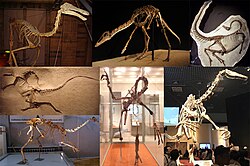
Picture of Ornithomimosauria
- Source
- Wikipedia/Commons
- Credit
- Ballista User:Esv Sebastian Bergmann ケラトプスユウタ DEINO ★Kumiko★ Mike Beauregard Sergio Conti
- Licence
- CC BY 2.0
- Commercial use
- the licence allows it
No 3D scan of Ornithomimosauria was found in MorphoSource and Sketchfab.
Smithsonian Open Access was not reached for this taxon, so this list is what the others held rather than everything there is.
The description on this site
- Licence
- CC BY-SA 4.0
This is what the site found, which is not the same as what exists.
Keep going
What may have been alongside itTheropoda through timeFormations of the Late CretaceousThe world it lived on
Occurrence data from the Paleobiology Database, CC BY 4.0. (Barsbold 1976)