Oulophyllia crispa
Oulophyllia crispa, sometimes called the intermediate valley coral, is a species of stony coral in the family Merulinidae. It is native to the tropical western and central Indo-Pacific region. Although this coral has a wide range, it is generally uncommon and seems to be decreasing in abundance, and the International Union for Conservation of Nature has rated its conservation status as being "near threatened".

Júlio Reis · CC BY-SA 3.0 · via Wikipedia/Commons. May be a photograph of a specimen, or an artist’s reconstruction — an interpretation of a skeleton, since colour and soft tissue are almost never preserved.
On record
Recorded, not inferred- Sits inside
- OulophylliaPBDB
- Diet
- microcarnivore, photosymbioticPBDB, for Scleractinia
- Life habit
- intermediate-level epifaunal, colonial, clonalPBDB, for Scleractinia
- Motility
- stationary, attachedPBDB, for Scleractinia
- Vision
- blindPBDB, for Anthozoa
- Environment
- marinePBDB, for Scleractinia
Time the record covers
At least 15 million years on record.
The record covers at least 15.98 Mya to 129 ka. No occurrence read is dated outside 23.04 Mya to 0 Mya.
11 occurrences of Oulophyllia crispa on record, most of them in the Pleistocene. The Paleobiology Database records this as a living group. Bar height is expected occurrences, not a count: each fossil is spread across the span it is dated to, so a tall narrow bar means tight dating and a low wide one means loose.
When
11 occurrences- Miocene18%
- Pliocene18%
- Pleistocene64%
These are dates about fossils, not the animal: the record can only begin after it arose and end before it died out, so either end may reach further. Shares are expected occurrences: a fossil dated to a span is counted partly in each period it straddles. More on what this infers.
Found in
3 formations
- Riukiu Limestone Formation1
- Miyako-jima Formation · Ryukyu Group1
- Mikindani Formation1
Loading coastlines…
The named rock units Oulophyllia crispa has been recovered from, largest first. Drawn where the rock is now, not where it formed. 8 occurrences have no formation on record, which is common for older literature.
Oulophyllia crispa and its relatives
PleistoceneWhere Oulophyllia crispa and its relatives were recorded in the Pleistocene.
Found in the same rock
84 taxa- Acropora4 sites
- Galaxea fascicularis4 sites
- Cyphastrea chalcidicum3 sites
- Cyphastrea microphthalma3 sites
- Dipsastraea speciosa3 sites
- Goniopora3 sites
- Porites3 sites
- Symphyllia recta3 sites
- Acanthastrea echinata2 sites
- Acanthastrea hemprichii2 sites
- Acropora robusta2 sites
- Alveopora verrilliana2 sites
- Astrea curta2 sites
- Astreopora gracilis2 sites
- Cycloseris cyclolites2 sites
- Dipsastraea pallida2 sites
- Favia2 sites
- Favites valenciennesii2 sites
- Goniastrea pectinata2 sites
- Hydnophora exesa2 sites
- Leptoria phrygia2 sites
- Montipora2 sites
- Pavona varians2 sites
- Platygyra2 sites
The Paleobiology Database records 5 sites for Oulophyllia crispa, and this reads all of them. The number is how many of those sites it was catalogued from too. The 24 sharing the most are listed.
This is not a list of everything alive at the time. It is only what has come out of the same ground as this animal and been written down.
Entered from
9 references- Les Madreporaires fossiles de Mare [The fossil corals from Mare]2
- Geological and geographical distribution of reef-corals in Japan2
- High coral reef connectivity across the Indian Ocean is revealed 6–7 Ma ago by a turbid-water scleractinian assemblage from Tanzania (Eastern Africa)1
- Pliocene corals from the Togopi Formation of the Dent Peninsula, Sabah, northeastern Borneo, Malaysia1
- Variations in Pleistocene coral assemblages in space and time in southern and northern central Ryukyu Islands, Japan1
- Interstadial coral reef terraces and relative sea-level changes during marine oxygen isotope stages 3-4, Kikai Island, central Ryukyus, Japan1
- Arun Field Indonesia, North Sumatra Basin, Sumatra1
- Community Structures of Recent and Pleistocene Hermatypic Corals in the Ryukyu Islands, Japan1
- Evidence of high sea level during isotope stage 5c in Queensland, Australia1
Each of the 11 occurrences read was entered from one of these publications, ordered by how many each accounts for. This is not a search for papers mentioning the name. Entries link to doi.org where the Paleobiology Database holds an identifier, and to its own record where it does not. Relayed as the Paleobiology Database holds them, not checked against what they resolve to.
Media and terms
Media content1
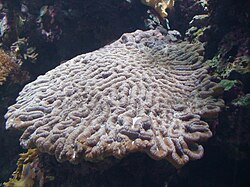
Picture of Oulophyllia crispa
- Source
- Wikipedia/Commons
- Credit
- Júlio Reis
- Licence
- CC BY-SA 3.0
- Commercial use
- the licence allows it
No 3D scan of Oulophyllia crispa was found in Sketchfab.
Smithsonian Open Access and MorphoSource were not reached for this taxon, so this list is what the others held rather than everything there is.
The description on this site
- Licence
- CC BY-SA 4.0
This is what the site found, which is not the same as what exists.
Keep going
What may have been alongside itOulophyllia through timeFormations of the PleistoceneThe world it lived on
Occurrence data from the Paleobiology Database, CC BY 4.0. (Lamarck 1816)