Palaeoniscidae
Palaeoniscidae is an extinct family of "palaeoniscoid" ray-finned fishes (Actinopterygii). The family includes the genus Palaeoniscum and potentially other Palaeozoic and Mesozoic early actinopterygian genera. The name is derived from the Ancient Greek words παλαιός and ὀνίσκος.

Ghedoghedo · CC BY-SA 4.0 · via Wikipedia/Commons. May be a photograph of a specimen, or an artist’s reconstruction — an interpretation of a skeleton, since colour and soft tissue are almost never preserved.
On record
Recorded, not inferred- Sits inside
- PalaeoniscoideiPBDB
- Diet
- carnivorePBDB, for Palaeonisciformes
- Life habit
- nektonicPBDB, for Palaeonisciformes
- Motility
- actively mobilePBDB, for Palaeonisciformes
Time the record covers
At least 239 million years on record.
The record covers at least 382.31 Mya to 143.1 Mya. No occurrence read is dated outside 383.4 Mya to 121.4 Mya.
369 occurrences of Palaeoniscidae on record, most of them in the Late Triassic. Bar height is expected occurrences, not a count: each fossil is spread across the span it is dated to, so a tall narrow bar means tight dating and a low wide one means loose.
When
369 occurrences- Devonian3%
- Carboniferous22%
- Permian31%
- Early Triassic2%
- Middle Triassic8%
- Late Triassic32%
- Early Jurassic2%
- Late Jurassicunder 1%
- Early Cretaceousunder 1%
These are dates about fossils, not the animal: the record can only begin after it arose and end before it died out, so either end may reach further. Shares are expected occurrences: a fossil dated to a span is counted partly in each period it straddles. More on what this infers.
Found in
115 formations
- Raisby Formation29
- Westbury Formation · Penarth Group21
- Lockatong Formation · Chatham Group15
- Chinle Formation14
- Kupferschiefer Formation11
- Tyne limestone Formation · Yoredale Group8
Loading coastlines…
The named rock units Palaeoniscidae has been recovered from, largest first. Drawn where the rock is now, not where it formed. 91 further formations hold fewer occurrences each and are not listed. 82 occurrences have no formation on record, which is common for older literature.
Palaeoniscidae and its relatives
Late TriassicWhere Palaeoniscidae and its relatives were recorded in the Late Triassic.
Found in the same rock
1,712 taxa- Gyrolepis albertii33 sites
- Gyrolepis32 sites
- Turseodus24 sites
- Lissodus minimus23 sites
- Palaeoniscum22 sites
- Nemacanthus monilifer21 sites
- Palaeoniscum freieslebeni21 sites
- Sargodon tomicus21 sites
- Pygopterus humboldti17 sites
- Actinopterygii16 sites
- Birgeria acuminata16 sites
- Palaeoniscus freieslebeni16 sites
- Redfieldiidae16 sites
- Hybodus14 sites
- Polyacrodus cloacinus14 sites
- Elonichthys13 sites
- Gonatodus punctatus13 sites
- Reptilia13 sites
- Acrolepis sedgwickii12 sites
- Birgeria12 sites
- Elonichthys robisoni12 sites
- Nematoptychius greenocki12 sites
- Semionotus12 sites
- Acentrophorus glaphyrus11 sites
The Paleobiology Database records 277 sites for Palaeoniscidae, and this reads 240 of them. The number is how many of those sites it was catalogued from too. The 24 sharing the most are listed.
This is not a list of everything alive at the time. It is only what has come out of the same ground as this animal and been written down.
Entered from
141 references- Catalogue of the Fossil Fishes in the British Museum (Natural History). Part II30
- Monograph of the Permian fossils of England23
- The early diversification of ray-finned fishes (Actinopterygii): hypotheses, challenges and future prospects11
- Type and reference sections of the Middle and Upper Permian of the Volga and Kama River Regions: A Field Guidebook of XVIII International Congress on Carboniferous and Permian11
- Catalogue of Canadian fossil fishes10
- Glencartholm revisited: describing for the first time Stan Wood's discovery and excavation of Mumbie Quarry, adjacent to the important Palaeozoic fossil site of Glencartholm8
- Marine bands of Arnsbergian age (Namurian) in the south-eastern portion of the Askrigg Block, Yorkshire8
- Les poissons et les reptiles du Muschelkalk et du Rhetien de Basse-Provence8
- On the Zone of Avicula contorta, and the Lower Lias of the South of England8
- New eastern American Triassic fishes and Triassic correlations7
- L'Infralias dans la Franche-Comté [The Lower Lias of Franche-Comté]7
- A coelacanthid-rich site at Hasbergen (NW Germany): taphonomy and palaeoenvironment of a first systematic excavation in the Kupferschiefer (Upper Permian, Lopingian)6
Each of the 369 occurrences read was entered from one of these publications, ordered by how many each accounts for. This is not a search for papers mentioning the name. 129 further references are not listed. Entries link to doi.org where the Paleobiology Database holds an identifier, and to its own record where it does not. Relayed as the Paleobiology Database holds them, not checked against what they resolve to.
Media and terms
Media content1
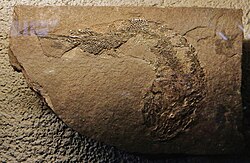
Picture of Palaeoniscidae
- Source
- Wikipedia/Commons
- Credit
- Ghedoghedo
- Licence
- CC BY-SA 4.0
- Commercial use
- the licence allows it
No 3D scan of Palaeoniscidae was found in Sketchfab.
Smithsonian Open Access and MorphoSource were not reached for this taxon, so this list is what the others held rather than everything there is.
The description on this site
- Licence
- CC BY-SA 4.0
This is what the site found, which is not the same as what exists.
Keep going
What may have been alongside itPalaeoniscoidei through timeFormations of the Late TriassicThe world it lived on
Occurrence data from the Paleobiology Database, CC BY 4.0. Vogt 1852