Birgeria
Birgeria is a genus of carnivorous marine ray-finned fish from the Triassic period. Birgeria had a global distribution, with fossil known from Madagascar, Spitsbergen, Germany, Switzerland, Italy, Slovenia, China, Russia, Canada and Nevada, United States. The oldest fossils are from Griesbachian aged beds of the Wordie Creek Formation of East Greenland. Birgeria existed throughout the entire Triassic period, from the very beginning just after the Permian-Triassic mass extinction, up to the very end with its extinction during the Triassic-Jurassic mass extinction.

Ghedoghedo · CC BY-SA 3.0 · via Wikipedia/Commons. May be a photograph of a specimen, or an artist’s reconstruction — an interpretation of a skeleton, since colour and soft tissue are almost never preserved.
On record
Recorded, not inferred- Sits inside
- BirgeriidaePBDB
- Diet
- carnivorePBDB
- Life habit
- nektonicPBDB, for Palaeonisciformes
- Motility
- actively mobilePBDB, for Palaeonisciformes
Time the record covers
At least 58 million years on record.
The record covers at least 251.1 Mya to 192.9 Mya. No occurrence read is dated outside 251.902 Mya to 184.2 Mya.
137 occurrences of Birgeria on record, most of them in the Late Triassic. Bar height is expected occurrences, not a count: each fossil is spread across the span it is dated to, so a tall narrow bar means tight dating and a low wide one means loose.
When
137 occurrencesThese are dates about fossils, not the animal: the record can only begin after it arose and end before it died out, so either end may reach further. Shares are expected occurrences: a fossil dated to a span is counted partly in each period it straddles. More on what this infers.
Found in
28 formations
- Pardonet Formation25
- Westbury Formation · Penarth Group17
- Transitional Beds Formation12
- Kongressfjellet Formation4
- Grès de Mortinsart Formation4
- Sticky Keep Formation · Sassendalen Group3
Loading coastlines…
The named rock units Birgeria has been recovered from, largest first. Drawn where the rock is now, not where it formed. 4 further formations hold fewer occurrences each and are not listed. 42 occurrences have no formation on record, which is common for older literature.
Birgeria and its relatives
Late TriassicWhere Birgeria and its relatives were recorded in the Late Triassic.
Found in the same rock
417 taxa- Lissodus minimus32 sites
- Nemacanthus monilifer28 sites
- Gyrolepis albertii26 sites
- Sargodon tomicus25 sites
- Norigondolella21 sites
- Actinopterygii20 sites
- Metapolygnathus17 sites
- Polyacrodus cloacinus17 sites
- Osteichthyes16 sites
- Hayashiella nodosa14 sites
- Saurichthys longidens14 sites
- Hybodus12 sites
- Pseudodalatias barnstonensis12 sites
- Colobodus11 sites
- Elasmobranchii11 sites
- Lepidotes11 sites
- Metapolygnathus communisti11 sites
- Saurichthys11 sites
- Epigondolella10 sites
- Gyrolepis10 sites
- Fragilicorona9 sites
- Tardogondolella postera8 sites
- Polyacrodus7 sites
- Acrodus6 sites
The Paleobiology Database records 126 sites for Birgeria, and this reads all of them. The number is how many of those sites it was catalogued from too. The 24 sharing the most are listed.
This is not a list of everything alive at the time. It is only what has come out of the same ground as this animal and been written down.
Entered from
53 references- Fossil succession and sequence stratigraphy of the Upper Triassic of Black Bear Ridge, northeast British Columbia, a GSSP prospect for the Carnian-Norian boundary38
- Macfadyen, 19708
- Stensiö, 19218
- Les poissons et les reptiles du Muschelkalk et du Rhetien de Basse-Provence7
- Catalogue of the Fossil Fishes in the British Museum (Natural History), Part III7
- Microvertebrates from the classic Rhaetian bone beds of Manor Farm Quarry, near Aust (Bristol, UK)4
- Rhaetian (Upper Triassic) marine faunas from "Le Golfe du Luxembourg" in Belgium (preliminary note)4
- Teeth of enigmatic neoselachian sharks and an ornithischian dinosaur from the uppermost Triassic of Lons-le-Saunier (Jura, France)3
- Studies on Triassic Fishes 2. Australosomus and Birgeria3
- Triassic Fishes from East Greenland collected by the Danish expeditions in 1929-19313
- Microvertebrates from the Rhaetian bone beds at Blue Anchor Bay, Somerset2
- Marine Early Triassic Actinopterygii from Elko County (Nevada, USA): implications for the Smithian equatorial vertebrate eclipse2
Each of the 137 occurrences read was entered from one of these publications, ordered by how many each accounts for. This is not a search for papers mentioning the name. 41 further references are not listed. Entries link to doi.org where the Paleobiology Database holds an identifier, and to its own record where it does not. Relayed as the Paleobiology Database holds them, not checked against what they resolve to.
Media and terms
Media content2
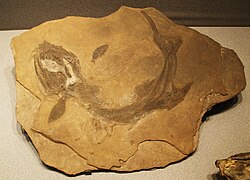
Picture of Birgeria
- Source
- Wikipedia/Commons
- Credit
- Ghedoghedo
- Licence
- CC BY-SA 3.0
- Commercial use
- the licence allows it
Synchrotron Imaging scan
- Source
- MorphoSource
- Licence
- In Copyright
- Commercial use
- cannot be read from the licence given — check the record
- Specimen
- Birgeria stensioei · pimuz:T2183
Smithsonian Open Access was not reached for this taxon, so this list is what the others held rather than everything there is.
The description on this site
- Source
- Wikipedia, “Birgeria”
- Licence
- CC BY-SA 4.0
This is what the site found, which is not the same as what exists.
Keep going
What may have been alongside itBirgeriidae through timeFormations of the Late TriassicThe world it lived on
Occurrence data from the Paleobiology Database, CC BY 4.0. Stensiö 1919