Panoplosaurus
Panoplosaurus is a genus of armoured dinosaur from the Late Cretaceous of Alberta, Canada. Few specimens of the genus are known, all from the middle Campanian of the Dinosaur Park Formation, roughly 76 to 75 million years ago. It was first discovered in 1917, and named in 1919 by Lawrence Lambe, named for its extensive armour, meaning "well-armoured lizard". Panoplosaurus has at times been considered the proper name for material otherwise referred to as Edmontonia, complicating its phylogenetic and ecological interpretations, at one point being considered to have existed across Alberta, New Mexico and Texas, with specimens in institutions from Canada and the United States. The skull and skeleton of Panoplosaurus are similar to its relatives, but have a few significant differences, such as the lumpy form of the skull osteoderms, a completely fused shoulder blade, and regularly shaped plates on its neck and body lacking prominent spines. It was a quadrupedal animal, roughly 5 m (16 ft) long and 1,600 kg (3,500 lb) in weight. The skull has a short snout, with a very domed surface, and bony plates directly covering the cheek. The neck had circular groups of plates arranged around the top surface, both the forelimb and hindlimb were about the same length, and the hand may have only included three fingers. Almost the entire surface of the body was covered in plates, osteoderms and scutes of varying sizes, ranging from large elements along the skull and neck, to smaller, round bones underneath the chin and body, to small ossicles that filled in the spaces between other, larger osteoderms.

Lawrence Lambe · Public Domain · via Wikipedia/Commons. May be a photograph of a specimen, or an artist’s reconstruction — an interpretation of a skeleton, since colour and soft tissue are almost never preserved.
On record
Recorded, not inferred- Sits inside
- NodosauridaePBDB
- Diet
- herbivorePBDB, for Ornithischia
- Life habit
- ground dwelling, gregariousPBDB, for Ornithischia
- Motility
- actively mobilePBDB, for Ornithischia
- Environment
- terrestrialPBDB, for Ornithischia
- Length
- 7 mWikidata
Time the record covers
At most 18 million years on record.
Every occurrence read is dated to somewhere between 83.6 Mya and 66 Mya, and nothing in the dating separates them, so that window is what the record shows rather than a span.
15 occurrences of Panoplosaurus on record, most of them in the Late Cretaceous. Bar height is expected occurrences, not a count: each fossil is spread across the span it is dated to, so a tall narrow bar means tight dating and a low wide one means loose.
When
15 occurrences- Late Cretaceous100%
These are dates about fossils, not the animal: the record can only begin after it arose and end before it died out, so either end may reach further. Shares are expected occurrences: a fossil dated to a span is counted partly in each period it straddles. More on what this infers.
Found in
7 formations
- Dinosaur Park Formation · Belly River Group5
- Ferris Formation4
- Two Medicine Formation · Montana Group2
- Bearpaw Shale Formation · Montana Group1
- Judith River Formation · Montana Group1
- Aguja Formation1
Loading coastlines…
The named rock units Panoplosaurus has been recovered from, largest first. Drawn where the rock is now, not where it formed.
Panoplosaurus and its relatives
Late CretaceousWhere Panoplosaurus and its relatives were recorded in the Late Cretaceous.
Found in the same rock
69 taxa- Baenidae4 sites
- Chasmosaurinae4 sites
- Lepisosteidae4 sites
- Trionychidae4 sites
- Basilemys3 sites
- Brachychampsa3 sites
- Compsemys victa3 sites
- Cyclurus fragosus3 sites
- Hadrosaurinae3 sites
- Theropoda3 sites
- Tyrannosauridae3 sites
- Adocus2 sites
- Eusuchia2 sites
- Myledaphus bipartitus2 sites
- Ornithomimidae2 sites
- Saurornitholestes2 sites
- Troodon formosus2 sites
- Acipenseriformes1 site
- Albanerpetontidae1 site
- Albertosaurus1 site
- Allognathosuchus1 site
- Alphadon halleyi1 site
- Amia1 site
- Ammonoidea1 site
The Paleobiology Database records 15 sites for Panoplosaurus, and this reads all of them. The number is how many of those sites it was catalogued from too. The 24 sharing the most are listed.
This is not a list of everything alive at the time. It is only what has come out of the same ground as this animal and been written down.
Entered from
8 references- Vertebrate faunal changes through Lancian and Puercan time in southern Wyoming4
- Ankylosaur systematics: example using Panoplosaurus and Edmontonia (Ankylosauria: Nodosauridae)3
- Quarries of Dinosaur Provincial Park2
- The families of the ornithischian dinosaur order Ankylosauria2
- New skeleton of nodosaurine ankylosaur from Lance Formation (Upper Cretaceous) in Wyoming: taxonomy and morphology of the armor1
- Additions to the mammalian paleofauna of Saskatchewan1
- On dinosaurian reptiles from the Two Medicine Formation of Montana1
- Description of a new genus and species (Panoplosaurus mirus) of an armoured dinosaur from the Belly River Beds of Alberta1
Each of the 15 occurrences read was entered from one of these publications, ordered by how many each accounts for. This is not a search for papers mentioning the name. Entries link to doi.org where the Paleobiology Database holds an identifier, and to its own record where it does not. Relayed as the Paleobiology Database holds them, not checked against what they resolve to.
Media and terms
Media content3
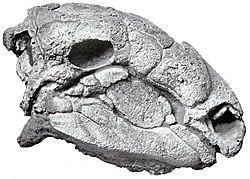
Picture of Panoplosaurus
- Source
- Wikipedia/Commons
- Credit
- Lawrence Lambe
- Licence
- Public Domain
- Commercial use
- the licence allows it
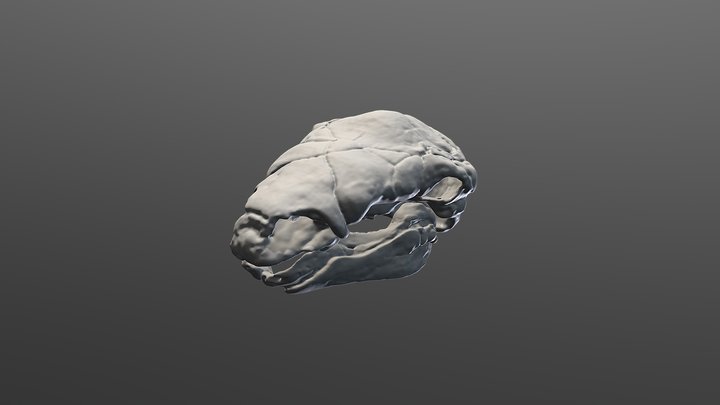
CT scan
- Source
- MorphoSource
- Licence
- not stated by the source
- Commercial use
- cannot be read from the licence given — check the record
- Specimen
- Panoplosaurus sp. · CMN:CMNFV:2759
The description on this site
- Licence
- CC BY-SA 4.0
This is what the site found, which is not the same as what exists.
Keep going
What may have been alongside itNodosauridae through timeFormations of the Late CretaceousThe world it lived on
Occurrence data from the Paleobiology Database, CC BY 4.0. Lambe 1919