Peromyscus difficilis
The Zacatecan deer mouse, Zacatecan deermouse, or southern rock mouse is a species of rodent in the family Cricetidae. It is a species of the genus Peromyscus, a closely related group of New World mice often called "deermice". It is found only in Mexico, and is not considered endangered.

Geni · CC BY-SA 4.0 · via Wikipedia/Commons. May be a photograph of a specimen, or an artist’s reconstruction — an interpretation of a skeleton, since colour and soft tissue are almost never preserved.
On record
Recorded, not inferred- Sits inside
- PeromyscusPBDB
- Diet
- herbivorePBDB, for Rodentia
- Life habit
- ground dwellingPBDB, for Peromyscus
- Motility
- actively mobilePBDB, for Osteichthyes
- Environment
- terrestrialPBDB, for Eutheria
Time the record covers
At most 199 thousand years on record.
Every occurrence read is dated to somewhere between 210 ka and 11.7 ka, and nothing in the dating separates them, so that window is what the record shows rather than a span.
3 occurrences of Peromyscus difficilis on record, most of them in the Pleistocene. The Paleobiology Database records this as a living group. Bar height is expected occurrences, not a count: each fossil is spread across the span it is dated to, so a tall narrow bar means tight dating and a low wide one means loose.
When
3 occurrences- Pleistocene100%
These are dates about fossils, not the animal: the record can only begin after it arose and end before it died out, so either end may reach further. Shares are expected occurrences: a fossil dated to a span is counted partly in each period it straddles. More on what this infers.
Peromyscus difficilis and its relatives
PleistoceneWhere Peromyscus difficilis and its relatives were recorded in the Pleistocene.
Found in the same rock
145 taxa- Neotoma mexicana3 sites
- Bufo2 sites
- Crotalus2 sites
- Dipodomys spectabilis2 sites
- Eptesicus fuscus2 sites
- Equus conversidens2 sites
- Lynx rufus2 sites
- Marmota flaviventris2 sites
- Megascapheus bottae2 sites
- Microtus mexicanus2 sites
- Myotis lucifugus2 sites
- Myotis velifer2 sites
- Neotoma albigula2 sites
- Odocoileus2 sites
- Otospermophilus variegatus2 sites
- Perognathus2 sites
- Perognathus flavus2 sites
- Peromyscus boylii2 sites
- Peromyscus eremicus2 sites
- Peromyscus maniculatus2 sites
- Reithrodontomys megalotis2 sites
- Salpinctes obsoletus2 sites
- Sceloporus2 sites
- Sylvilagus2 sites
The Paleobiology Database records 3 sites for Peromyscus difficilis, and this reads all of them. The number is how many of those sites it was catalogued from too. The 24 sharing the most are listed.
This is not a list of everything alive at the time. It is only what has come out of the same ground as this animal and been written down.
Entered from
3 references- Tovar et al., 20071
- Reconstruction of mid Wisconsinan environments in southern New Mexico1
- Late Pleistocene and early Recent mammals from Fowlkes Cave, southern Culberson County, Texas1
Each of the 3 occurrences read was entered from one of these publications, ordered by how many each accounts for. This is not a search for papers mentioning the name. Entries link to doi.org where the Paleobiology Database holds an identifier, and to its own record where it does not. Relayed as the Paleobiology Database holds them, not checked against what they resolve to.
Media and terms
Media content2
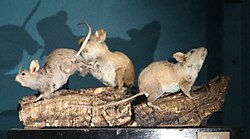
Picture of Peromyscus difficilis
- Source
- Wikipedia/Commons
- Credit
- Geni
- Licence
- CC BY-SA 4.0
- Commercial use
- the licence allows it
CT scan
- Source
- MorphoSource
- Licence
- In Copyright
- Commercial use
- cannot be read from the licence given — check the record
- Specimen
- Peromyscus difficilis difficilis · UMMZ:mammals:101274
The description on this site
- Licence
- CC BY-SA 4.0
This is what the site found, which is not the same as what exists.
Keep going
What may have been alongside itPeromyscus through timeFormations of the PleistoceneThe world it lived on
Occurrence data from the Paleobiology Database, CC BY 4.0. (Allen 1891)