Phoebe
Phoebe is a genus of evergreen trees and shrubs belonging to the Laurel family, Lauraceae. There are 75 accepted species in the genus, distributed in tropical and subtropical Asia and New Guinea. 35 species occur in China, of which 27 are endemic. The first description of the genus was of the type species P. lanceolata made in 1836 by Christian Gottfried Daniel Nees von Esenbeck in Systema Laurinarum, p. 98.

Phil41 · CC0 · via Wikipedia/Commons. May be a photograph of a specimen, or an artist’s reconstruction — an interpretation of a skeleton, since colour and soft tissue are almost never preserved.
On record
Recorded, not inferred- Sits inside
- LauraceaePBDB
- Diet
- "photoautotroph"PBDB, for Angiospermae
Time the record covers
At least 50 million years on record.
The record covers at least 51.1 Mya to 129 ka. No occurrence read is dated outside 66 Mya to 11.7 ka.
44 occurrences of Phoebe on record, most of them in the Miocene. The Paleobiology Database records this as a living group. Bar height is expected occurrences, not a count: each fossil is spread across the span it is dated to, so a tall narrow bar means tight dating and a low wide one means loose.
When
44 occurrencesThese are dates about fossils, not the animal: the record can only begin after it arose and end before it died out, so either end may reach further. Shares are expected occurrences: a fossil dated to a span is counted partly in each period it straddles. More on what this infers.
Found in
10 formations
- Willwood Formation6
- Shuanghe Formation3
- Xiaolongtan Formation2
- Nanlin Formation2
- Fort Union Formation1
- Klondike Mountain Formation1
Loading coastlines…
The named rock units Phoebe has been recovered from, largest first. Drawn where the rock is now, not where it formed. 25 occurrences have no formation on record, which is common for older literature.
Phoebe and its relatives
MioceneWhere Phoebe and its relatives were recorded in the Miocene.
Found in the same rock
799 taxa- Acer10 sites
- Alnus10 sites
- Quercus9 sites
- Falco sparverius7 sites
- Ulmus7 sites
- Ficus6 sites
- Glyptostrobus europaeus6 sites
- Litsea6 sites
- Machilus6 sites
- Rhus6 sites
- Turdus migratorius6 sites
- Cinnamomum5 sites
- Corvus corax5 sites
- Hamamelidaceae5 sites
- Lithocarpus5 sites
- Menispermites parvareolatus5 sites
- Nothaphoebe5 sites
- Populus5 sites
- Annona4 sites
- Bonasa umbellus4 sites
- Buteo jamaicensis4 sites
- Carpinus4 sites
- Cercidiphyllum genetrix4 sites
- Colaptes auratus4 sites
The Paleobiology Database records 32 sites for Phoebe, and this reads all of them. The number is how many of those sites it was catalogued from too. The 24 sharing the most are listed.
This is not a list of everything alive at the time. It is only what has come out of the same ground as this animal and been written down.
Entered from
22 references- Plant and mammal diversity in the Paleocene to Early Eocene of the Bighorn Basin7
- A catalogue of Cenozoic megafossil plants in China5
- Terminal Pleistocene–Holocene Avifauna of San Miguel and Santa Rosa Islands: Identifications of Previously Unidentified Avian Remains Recovered from Fossil Sites and Prehistoric Cave Deposits4
- Reconstructing Neogene vegetation and climates to infer tectonic uplift in western Yunnan, China4
- Die Miozaenan Frucht-und Samen-Floren die Oberpfaelzer Braunkohle. I. Funde aus den sandigen zwischenmitteln4
- Contribution to the flora of the middle Oligocene Calau Beds in Brandenberg, Germany2
- A Catalogue of Indian Fossil Plants2
- Tertiary flora from the Rio Pichileufu, Argentina2
- Paleoclimatic estimation reveals a weak winter monsoon in southwestern China during the late Miocene: Evidence from plant macrofossils1
- Quantitative climate reconstructions of the late Miocene Xiaolongtan megaflora from Yunnan, southwest China1
- Angiospermous fossil leaves from the Siwalik foreland basins and their palaeoclimatic implications1
- Late Pleistocene birds from Kingston Saltpeter Cave, southern Appalachian Mountains, Georgia1
Each of the 44 occurrences read was entered from one of these publications, ordered by how many each accounts for. This is not a search for papers mentioning the name. 10 further references are not listed. Entries link to doi.org where the Paleobiology Database holds an identifier, and to its own record where it does not. Relayed as the Paleobiology Database holds them, not checked against what they resolve to.
Media and terms
Media content2
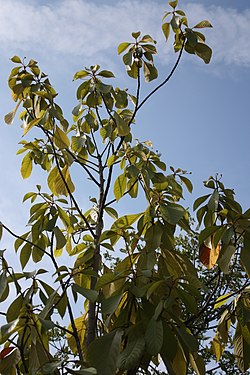
Picture of Phoebe
- Source
- Wikipedia/Commons
- Credit
- Phil41
- Licence
- CC0
- Commercial use
- the licence allows it
3D model
- Source
- Sketchfab
- Credit
- ilyakardailskiy
- Licence
- CC Attribution
- Commercial use
- cannot be read from the licence given — check the record
Smithsonian Open Access and MorphoSource were not reached for this taxon, so this list is what the others held rather than everything there is.
The description on this site
- Licence
- CC BY-SA 4.0
This is what the site found, which is not the same as what exists.
Keep going
What may have been alongside itLauraceae through timeFormations of the MioceneThe world it lived on
Occurrence data from the Paleobiology Database, CC BY 4.0. Nees 1836