Plagiostoma
Plagiostoma is a genus of fossil saltwater clams, marine bivalve mollusks in the family Limidae, the file clams.

MarnixR · CC BY-SA 4.0 · via Wikipedia/Commons. May be a photograph of a specimen, or an artist’s reconstruction — an interpretation of a skeleton, since colour and soft tissue are almost never preserved.
On record
Recorded, not inferred- Sits inside
- LimidaePBDB
- Diet
- suspension feederPBDB, for Limidae
- Life habit
- low-level epifaunalPBDB, for Limidae
- Motility
- stationary, attachedPBDB, for Limidae
- Vision
- blindPBDB, for Bivalvia
Time the record covers
At least 246 million years on record.
The record covers at least 312.8 Mya to 66 Mya. No occurrence read is dated outside 318.6 Mya to 61.66 Mya.
1,420 occurrences of Plagiostoma on record, most of them in the Early Jurassic. Bar height is expected occurrences, not a count: each fossil is spread across the span it is dated to, so a tall narrow bar means tight dating and a low wide one means loose.
When
1,420 occurrences- Carboniferousunder 1%
- Permianunder 1%
- Early Triassicunder 1%
- Middle Triassic6%
- Late Triassic7%
- Early Jurassic39%
- Middle Jurassic23%
- Late Jurassic14%
- Early Cretaceous2%
- Late Cretaceous8%
- Paleoceneunder 1%
These are dates about fossils, not the animal: the record can only begin after it arose and end before it died out, so either end may reach further. Shares are expected occurrences: a fossil dated to a span is counted partly in each period it straddles. More on what this infers.
Found in
240 formations
- Dhruma Formation · Shaqra Group53
- Calcaire a gryphees Formation35
- Carmel Formation32
- Kap Leslie Formation29
- Chari Formation27
- Turmiel Fm Formation27
Loading coastlines…
The named rock units Plagiostoma has been recovered from, largest first. Drawn where the rock is now, not where it formed. 216 further formations hold fewer occurrences each and are not listed. 534 occurrences have no formation on record, which is common for older literature.
Plagiostoma and its relatives
Early JurassicWhere Plagiostoma and its relatives were recorded in the Early Jurassic.
Found in the same rock
1,441 taxa- Nanogyra (Nanogyra) nana55 sites
- Isognomon54 sites
- Chlamys textoria53 sites
- Astarte51 sites
- Modiolus49 sites
- Serpula46 sites
- Pleuromya uniformis45 sites
- Camptonectes42 sites
- Liostrea39 sites
- Pinna37 sites
- Pseudomelania32 sites
- Pholadomya31 sites
- Grammatodon30 sites
- Actinostreon gregarea29 sites
- Cucullaea29 sites
- Grammatodon concinnus29 sites
- Protocardia striatula29 sites
- Isocyprina28 sites
- Entolium (Entolium) corneolum27 sites
- Pleuromya27 sites
- Belemnitida26 sites
- Nuculana26 sites
- Entolium orbiculare25 sites
- Weyla alata25 sites
The Paleobiology Database records 986 sites for Plagiostoma, and this reads 240 of them. The number is how many of those sites it was catalogued from too. The 24 sharing the most are listed.
This is not a list of everything alive at the time. It is only what has come out of the same ground as this animal and been written down.
Entered from
268 references- Palokologie und zeitliche Verbreitung benthischer Faunengemeinschaften im Unterjura von Chile208
- Le Jurassique D`Arabie Centrale56
- Unpublished data55
- Geologie, Paleontologie et Paleoecologie du Bathonien au sud-ouest du Massif Ardennais45
- Unpublished data from Kachchh40
- Palökologie benthischer Faunen aus dem Unter-Toarc SW-Europas40
- Paleoenvironnements dans le Calcaire a gryphees du Lias de Lorraine, de la carriere de Xeuilley au Bassin parisien36
- Marine Jurassic Pelecypods From Central and Southern Utah34
- Unpublished data on Cretaceous-Paleocene molluscan assemblages33
- Temperature-related body size change of marine benthic macroinvertebrates across the Early Toarcian Anoxic Event31
- Dynamische Palaookologie und taxonomische Bearbeitung des Unterjura (Hettangium bis unteres Sinemurium) auf der Schwabischen Alb30
- Stratigraphie und Biofacies der Koessener Formation (Obertrias, Nordliche Kalkalpen)28
Each of the 1,420 occurrences read was entered from one of these publications, ordered by how many each accounts for. This is not a search for papers mentioning the name. 256 further references are not listed. Entries link to doi.org where the Paleobiology Database holds an identifier, and to its own record where it does not. Relayed as the Paleobiology Database holds them, not checked against what they resolve to.
Media and terms
Media content2

Picture of Plagiostoma
- Source
- Wikipedia/Commons
- Credit
- MarnixR
- Licence
- CC BY-SA 4.0
- Commercial use
- the licence allows it
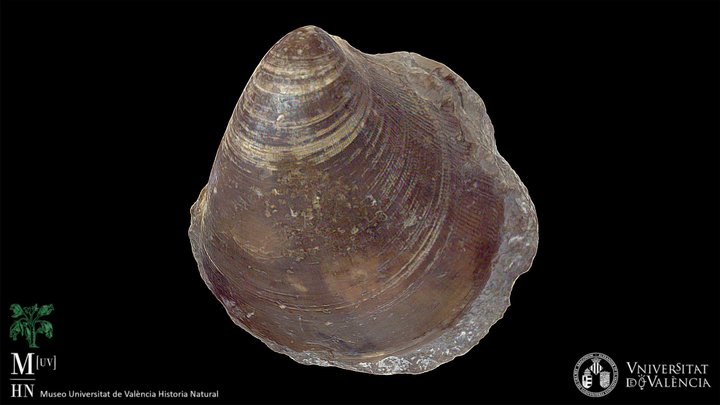
3D model
- Source
- Sketchfab
- Licence
- CC Attribution
- Commercial use
- cannot be read from the licence given — check the record
The description on this site
- Licence
- CC BY-SA 4.0
This is what the site found, which is not the same as what exists.
Keep going
What may have been alongside itLimidae through timeFormations of the Early JurassicThe world it lived on
Occurrence data from the Paleobiology Database, CC BY 4.0. (Sowerby 1814)