Pleocyemata
Pleocyemata is a suborder of decapod crustaceans, erected by Martin Burkenroad in 1963. Burkenroad's classification replaced the earlier sub-orders of Natantia and Reptantia with the monophyletic groups Dendrobranchiata (prawns) and Pleocyemata. Pleocyemata contains all the members of the Reptantia, as well as the Stenopodidea, and Caridea, which contains the true shrimp.

Photo by Fabio Liverani ( http://www.fabioliverani.com ) uploaded by Esculapio · CC BY-SA 2.5 · via Wikipedia/Commons. May be a photograph of a specimen, or an artist’s reconstruction — an interpretation of a skeleton, since colour and soft tissue are almost never preserved.
On record
Recorded, not inferred- Sits inside
- DecapodaPBDB
- Diet
- carnivorePBDB, for Decapoda
- Life habit
- epifaunalPBDB, for Decapoda
- Motility
- actively mobilePBDB, for Malacostraca
- Vision
- well-developedPBDB, for Malacostraca
Time the record covers
At least 358 million years on record.
The record covers at least 358.86 Mya to 11.7 ka. No occurrence read is dated outside 382.31 Mya to 0 Mya.
8,360 occurrences of Pleocyemata on record, most of them in the Eocene. The Paleobiology Database records this as a living group. Bar height is expected occurrences, not a count: each fossil is spread across the span it is dated to, so a tall narrow bar means tight dating and a low wide one means loose.
When
8,360 occurrences- Devonianunder 1%
- Permianunder 1%
- Early Triassicunder 1%
- Middle Triassic1%
- Late Triassicunder 1%
- Early Jurassic1%
- Middle Jurassic2%
- Late Jurassic6%
- Early Cretaceous8%
- Late Cretaceous15%
- Paleocene3%
- Eocene24%
- Oligocene5%
- Miocene20%
- Pliocene5%
- Pleistocene7%
- Holocene3%
These are dates about fossils, not the animal: the record can only begin after it arose and end before it died out, so either end may reach further. Shares are expected occurrences: a fossil dated to a span is counted partly in each period it straddles. More on what this infers.
Found in
899 formations
- Sandakan Formation124
- Cercado Formation · Yaque Group85
- Ernstbrunn Formation81
- Palos Verdes Sand Formation65
- London Clay Formation62
- Pirabas Formation60
Loading coastlines…
The named rock units Pleocyemata has been recovered from, largest first. Drawn where the rock is now, not where it formed. 875 further formations hold fewer occurrences each and are not listed. 3,472 occurrences have no formation on record, which is common for older literature.
Pleocyemata and its relatives
EoceneWhere Pleocyemata and its relatives were recorded in the Eocene.
Found in the same rock
3,198 taxa- Ostrea24 sites
- Turritella22 sites
- Callianassa21 sites
- Pinna16 sites
- Dentalium15 sites
- Planolites12 sites
- Conus11 sites
- Nucula11 sites
- Panopea11 sites
- Bositra buchi10 sites
- Chlamys10 sites
- Crassatella10 sites
- Cucullaea10 sites
- Decapoda10 sites
- Echinoidea10 sites
- Gastropoda10 sites
- Grammatodon10 sites
- Lithophaga10 sites
- Natica10 sites
- Pitar10 sites
- Astarte9 sites
- Chama9 sites
- Entolium orbiculare9 sites
- Lucina9 sites
The Paleobiology Database records at least 965 sites for Pleocyemata, and this reads 240 of them. The number is how many of those sites it was catalogued from too. The 24 sharing the most are listed.
This is not a list of everything alive at the time. It is only what has come out of the same ground as this animal and been written down.
Entered from
1,220 references- Fossil Crustacea of the Atlantic and Gulf Coastal Plain331
- The fossil stalk-eyed Crustacea of the Pacific slope of North America254
- Decapod crustacea of the Badenian191
- I crostacei associati a coralli nell’Eocene inferiore dell’area di Bolca (Verona e Vicenza, Italia nordorientale)172
- The genus Cancer (Crustacea: Brachyura): systematics, biogeography and fossil record165
- Miocene and Pleistocene Crabs (Crustacea, Decapoda) from Sabah and Sarawak161
- Cenozoic Decapod Crustacea from Southwest Japan146
- Decapod crustaceans from the Miocene Kukinaga Group, Tanegashima Island, Kyushu, Japan133
- Notes on North American Crustacea106
- Notes on North American Crustacea, in the Museum of the Smithsonian Institution. No. II104
- Crustacés décapodes nouveaux ou peu connus de l'époque Crétacique103
- Neogene and Quaternary crabs (Crustacea, Decapoda) collected from Costa Rica and Panama by members of the Panama Paleontology Project97
Each of the 8,360 occurrences read was entered from one of these publications, ordered by how many each accounts for. This is not a search for papers mentioning the name. 1,208 further references are not listed. Entries link to doi.org where the Paleobiology Database holds an identifier, and to its own record where it does not. Relayed as the Paleobiology Database holds them, not checked against what they resolve to.
Media and terms
Media content1
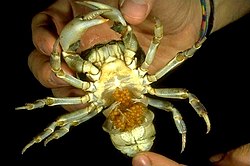
Picture of Pleocyemata
- Source
- Wikipedia/Commons
- Credit
- Photo by Fabio Liverani ( http://www.fabioliverani.com ) uploaded by Esculapio
- Licence
- CC BY-SA 2.5
- Commercial use
- the licence allows it
No 3D scan of Pleocyemata was found in Sketchfab.
Smithsonian Open Access and MorphoSource were not reached for this taxon, so this list is what the others held rather than everything there is.
The description on this site
- Source
- Wikipedia, “Pleocyemata”
- Licence
- CC BY-SA 4.0
This is what the site found, which is not the same as what exists.
Keep going
What may have been alongside itDecapoda through timeFormations of the EoceneThe world it lived on
Occurrence data from the Paleobiology Database, CC BY 4.0. Burkenroad 1963