Pliomera
Pliomera is a genus of trilobites that lived during the Middle Ordovician on the paleocontinent Baltica, now Norway, Sweden, Estonia and the Russian Federation, and in Argentina. It can be recognized for its pentagonal glabella widest between the frontal corners, with an inverted V-shaped occipital ring. In front of the occipital furrow that crosses the entire glabella, two pairs of dead-ending furrows create three side lobes left and right. The front of the glabella also has three dead-ending furrows, a very short one on the midline and left and right a longer one, directed inward and slightly backward. The eyes are small and are not connected to the glabella by an eye ridge. The thorax and pygidium are very regularly divided into up to 23 rather narrow segments, without a furrow within each of the pleurae. The pleurae are clearly wider than the axis. The pygidium ends in downward pointing toothlike spines.

Dwergenpaartje · CC BY-SA 3.0 · via Wikipedia/Commons. May be a photograph of a specimen, or an artist’s reconstruction — an interpretation of a skeleton, since colour and soft tissue are almost never preserved.
On record
Recorded, not inferred- Sits inside
- PliomeridaePBDB
- Diet
- carnivorePBDB, for Trilobita
- Life habit
- low-level epifaunalPBDB, for Trilobita
- Motility
- fast-movingPBDB, for Trilobita
- Vision
- well-developedPBDB, for Pliomeridae
- Environment
- marinePBDB, for Trilobita
Time the record covers
At least 21 million years on record.
The record covers at least 471.3 Mya to 449.5 Mya. No occurrence read is dated outside 477.1 Mya to 445.2 Mya.
47 occurrences of Pliomera on record, most of them in the Ordovician. Bar height is expected occurrences, not a count: each fossil is spread across the span it is dated to, so a tall narrow bar means tight dating and a low wide one means loose.
When
47 occurrences- Ordovician100%
These are dates about fossils, not the animal: the record can only begin after it arose and end before it died out, so either end may reach further. Shares are expected occurrences: a fossil dated to a span is counted partly in each period it straddles. More on what this infers.
Found in
16 formations
- Holen Formation17
- Suri Formation5
- Voskresenka Formation · Batun Group5
- San Juan Formation3
- Gulang Formation2
- Volkhov Formation2
Loading coastlines…
The named rock units Pliomera has been recovered from, largest first. Drawn where the rock is now, not where it formed. 1 occurrence has no formation on record, which is common for older literature.
Pliomera and its relatives
OrdovicianWhere Pliomera and its relatives were recorded in the Ordovician.
Found in the same rock
235 taxa- Asaphus (Asaphus) raniceps18 sites
- Illaenus18 sites
- Megistaspis15 sites
- Metopolichas celorrhin11 sites
- Ampyx nasutus10 sites
- Pterygometopus sclerops10 sites
- Cyrtometopus8 sites
- Remopleurides8 sites
- Cyrtometopus affinis7 sites
- Megistaspis (Megistaspidella) extenuata7 sites
- Ptychopyge7 sites
- Carolinites6 sites
- Cyrtometopus clavifrons5 sites
- Metopolichas verrucosus5 sites
- Niobe frontalis5 sites
- Orthis5 sites
- Pseudasaphus5 sites
- Trinodus5 sites
- Asaphus4 sites
- Bathyurellus4 sites
- Ceraurinella frequens4 sites
- Didymograptus4 sites
- Glaphurus4 sites
- Hungioides intermedia4 sites
The Paleobiology Database records 46 sites for Pliomera, and this reads all of them. The number is how many of those sites it was catalogued from too. The 24 sharing the most are listed.
This is not a list of everything alive at the time. It is only what has come out of the same ground as this animal and been written down.
Entered from
16 references- The Asaphus Limestone in northernmost Öland18
- Ordovician trilobites of Argentina6
- The Lower Palaeozoic fossils of the Northern Shan States, Burma. With a section of Ordovician cystidea by F. A. Bather [q.v.]5
- Ordovician Sedimentary Basin and Paleobiotas of the Gorny Altai3
- The new Ordovician stage standard as applied to the stratigraphic units of the western Altai–Sayan Folded Area3
- Legend of the Central European series of sheets of the State Geological Map of the Russian Federation, scale 1:1,000,000 (third generation)2
- Upper Arenig trilobite biostratigraphy and sea-level changes at Lynna River near Volkhov, Russia1
- Available generic names for trilobites1
- Nuevos trilobites de la Formacion San Juan (Ordovicico temprano), Precordillera de San Juan y La Rioja, Argentina1
- The Middle Ordovician of the Oslo region, Norway, 33. Trilobites from the lowermost part of the Ogygiocaris Series1
- Stratigraphic table of northwestern region of China: ShaanXi Province part1
- Stratigraphic Summary of the Southwestern Region of China1
Each of the 47 occurrences read was entered from one of these publications, ordered by how many each accounts for. This is not a search for papers mentioning the name. 4 further references are not listed. Entries link to doi.org where the Paleobiology Database holds an identifier, and to its own record where it does not. Relayed as the Paleobiology Database holds them, not checked against what they resolve to.
Media and terms
Media content2

Picture of Pliomera
- Source
- Wikipedia/Commons
- Credit
- Dwergenpaartje
- Licence
- CC BY-SA 3.0
- Commercial use
- the licence allows it
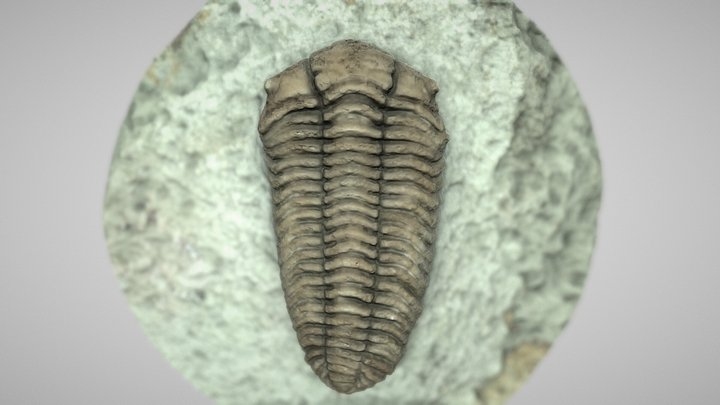
3D model
- Source
- Sketchfab
- Licence
- Free Standard
- Commercial use
- cannot be read from the licence given — check the record
Smithsonian Open Access and MorphoSource were not reached for this taxon, so this list is what the others held rather than everything there is.
The description on this site
- Source
- Wikipedia, “Pliomera”
- Licence
- CC BY-SA 4.0
This is what the site found, which is not the same as what exists.
Keep going
What may have been alongside itPliomeridae through timeFormations of the OrdovicianThe world it lived on
Occurrence data from the Paleobiology Database, CC BY 4.0. Angelin 1845