Podiceps grisegena
The red-necked grebe is an aquatic bird found in the temperate regions of the northern hemisphere. A migratory bird, its wintering habitat is largely restricted to calm waters just beyond the waves around ocean coasts, although some birds may winter on large lakes. Grebes prefer shallow bodies of fresh water such as lakes, marshes or fish-ponds as breeding sites.

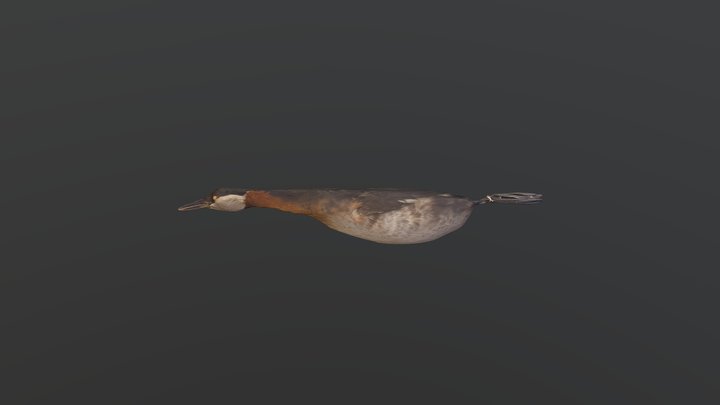
Charles J. Sharp · CC BY-SA 4.0 · via Wikipedia/Commons. May be a photograph of a specimen, or an artist’s reconstruction — an interpretation of a skeleton, since colour and soft tissue are almost never preserved.
On record
Recorded, not inferred- Also called
- red-necked grebePBDB
- Sits inside
- PodicepsPBDB
- Diet
- carnivorePBDB, for Coelurosauria
- Life habit
- ground dwelling, solitaryPBDB, for Theropoda
- Motility
- actively mobilePBDB, for Theropoda
- Environment
- terrestrialPBDB, for Theropoda
- Mass
- 785.4 gWikidata
Time the record covers
At least 117 thousand years on record.
The record covers at least 129 ka to 11.7 ka. No occurrence read is dated outside 774 ka to 0 Mya.
4 occurrences of Podiceps grisegena on record, most of them in the Pleistocene. The Paleobiology Database records this as a living group. Bar height is expected occurrences, not a count: each fossil is spread across the span it is dated to, so a tall narrow bar means tight dating and a low wide one means loose.
When
4 occurrences- Pleistocene75%
- Holocene25%
These are dates about fossils, not the animal: the record can only begin after it arose and end before it died out, so either end may reach further. Shares are expected occurrences: a fossil dated to a span is counted partly in each period it straddles. More on what this infers.
Podiceps grisegena and its relatives
PleistoceneWhere Podiceps grisegena and its relatives were recorded in the Pleistocene.
Found in the same rock
164 taxa- Anas crecca3 sites
- Anas platyrhynchos3 sites
- Anas2 sites
- Anas acuta2 sites
- Anatidae2 sites
- Aythya fuligula2 sites
- Chroicocephalus ridibundus2 sites
- Clangula hyemalis2 sites
- Gallinago2 sites
- Hirundo rustica2 sites
- Lagopus2 sites
- Lagopus lagopus2 sites
- Lagopus muta2 sites
- Mareca penelope2 sites
- Milvus migrans2 sites
- Passeriformes2 sites
- Perisoreus infaustus2 sites
- Phalaropus lobatus2 sites
- Podiceps cristatus2 sites
- Scolopacidae2 sites
- Sibirionetta formosa2 sites
- Spatula clypeata2 sites
- Turdus2 sites
- Turdus hortulorum2 sites
The Paleobiology Database records 4 sites for Podiceps grisegena, and this reads all of them. The number is how many of those sites it was catalogued from too. The 24 sharing the most are listed.
This is not a list of everything alive at the time. It is only what has come out of the same ground as this animal and been written down.
Entered from
3 references- Birds of the Late Pleistocene and Holocene from the Palaeolithic Djuktai cave site of Yakutia, eastern Siberia2
- A catalogue of late Quaternary vertebrates from California: Part One, nonmarine lower vertebrate and avian taxa1
- Fossil birds from the Equus Beds of Oregon1
Each of the 4 occurrences read was entered from one of these publications, ordered by how many each accounts for. This is not a search for papers mentioning the name. Each entry links to the Paleobiology Database's own record for the work.
Media and terms
Media content2

Picture of Podiceps grisegena
- Source
- Wikipedia/Commons
- Credit
- Charles J. Sharp
- Licence
- CC BY-SA 4.0
- Commercial use
- the licence allows it
Smithsonian Open Access was not reached for this taxon, so this list is what the others held rather than everything there is.
The description on this site
- Licence
- CC BY-SA 4.0
This is what the site found, which is not the same as what exists.
Keep going
What may have been alongside itPodiceps through timeFormations of the PleistoceneThe world it lived on
Occurrence data from the Paleobiology Database, CC BY 4.0. (Boddaert 1783)