Hemiptera
Searched as Proboscidea indet.. The Paleobiology Database treats Hemiptera as the accepted name.
No picture of Hemiptera was found. iDigBio was searched and had none. Wikipedia and Wikidata have a picture filed under this name, but nothing tied it to Hemiptera itself, so it was not used. Smithsonian Open Access did not answer, so this is what the others held rather than everything there is. GBIF was asked, and what came back is not recorded: nothing, or a picture this site could not tie to Hemiptera, or no answer at all. This entry cannot say which.
On record
Recorded, not inferred- Sits inside
- CondylognathaPBDB
- Motility
- actively mobilePBDB, for Arthropoda
- Environment
- terrestrialPBDB, for Insecta
Time the record covers
At least 47 million years on record.
The record covers at least 48.07 Mya to 129 ka. No occurrence read is dated outside 56 Mya to 0 Mya.
257 occurrences of Hemiptera on record, most of them in the Miocene. The Paleobiology Database records this as a living group. Bar height is expected occurrences, not a count: each fossil is spread across the span it is dated to, so a tall narrow bar means tight dating and a low wide one means loose.
When
257 occurrencesThese are dates about fossils, not the animal: the record can only begin after it arose and end before it died out, so either end may reach further. Shares are expected occurrences: a fossil dated to a span is counted partly in each period it straddles. More on what this infers.
Found in
78 formations
- Hunter Creek Sandstone Formation17
- Manchar Formation12
- Chitarwata Formation6
- Vihowa Formation6
- Valentine Formation · Ogallala Group5
- Koobi Fora Formation · Omo Group4
Loading coastlines…
The named rock units Hemiptera has been recovered from, largest first. Drawn where the rock is now, not where it formed. 54 further formations hold fewer occurrences each and are not listed. 119 occurrences have no formation on record, which is common for older literature.
Hemiptera and its relatives
MioceneWhere Hemiptera and its relatives were recorded in the Miocene.
Found in the same rock
6,964 taxa- Coleoptera18 sites
- Blattodea11 sites
- Haenbea badamgaravae11 sites
- Diptera10 sites
- Odonata9 sites
- Heteroptera8 sites
- Insecta8 sites
- Artinska clara7 sites
- Curculionidae7 sites
- Diapherinus ornatipennis7 sites
- Homoptera7 sites
- Lemmatophora typa7 sites
- Lisca minuta7 sites
- Panorpidium geinitzi7 sites
- Permopsylla americana7 sites
- Petromantis rossica7 sites
- Tipulidae7 sites
- Aktassoblatta fusca6 sites
- Artinska ovata6 sites
- Asthenohymen dunbari6 sites
- Aves6 sites
- Blattula brevicaudata6 sites
- Dichentomum tinctum6 sites
- Heterophlebia buckmani6 sites
The Paleobiology Database records at least 492 sites for Hemiptera, and this reads 240 of them. The number is how many of those sites it was catalogued from too. The 24 sharing the most are listed.
This is not a list of everything alive at the time. It is only what has come out of the same ground as this animal and been written down.
Entered from
138 references- Biostratigraphy of the Hunter Creek Sandstone, Verdi Basin, Washoe County, Nevada17
- Preliminary report on the geology and vertebrate fauna of the Miocene Manchar Formation, Sind, Pakistan14
- Will Downs and the Zinda Pir Dome12
- Synonymies and reidentifications of North American fossil mammals11
- Additional Late Cenozoic (latest Hemphillian to earliest Irvingtonian) mammals from Douglas County, Nevada8
- Late Pleistocene Mammuthus and Cuvieronius (proboscidea) from Térapa, Sonora, Mexico7
- Two Pliocene (Blancan) vertebrate faunas from Douglas County, Nevada6
- Recent discoveries of fossil vertebrates in the lower peninsula of Michigan6
- Pleistocene proboscidean sites in Michigan: New records and an update on published sites5
- The first quarterly report covering the quarter ending June 30,1939 for the state-wide paleontologic-mineralogic survey in Texas5
- The bone assemblages from the excavated sites4
- Vertebrate biostratigraphy of the Ogallala Group in Nebraska4
Each of the 257 occurrences read was entered from one of these publications, ordered by how many each accounts for. This is not a search for papers mentioning the name. 126 further references are not listed. Entries link to doi.org where the Paleobiology Database holds an identifier, and to its own record where it does not. Relayed as the Paleobiology Database holds them, not checked against what they resolve to.
Media and terms
Media content1
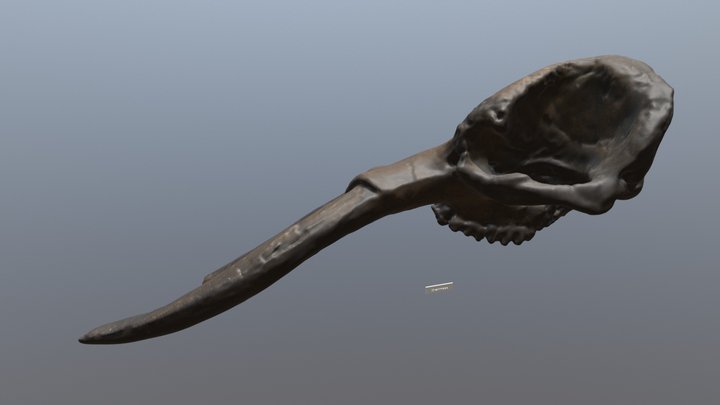
3D model
- Source
- Sketchfab
- Credit
- Virtual Curation Lab
- Licence
- CC Attribution-NonCommercial-NoDerivs
- Commercial use
- the licence does not allow it
No picture of Hemiptera was found. iDigBio was searched and had none.
Wikipedia and Wikidata have a picture filed under this name, but nothing tied it to Hemiptera itself, so it was not used.
Smithsonian Open Access did not answer, so this is what the others held rather than everything there is.
GBIF was asked, and what came back is not recorded: nothing, or a picture this site could not tie to Hemiptera, or no answer at all. This entry cannot say which.
Smithsonian Open Access and MorphoSource were not reached for this taxon, so this list is what the others held rather than everything there is.
This is what the site found, which is not the same as what exists.
Keep going
What may have been alongside itCondylognatha through timeFormations of the MioceneThe world it lived on
Occurrence data from the Paleobiology Database, CC BY 4.0. Scopoli 1763