Pterodactylus
Pterodactylus is a genus of extinct pterosaurs. It is thought to contain only a single species, Pterodactylus antiquus, which was the first pterosaur to be named and identified as a flying reptile and one of the first prehistoric reptiles ever to be discovered.

Steven U. Vidovic, David M. Martill, Matthew Martyniuk , · CC BY-SA 3.0 · via Wikipedia/Commons. May be a photograph of a specimen, or an artist’s reconstruction — an interpretation of a skeleton, since colour and soft tissue are almost never preserved.
On record
Recorded, not inferred- Sits inside
- MonofenestrataPBDB
- Diet
- piscivorePBDB
- Life habit
- volantPBDB
- Motility
- actively mobilePBDB, for Osteichthyes
- Environment
- marinePBDB, for Pterosauria
Time the record covers
At least 62 million years on record.
The record covers at least 199.5 Mya to 137.05 Mya. No occurrence read is dated outside 201.4 Mya to 132.6 Mya.
15 occurrences of Pterodactylus on record, most of them in the Late Jurassic. Bar height is expected occurrences, not a count: each fossil is spread across the span it is dated to, so a tall narrow bar means tight dating and a low wide one means loose.
When
15 occurrencesThese are dates about fossils, not the animal: the record can only begin after it arose and end before it died out, so either end may reach further. Shares are expected occurrences: a fossil dated to a span is counted partly in each period it straddles. More on what this infers.
Found in
6 formations
- Solnhofener Plattenkalk Formation4
- Solnhofen Formation4
- Tendaguru Formation2
- Alcobaça Formation1
- Wadhurst Clay Formation · Wealden Group1
- Süntel Formation1
Loading coastlines…
The named rock units Pterodactylus has been recovered from, largest first. Drawn where the rock is now, not where it formed. 2 occurrences have no formation on record, which is common for older literature.
Pterodactylus and its relatives
Late JurassicWhere Pterodactylus and its relatives were recorded in the Late Jurassic.
Found in the same rock
250 taxa- Goniopholis3 sites
- Ctenochasma elegans2 sites
- Foraminifera2 sites
- Gastropoda2 sites
- Iguanodontidae2 sites
- Paulchoffatiidae2 sites
- Pterodactyloidea2 sites
- Rhamphorhynchus2 sites
- Testudines2 sites
- Theropoda2 sites
- Torvosaurus2 sites
- Velociraptorinae2 sites
- ? Vioa michelini1 site
- Acrodus1 site
- Alligatorellus beaumonti1 site
- Alligatorellus beaumonti bavaricus1 site
- Alligatorium meyeri1 site
- Allosauroidea1 site
- Allosaurus1 site
- Amiidae1 site
- Angyomphalus lens1 site
- Anomia1 site
- Anura1 site
- Anurognathus ammoni1 site
The Paleobiology Database records 11 sites for Pterodactylus, and this reads all of them. The number is how many of those sites it was catalogued from too. The 24 sharing the most are listed.
This is not a list of everything alive at the time. It is only what has come out of the same ground as this animal and been written down.
Entered from
10 references- Die Pterodactyloidea (Pterosauria) der Oberjura-Plattenkalke Süddeutschlands [The Pterydactyloidea (Pterosauria) of the Upper Jurassic plattenkalks of southern Germany]4
- Forgotten pterosaurus in Hungarian collections: first description of Rhamphorhynchus and Pterodactylus specimens2
- Die deutschostafrikanischen Flugsaurier [The German East African pterosaurs]2
- Dinosaur sites in the Upper Jurassic of northern Germany1
- A new pterosaur bone from the Kimmeridgian lithographic limestones of Cerin (France)1
- Teeth of ornithischian dinosaurs from the Upper Jurassic of Portugal, with description of a hypsilophodontid (Phyllodon henkeli gen. et sp. nov.) from the Guimarota lignite1
- Lydekker, 18881
- Etheridge, 18851
- Zoologie et Paléontologie Françaises (Animaux Vertébrés) ou Nouvelles Recherches sur les Animaux Vivants et Fossiles de la France1
- Über einen Ornithocephalus [On an Ornithocephalus]1
Each of the 15 occurrences read was entered from one of these publications, ordered by how many each accounts for. This is not a search for papers mentioning the name. Entries link to doi.org where the Paleobiology Database holds an identifier, and to its own record where it does not. Relayed as the Paleobiology Database holds them, not checked against what they resolve to.
Media and terms
Media content3

Picture of Pterodactylus
- Source
- Wikipedia/Commons
- Credit
- Steven U. Vidovic, David M. Martill, Matthew Martyniuk ,
- Licence
- CC BY-SA 3.0
- Commercial use
- the licence allows it
Photogrammetry
- Source
- MorphoSource
- Licence
- In Copyright
- Commercial use
- cannot be read from the licence given — check the record
- Specimen
- Pterodactylus daviesii · NHMUK:PAL:PV OR 43074
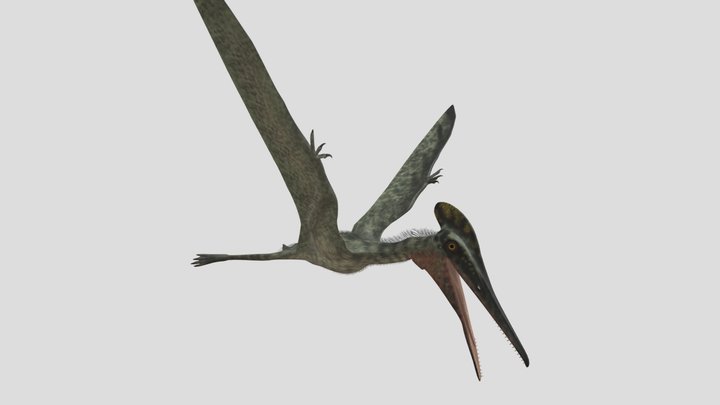
3D model
- Source
- Sketchfab
- Credit
- seth the yutyrannus
- Licence
- CC Attribution
- Commercial use
- cannot be read from the licence given — check the record
The description on this site
- Licence
- CC BY-SA 4.0
This is what the site found, which is not the same as what exists.
Keep going
What may have been alongside itMonofenestrata through timeFormations of the Late JurassicThe world it lived on
Occurrence data from the Paleobiology Database, CC BY 4.0. Cuvier 1809