Rhamphorhynchus
Rhamphorhynchus is a genus of long-tailed pterosaurs in the Jurassic period. Less specialized than contemporary, short-tailed pterodactyloid pterosaurs such as Pterodactylus, it had a long tail, stiffened with ligaments, which ended in a characteristic soft-tissue tail vane. The mouth of Rhamphorhynchus housed needle-like teeth, which were angled forward, with a curved, sharp, beak-like tip lacking teeth, indicating a diet mainly of fish; indeed, fish and cephalopod remains are frequently found in Rhamphorhynchus abdominal contents, as well as in their coprolites.

M0tty · CC BY-SA 3.0 · via Wikipedia/Commons. May be a photograph of a specimen, or an artist’s reconstruction — an interpretation of a skeleton, since colour and soft tissue are almost never preserved.
On record
Recorded, not inferred- Sits inside
- RhamphorhynchinaePBDB
- Diet
- piscivorePBDB
- Life habit
- volantPBDB
- Motility
- actively mobilePBDB, for Osteichthyes
- Environment
- marinePBDB, for Pterosauria
- Length
- 1.26 mWikidata
Time the record covers
At least 8.7 million years on record.
The record covers at least 157.9 Mya to 149.2 Mya. No occurrence read is dated outside 159 Mya to 143.1 Mya.
30 occurrences of Rhamphorhynchus on record, most of them in the Late Jurassic. Bar height is expected occurrences, not a count: each fossil is spread across the span it is dated to, so a tall narrow bar means tight dating and a low wide one means loose.
When
30 occurrences- Late Jurassic100%
These are dates about fossils, not the animal: the record can only begin after it arose and end before it died out, so either end may reach further. Shares are expected occurrences: a fossil dated to a span is counted partly in each period it straddles. More on what this infers.
Found in
13 formations
- Solnhofen Formation7
- Solnhofener Plattenkalk Formation7
- Painten Formation · Weißjura Group2
- Altmühltal Formation · Weißjura Group2
- Liegende Bankkalk Formation2
- Cabaços Formation1
Loading coastlines…
The named rock units Rhamphorhynchus has been recovered from, largest first. Drawn where the rock is now, not where it formed. 2 occurrences have no formation on record, which is common for older literature.
Rhamphorhynchus and its relatives
Late JurassicWhere Rhamphorhynchus and its relatives were recorded in the Late Jurassic.
Found in the same rock
334 taxa- Lepidotes4 sites
- Cymatophlebia longialata3 sites
- Gastropoda3 sites
- Goniopholis3 sites
- Isophlebia aspasia3 sites
- Solnhofia parsonsi3 sites
- Stenophlebia latreillei3 sites
- Aeschnogomphus intermedius2 sites
- Allosaurus2 sites
- Archipsyche eichstattensis2 sites
- Asteracanthus2 sites
- Bisulcocypris2 sites
- Bivalvia2 sites
- Brachyphyllum2 sites
- Chresmoda obscura2 sites
- Cricosaurus suevicus2 sites
- Cymatophlebia pumilio2 sites
- Dakosaurus maximus2 sites
- Darwinula2 sites
- Ditomoptera dubia2 sites
- Dromaeosauridae2 sites
- Elcana lithophila2 sites
- Engeseriteuthis arcuatus2 sites
- Eumorbaeschna jurassica2 sites
The Paleobiology Database records 20 sites for Rhamphorhynchus, and this reads all of them. The number is how many of those sites it was catalogued from too. The 24 sharing the most are listed.
This is not a list of everything alive at the time. It is only what has come out of the same ground as this animal and been written down.
Entered from
10 references- Die Rhamphorhynchoidea (Pterosauria) der Oberjura-Plattenkalke Süddeutschlands, Teil II, Systematische Beschreibung19
- Im Reich der Meerengel. Der Nusplinger Plattenkalk und seine Fossilien2
- Teeth of ornithischian dinosaurs from the Upper Jurassic of Portugal, with description of a hypsilophodontid (Phyllodon henkeli gen. et sp. nov.) from the Guimarota lignite2
- Evidence for the presence of Rhamphorhynchus (Pterosauria: Rhamphorhynchinae) in the Kimmeridge Clay of the UK1
- Vertebrate fauna at the Allosaurus fossil-site of Andres (Upper Jurassic), Pombal, Portugal1
- Forgotten pterosaurus in Hungarian collections: first description of Rhamphorhynchus and Pterodactylus specimens1
- First remains of the head of Steneosaurus (Crocodylomorpha: Teleosauridae) from the Late Jurassic of Oker (Lower Saxony, Germany)1
- Schamhaupten, an outstanding Fossil-Lagerstätte in a silicified Plattenkalk around the Kimmeridgian-Tithonian boundary (Southern Franconian Alb, Bavaria)1
- Solnhofen tetrapod taphonomy1
- Die deutschostafrikanischen Flugsaurier [The German East African pterosaurs]1
Each of the 30 occurrences read was entered from one of these publications, ordered by how many each accounts for. This is not a search for papers mentioning the name. Entries link to doi.org where the Paleobiology Database holds an identifier, and to its own record where it does not. Relayed as the Paleobiology Database holds them, not checked against what they resolve to.
Media and terms
Media content3

Picture of Rhamphorhynchus
- Source
- Wikipedia/Commons
- Credit
- M0tty
- Licence
- CC BY-SA 3.0
- Commercial use
- the licence allows it
CT scan
- Source
- MorphoSource
- Licence
- not stated by the source
- Commercial use
- cannot be read from the licence given — check the record
- Specimen
- Rhamphorhynchus muensteri · NHMD:VP:1891.738
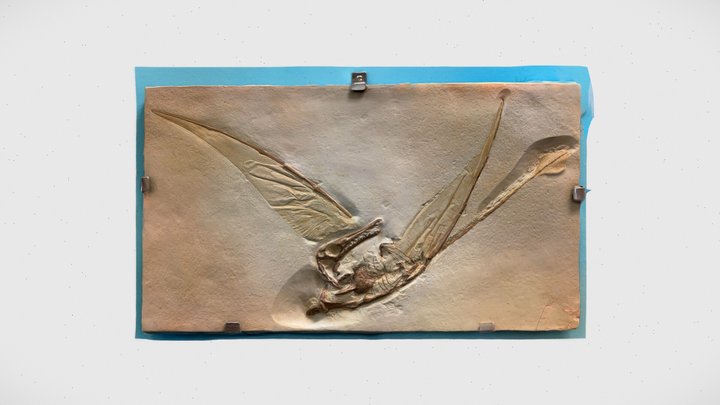
3D model
- Source
- Sketchfab
- Licence
- Free Standard
- Commercial use
- cannot be read from the licence given — check the record
The description on this site
- Licence
- CC BY-SA 4.0
This is what the site found, which is not the same as what exists.
Keep going
What may have been alongside itRhamphorhynchinae through timeFormations of the Late JurassicThe world it lived on
Occurrence data from the Paleobiology Database, CC BY 4.0. Meyer 1847