Restionaceae
The Restionaceae, also called restiads and restios, are a family of flowering plants native to the Southern Hemisphere; they vary from a few centimeters to 3 meters in height. Following the APG IV (2016): the family now includes the former families Anarthriaceae, Centrolepidaceae and Lyginiaceae, and as such includes 51 genera with 572 known species. Based on evidence from fossil pollen, the Restionaceae likely originated more than 65 million years ago during the Late Cretaceous period, when the southern continents were still part of Gondwana.

Andy king50 · CC BY-SA 3.0 · via Wikipedia/Commons. May be a photograph of a specimen, or an artist’s reconstruction — an interpretation of a skeleton, since colour and soft tissue are almost never preserved.
On record
Recorded, not inferred- Sits inside
- PoalesPBDB
- Diet
- "photoautotroph"PBDB, for Angiospermae
Time the record covers
At least 63 million years on record.
The record covers at least 66 Mya to 2.58 Mya. No occurrence read is dated outside 83.6 Mya to 11.7 ka.
95 occurrences of Restionaceae on record, most of them in the Eocene. The Paleobiology Database records this as a living group. Bar height is expected occurrences, not a count: each fossil is spread across the span it is dated to, so a tall narrow bar means tight dating and a low wide one means loose.
When
95 occurrences- Late Cretaceous1%
- Paleocene4%
- Eocene35%
- Oligocene8%
- Miocene26%
- Plioceneunder 1%
- Pleistocene26%
These are dates about fossils, not the animal: the record can only begin after it arose and end before it died out, so either end may reach further. Shares are expected occurrences: a fossil dated to a span is counted partly in each period it straddles. More on what this infers.
Found in
17 formations
- Chenque Formation5
- Malboro Clay Formation4
- Eifel Formation3
- Morwell Formation3
- Piney Point Formation3
- Hatchetigbee Formation3
Loading coastlines…
The named rock units Restionaceae has been recovered from, largest first. Drawn where the rock is now, not where it formed. 62 occurrences have no formation on record, which is common for older literature.
Restionaceae and its relatives
EoceneWhere Restionaceae and its relatives were recorded in the Eocene.
Found in the same rock
928 taxa- Milfordia47 sites
- Botryococcus38 sites
- Podocarpidites36 sites
- Cupressaceae33 sites
- Podocarpus33 sites
- Cunoniaceae29 sites
- Nothofagus29 sites
- Cyperaceae28 sites
- Gleichenia28 sites
- Monolites alveolatus28 sites
- Proteaceae28 sites
- Agathis27 sites
- Asteraceae27 sites
- Dacrydium27 sites
- Myrtaceae27 sites
- Symplocos27 sites
- Baculatisporites26 sites
- Poaceae26 sites
- Araucaria25 sites
- Chenopodiaceae25 sites
- Cyathea25 sites
- Eucalyptus25 sites
- Haloragis25 sites
- Laevigatosporites25 sites
The Paleobiology Database records 77 sites for Restionaceae, and this reads all of them. The number is how many of those sites it was catalogued from too. The 24 sharing the most are listed.
This is not a list of everything alive at the time. It is only what has come out of the same ground as this animal and been written down.
Entered from
27 references- Early Pleistocene vegetation change in upland south-eastern Australia22
- Vegetation dynamics in a disturbed lacustrine record: The Eocene maar lake of Groß-Zimmern (Hesse, Germany)17
- Paleogene Sporomorph Biostratigraphy, Northeastern Virginia9
- Middle Miocene palaeotopography at Little Bay, near Maroubra, New South Wales7
- Stratigraphic, Paleoclimatic, and Paleobiogeographic Significance of Tertiary Sporomorphs from Massachusetts5
- Palinomorph assemblage of the Chenque Formation, Late Oligocene?- Miocene from Golfo San Jorge Basin, Patagonia, Argentina, Part 4: polycolporate and porate pollen4
- The Oligo-Miocene coal floras of southeastern Australia4
- The Middle Eocene plant taphocoenosis from Eckfeld (Eifel, Germany)3
- Sporomorph Correlation and Paleoecology, Piney Point and Old Church Formations, Pamunkey River, Virginia3
- Polar forests on the edge of extinction: what does the fossil spore and pollen evidence from East Antarctica say?.2
- Palinomorfos continentales y marinos de la Formación Monte León en su área tipo, provincia de Santa Cruz, Argentina2
- A Late Oligocene‒ Early Miocene cool climate flora in Tasmania2
Each of the 95 occurrences read was entered from one of these publications, ordered by how many each accounts for. This is not a search for papers mentioning the name. 15 further references are not listed. Entries link to doi.org where the Paleobiology Database holds an identifier, and to its own record where it does not. Relayed as the Paleobiology Database holds them, not checked against what they resolve to.
Media and terms
Media content1
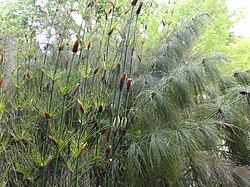
Picture of Restionaceae
- Source
- Wikipedia/Commons
- Credit
- Andy king50
- Licence
- CC BY-SA 3.0
- Commercial use
- the licence allows it
No 3D scan of Restionaceae was found in MorphoSource and Sketchfab.
Smithsonian Open Access was not reached for this taxon, so this list is what the others held rather than everything there is.
The description on this site
- Licence
- CC BY-SA 4.0
This is what the site found, which is not the same as what exists.
Keep going
What may have been alongside itPoales through timeFormations of the EoceneThe world it lived on
Occurrence data from the Paleobiology Database, CC BY 4.0. Brown 1810