Rhabdodontidae
Rhabdodontidae is a family of herbivorous iguanodontian ornithopod dinosaurs whose earliest stem members appeared in the middle of the Lower Cretaceous. The oldest dated fossils of these stem members were found in the Barremian Castrillo de la Reina Formation of Spain, dating to approximately 129.4 to 125.0 million years ago. With their deep skulls and jaws, Rhabdodontids were similar to large, robust iguanodonts. The family was first proposed by David B. Weishampel and colleagues in 2003. Rhabdodontid fossils have been mainly found in Europe in formations dating to the Late Cretaceous.

Tomopteryx · CC BY-SA 3.0 · via Wikipedia/Commons. May be a photograph of a specimen, or an artist’s reconstruction — an interpretation of a skeleton, since colour and soft tissue are almost never preserved.
On record
Recorded, not inferred- Also called
- rhabdodontidPBDB
- Sits inside
- RhabdodontoideaPBDB
- Diet
- herbivorePBDB, for Ornithopoda
- Life habit
- ground dwelling, gregariousPBDB, for Ornithischia
- Motility
- actively mobilePBDB, for Ornithischia
- Environment
- terrestrialPBDB, for Ornithischia
Time the record covers
At least 49 million years on record.
The record covers at least 121.4 Mya to 72.2 Mya. No occurrence read is dated outside 125.77 Mya to 66 Mya.
46 occurrences of Rhabdodontidae on record, most of them in the Late Cretaceous. Bar height is expected occurrences, not a count: each fossil is spread across the span it is dated to, so a tall narrow bar means tight dating and a low wide one means loose.
When
46 occurrencesThese are dates about fossils, not the animal: the record can only begin after it arose and end before it died out, so either end may reach further. Shares are expected occurrences: a fossil dated to a span is counted partly in each period it straddles. More on what this infers.
Found in
20 formations
- Marnes Rouges Inférieures Formation4
- Grès à Reptiles Formation4
- Vitoria Formation2
- Grünbach Formation · Gosau Group2
- Grès de Labarre Formation2
- Figuerola Formation · Fontllonga Group2
Loading coastlines…
The named rock units Rhabdodontidae has been recovered from, largest first. Drawn where the rock is now, not where it formed. 15 occurrences have no formation on record, which is common for older literature.
Rhabdodontidae and its relatives
Late CretaceousWhere Rhabdodontidae and its relatives were recorded in the Late Cretaceous.
Found in the same rock
305 taxa- Rhabdodon19 sites
- Rhabdodon priscus16 sites
- Dromaeosauridae15 sites
- Theropoda10 sites
- Titanosauria10 sites
- Dinosauria9 sites
- Nodosauridae9 sites
- Lepisosteidae8 sites
- Titanosauridae7 sites
- Abelisauridae6 sites
- Albanerpetontidae6 sites
- Crocodyliformes6 sites
- Dortokidae6 sites
- Neosuchia6 sites
- Solemys6 sites
- Velociraptorinae6 sites
- Ankylosauria5 sites
- Anura5 sites
- Azhdarchidae5 sites
- Eusuchia5 sites
- Foxemys mechinorum5 sites
- Lirainosaurus astibiae5 sites
- Paraves5 sites
- Testudines5 sites
The Paleobiology Database records 44 sites for Rhabdodontidae, and this reads all of them. The number is how many of those sites it was catalogued from too. The 24 sharing the most are listed.
This is not a list of everything alive at the time. It is only what has come out of the same ground as this animal and been written down.
Entered from
38 references- Rhabdodon (Dinosaur: Ornithopoda) from the Late Cretaceous of Aix-en-Provence Basin: 3D-modeling of Rhabdodon skeleton3
- Rhabdodontid (Dinosauria, Ornithopoda) diversity suggested by the first documented occurrence of associated cranial and postcranial material at Vălioara (uppermost Cretaceous Densuș-Ciula Formation, Hațeg Basin, Romania)2
- Late Cretaceous vertebrates from the Saint-Chinian area (southern France): a review of previous research and an update on recent finds2
- Taphonomy of the Late Cretaceous dinosaur-bearing beds of the Lano Quarry (Iberian Peninsula)2
- Nouveaux restes de Dinosauriens dans le Crétacé terminal de l'anticlinal de Dreuilhe. État des connaissances dans le domaine sous-pyrénéen [New dinosaur remains in the terminal Cretaceous of the Dreuilhe Anticline. State of knowledge in the sub-Pyrennean domain]2
- Les dinosauriens du Crétacé Supérieur du Midi de la France [The dinosaurs of the Upper Cretaceous of the south of France]2
- The reptile fauna of the Gosau Formation preserved in the Geological Museum of the University of Vienna2
- A new titanosaur genus (Dinosauria, Sauropoda) from the Late Cretaceous of southern France and its paleobiogeographic implications1
- New and exceptional discovery in the Upper Cretaceous of the Iberian Peninsula: the palaeontological site of ‘‘Lo Hueco’’, Cuenca, Spain1
- New data on the Dromaeosauridae (Dinosauria: Theropoda) from the Late Cretaceous of southern France1
- Notes on Neocomian (Lower Cretaceous) ornithopod dinosaurs from England - Hypsilophodon, Valdosaurus, "Camptosaurus", "Iguanodon" - and referred specimens from Romania and elsewhere1
- Description ostéologique de l'arrière-crâne de Rhabdodon (Dinosauria, Euornithopoda) et implications phylogénetiques [Osteological description of the braincase of Rhabdodon (Dinosauria, Euornithopoda) and phylogenetic implications]1
Each of the 46 occurrences read was entered from one of these publications, ordered by how many each accounts for. This is not a search for papers mentioning the name. 26 further references are not listed. Entries link to doi.org where the Paleobiology Database holds an identifier, and to its own record where it does not. Relayed as the Paleobiology Database holds them, not checked against what they resolve to.
Media and terms
Media content1
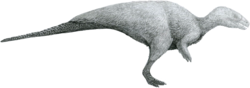
Picture of Rhabdodontidae
- Source
- Wikipedia/Commons
- Credit
- Tomopteryx
- Licence
- CC BY-SA 3.0
- Commercial use
- the licence allows it
No 3D scan of Rhabdodontidae was found in Sketchfab.
Smithsonian Open Access and MorphoSource were not reached for this taxon, so this list is what the others held rather than everything there is.
The description on this site
- Licence
- CC BY-SA 4.0
This is what the site found, which is not the same as what exists.
Keep going
What may have been alongside itRhabdodontoidea through timeFormations of the Late CretaceousThe world it lived on
Occurrence data from the Paleobiology Database, CC BY 4.0. Weishampel et al. 2003