Rhizocorallium
Rhizocorallium is an ichnogenus of burrow, the inclination of which is typically within 10° of the bedding planes of the sediment. These burrows can be very large, over a meter long in sediments that show good preservation, e.g. Jurassic rocks of the Yorkshire Coast, but the width is usually only up to 2 cm, restricted by the size of the organisms producing it. It is thought that they represent fodinichnia as the animal scoured the sediment for food.

Rygel, M.C. · CC BY-SA 3.0 · via Wikipedia/Commons. May be a photograph of a specimen, or an artist’s reconstruction — an interpretation of a skeleton, since colour and soft tissue are almost never preserved.
On record
Recorded, not inferred- Sits inside
- IchnofossilsPBDB
Time the record covers
At least 504 million years on record.
The record covers at least 538.8 Mya to 33.9 Mya. No occurrence read is dated outside 635 Mya to 23.04 Mya.
54 occurrences of Rhizocorallium on record, most of them in the Early Cretaceous. Bar height is expected occurrences, not a count: each fossil is spread across the span it is dated to, so a tall narrow bar means tight dating and a low wide one means loose.
When
54 occurrences- Cambrian11%
- Devonian4%
- Early Triassic9%
- Middle Triassic19%
- Late Triassic2%
- Early Jurassic6%
- Middle Jurassic7%
- Late Jurassic6%
- Early Cretaceous22%
- Late Cretaceous7%
- Paleocene2%
- Eocene2%
- Oligocene2%
These are dates about fossils, not the animal: the record can only begin after it arose and end before it died out, so either end may reach further. Shares are expected occurrences: a fossil dated to a span is counted partly in each period it straddles. More on what this infers.
Found in
25 formations
- Grès à Voltzia Formation · Buntsandstein Group7
- Kiowa Formation4
- Werfen Formation4
- Shemshak Formation3
- Laeso Formation3
- Wapiti Formation3
Loading coastlines…
The named rock units Rhizocorallium has been recovered from, largest first. Drawn where the rock is now, not where it formed. One further formation holds fewer occurrences and is not listed. 9 occurrences have no formation on record, which is common for older literature.
Rhizocorallium and its relatives
Early CretaceousWhere Rhizocorallium and its relatives were recorded in the Early Cretaceous.
Found in the same rock
408 taxa- Myophoria vulgaris8 sites
- Chondrites7 sites
- Modiolus7 sites
- Lingularia tenuissima6 sites
- Neoschizodus laevigatus6 sites
- Gastropoda5 sites
- Gervillia5 sites
- Ladinaticella costata5 sites
- Pseudomonotis5 sites
- Tirolites cassianus5 sites
- Werfenella rectecostata5 sites
- Bakevellia exporrecta4 sites
- Camptonectes4 sites
- Clytiopsis argentoratense4 sites
- Dinarites dalmatinus4 sites
- Diplocraterion4 sites
- Echinodermata4 sites
- Planolites4 sites
- Pleuromya4 sites
- Undularia scalata4 sites
- Arctica3 sites
- Arctichnus arcticus3 sites
- Astarte3 sites
- Bivalvia3 sites
The Paleobiology Database records 46 sites for Rhizocorallium, and this reads all of them. The number is how many of those sites it was catalogued from too. The 24 sharing the most are listed.
This is not a list of everything alive at the time. It is only what has come out of the same ground as this animal and been written down.
Entered from
31 references- Faunes et paysages du Grès à Voltzia du Nord des Vosges: Essai paléoécologique sur le Buntsandstein supérieur7
- Die Cephalopoden der oberen Werfener Schichten von Muć in Dalmatien sowie von anderen dalmatinischen, bosnisch-herzegowinischen und alpinen Lokalitäten5
- Paleoecology and Paleontology of the Lower Cretaceous Kiowa Formation, Kansas4
- The dinosaur tracks of Tyrants Aisle: an Upper Cretaceous ichnofauna from Unit 4 of the Wapiti Formation (upper Campanian), Alberta, Canada3
- The upper Shemshak Formation (Toarcian–Aalenian) of the Eastern Alborz (Iran): Biota and palaeoenvironments during a transgressive–regressive cycle3
- Substrate control of lower cambrian trace fossils from bornholm, Denmark3
- The Jurassic-Cretaceous Boundary and the Berriasian Stage in the Boreal Realm3
- Paleoenvironmental framework of dinosaur tracksites and other ichnofossils in Early Cretaceous mixed siliciclastic-carbonate deposits in the Neuquén Basin, northern Patagonia (Argentina)2
- Paleoecological interpretation of the echinocarid arthropod assemblages in the Late Devonian (Famennian) Chagrin Shale, Northeastern Ohio2
- Fossil associations from the middle and upper Eocene strata of the Pamplona Basin and surrounding areas (Navarre, western Pyrenees)1
- The Tommotian phase of the Early Cambrian Agronomic Revolution in the carbonate mud environment of central Siberia1
- Im Reich der Meerengel. Der Nusplinger Plattenkalk und seine Fossilien1
Each of the 54 occurrences read was entered from one of these publications, ordered by how many each accounts for. This is not a search for papers mentioning the name. 19 further references are not listed. Entries link to doi.org where the Paleobiology Database holds an identifier, and to its own record where it does not. Relayed as the Paleobiology Database holds them, not checked against what they resolve to.
Media and terms
Media content2

Picture of Rhizocorallium
- Source
- Wikipedia/Commons
- Credit
- Rygel, M.C.
- Licence
- CC BY-SA 3.0
- Commercial use
- the licence allows it
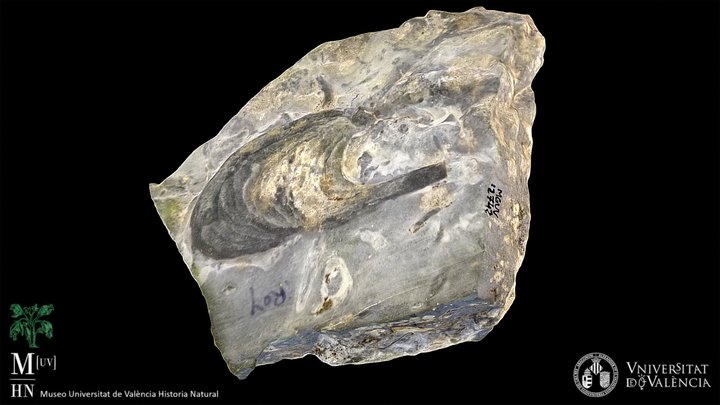
3D model
- Source
- Sketchfab
- Licence
- CC Attribution
- Commercial use
- cannot be read from the licence given — check the record
Smithsonian Open Access and MorphoSource were not reached for this taxon, so this list is what the others held rather than everything there is.
The description on this site
- Licence
- CC BY-SA 4.0
This is what the site found, which is not the same as what exists.
Keep going
What may have been alongside itIchnofossils through timeFormations of the Early CretaceousThe world it lived on
Occurrence data from the Paleobiology Database, CC BY 4.0. Zenker 1836