Rhizomyinae
The rodent subfamily Rhizomyinae includes the Asian bamboo rats and certain of the African mole-rats. The subfamily is grouped with the Spalacinae and the Myospalacinae into a family of fossorial muroid rodents basal to the other Muroidea.

Roadnottaken · CC BY-SA 3.0 · via Wikipedia/Commons. May be a photograph of a specimen, or an artist’s reconstruction — an interpretation of a skeleton, since colour and soft tissue are almost never preserved.
On record
Recorded, not inferred- Sits inside
- SpalacidaePBDB
- Diet
- herbivorePBDB, for Rodentia
- Life habit
- ground dwellingPBDB, for Rodentia
- Motility
- actively mobilePBDB, for Osteichthyes
- Environment
- terrestrialPBDB, for Eutheria
Time the record covers
At least 20 million years on record.
The record covers at least 20.45 Mya to 11.7 ka. No occurrence read is dated outside 27.3 Mya to 0 Mya.
94 occurrences of Rhizomyinae on record, most of them in the Miocene. The Paleobiology Database records this as a living group. Bar height is expected occurrences, not a count: each fossil is spread across the span it is dated to, so a tall narrow bar means tight dating and a low wide one means loose.
When
94 occurrences- Oligocene1%
- Miocene64%
- Pliocene9%
- Pleistocene19%
- Holocene7%
These are dates about fossils, not the animal: the record can only begin after it arose and end before it died out, so either end may reach further. Shares are expected occurrences: a fossil dated to a span is counted partly in each period it straddles. More on what this infers.
Found in
10 formations
- Lower Manchar Formation20
- Vihowa Formation9
- Chitarwata Formation8
- Hadar Formation · Awash Group5
- Maradah Formation3
- Xiacaowan Formation2
Loading coastlines…
The named rock units Rhizomyinae has been recovered from, largest first. Drawn where the rock is now, not where it formed. 43 occurrences have no formation on record, which is common for older literature.
Rhizomyinae and its relatives
MioceneWhere Rhizomyinae and its relatives were recorded in the Miocene.
Found in the same rock
732 taxa- Prokanisamys22 sites
- Sayimys19 sites
- Copemys18 sites
- Hystrix17 sites
- Sciuridae16 sites
- Myocricetodon13 sites
- Rhinoceros sinensis13 sites
- Rhizomys12 sites
- Macaca11 sites
- Muntiacus11 sites
- Brachyrhizomys10 sites
- Sus10 sites
- Felis9 sites
- Mammalia9 sites
- Mus9 sites
- Sus scrofa9 sites
- Cervus8 sites
- Diatomys8 sites
- Kanisamys8 sites
- Mellalomys8 sites
- Metacervulus8 sites
- Moschus8 sites
- Neocricetodon8 sites
- Primus cheemai8 sites
The Paleobiology Database records 70 sites for Rhizomyinae, and this reads all of them. The number is how many of those sites it was catalogued from too. The 24 sharing the most are listed.
This is not a list of everything alive at the time. It is only what has come out of the same ground as this animal and been written down.
Entered from
37 references- Miocene rodent evolution and migration. Muroidea from Pakistan, Turkey and Northern Africa20
- A preliminary report on a micromammalian assemblage from the hominoid locality of Lufeng, Yunnan12
- Will Downs and the Zinda Pir Dome9
- Late Oligocene and Early Miocene Muroidea of the Zinda Pir Dome8
- Faunal Evidence for Early Stockkeeping in the Central Rift Valley of Kenya: Preliminary Findings4
- Paleontological excavations in the Shungura Formation, Lower Omo Basin, 1969-19734
- Miocene small mammals from Jebel Zelten, Libya3
- Huanglong Cave: A Late Pleistocene human fossil site in Hubei Province, China2
- The Aragonian vertebrate fauna of Xiacaowan, Jiangsu2
- Mammalian fossils found in northwest part of Hunan province and their significance2
- Early Pottery and Pastoral Cultures of the Central Rift Valley, Kenya2
- Chad: discovery of a vertebrate fauna close to the Mio-Pliocene boundary1
Each of the 94 occurrences read was entered from one of these publications, ordered by how many each accounts for. This is not a search for papers mentioning the name. 25 further references are not listed. Entries link to doi.org where the Paleobiology Database holds an identifier, and to its own record where it does not. Relayed as the Paleobiology Database holds them, not checked against what they resolve to.
Media and terms
Media content1
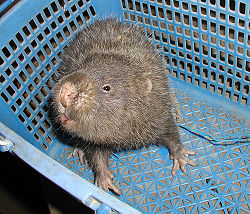
Picture of Rhizomyinae
- Source
- Wikipedia/Commons
- Credit
- Roadnottaken
- Licence
- CC BY-SA 3.0
- Commercial use
- the licence allows it
No 3D scan of Rhizomyinae was found in MorphoSource and Sketchfab.
Smithsonian Open Access was not reached for this taxon, so this list is what the others held rather than everything there is.
The description on this site
- Source
- Wikipedia, “Rhizomyinae”
- Licence
- CC BY-SA 4.0
This is what the site found, which is not the same as what exists.
Keep going
What may have been alongside itSpalacidae through timeFormations of the MioceneThe world it lived on
Occurrence data from the Paleobiology Database, CC BY 4.0. (Miller and Gidley 1918)