Muntiacus
Muntjacs, also known as the barking deer or rib-faced deer, are small deer of the genus Muntiacus native to South Asia and Southeast Asia. Muntjacs are thought to have begun appearing 15–35 million years ago, with remains found in Miocene deposits in France, Germany and Poland. Most are listed as least-concern species or Data Deficient by the International Union for Conservation of Nature (IUCN), although others such as the black muntjac, Bornean yellow muntjac, and giant muntjac are vulnerable, near threatened, and critically endangered, respectively.

Dr. Raju Kasambe · CC BY-SA 4.0 · via Wikipedia/Commons. May be a photograph of a specimen, or an artist’s reconstruction — an interpretation of a skeleton, since colour and soft tissue are almost never preserved.
On record
Recorded, not inferred- Also called
- muntjakPBDB
- Sits inside
- MuntiaciniPBDB
- Diet
- grazer, browserPBDB, for Cervidae
- Life habit
- ground dwellingPBDB, for Cervidae
- Motility
- actively mobilePBDB, for Osteichthyes
- Environment
- terrestrialPBDB, for Artiodactyla
Time the record covers
At least 7.2 million years on record.
The record covers at least 7.246 Mya to 11.7 ka. No occurrence read is dated outside 11.63 Mya to 0 Mya.
61 occurrences of Muntiacus on record, most of them in the Pleistocene. The Paleobiology Database records this as a living group. Bar height is expected occurrences, not a count: each fossil is spread across the span it is dated to, so a tall narrow bar means tight dating and a low wide one means loose.
When
61 occurrences- Miocene24%
- Pliocene10%
- Pleistocene61%
- Holocene5%
These are dates about fossils, not the animal: the record can only begin after it arose and end before it died out, so either end may reach further. Shares are expected occurrences: a fossil dated to a span is counted partly in each period it straddles. More on what this infers.
Found in
4 formations
Loading coastlines…
The named rock units Muntiacus has been recovered from, largest first. Drawn where the rock is now, not where it formed. 56 occurrences have no formation on record, which is common for older literature.
Muntiacus and its relatives
PleistoceneWhere Muntiacus and its relatives were recorded in the Pleistocene.
Found in the same rock
600 taxa- Hystrix23 sites
- Sus20 sites
- Sus scrofa18 sites
- Cervus16 sites
- Felis15 sites
- Macaca15 sites
- Cervus unicolor14 sites
- Panthera tigris14 sites
- Rhinoceros sinensis14 sites
- Ursus thibetanus14 sites
- Arctonyx collaris10 sites
- Bubalus10 sites
- Neocricetodon10 sites
- Panthera pardus10 sites
- Tapirus (Megatapirus) augustus10 sites
- Cuon9 sites
- Ictitherium9 sites
- Mus9 sites
- Pongo9 sites
- Sciurotamias9 sites
- Stegodon insignis9 sites
- Alilepus8 sites
- Bos (Bibos)8 sites
- Brachyrhizomys8 sites
The Paleobiology Database records 54 sites for Muntiacus, and this reads all of them. The number is how many of those sites it was catalogued from too. The 24 sharing the most are listed.
This is not a list of everything alive at the time. It is only what has come out of the same ground as this animal and been written down.
Entered from
40 references- The Artiodactyla of Ramapithecus site, Lufeng, Yunnan9
- The Late Neogene elephantoid-bearing faunas of Indonesia and their palaeozoogeographic implications. A study of the terrestrial faunal succession of Sulawesi, Flores and Java, including evidence for early hominid dispersal east of Wallace's Line4
- Large mammal fossil occurrences and associated archaeological evidence in Pleistocene contexts of peninsular India and Sri Lanka3
- Geochronology of Ailuropoda–Stegodon fauna and Gigantopithecus in Guangxi Province, southern China3
- Early Pliocene Bear Ursus thibetanus (Mammalia, Carnivora) from Priozernoe Locality in the Dniester Basin (Moldova Republic)2
- Summary of Vertebrate and Molluscan Assemblages Excavated from Late-Pleistocene and Holocene Deposits at Khao Toh Chong Rockshelter, Krabi, Thailand2
- First discovery of Pleistocene orangutan (Pongo sp.) fossils in Peninsular Malaysia: Biogeographic and paleoenvironmental implications2
- Huanglong Cave: A Late Pleistocene human fossil site in Hubei Province, China2
- Fossil Cervidae from the Tou-kou-shan Group in Taiwan2
- Identification of the Yuanmou fossil-man strata; study of the Yuanmou Formation2
- New early Pleistocene mammalian materials from Zhongdian, Yunnan Province, China1
- Biochronology and evolution of the Early Pliocene to the Early Pleistocene mammalian faunas of Romania1
Each of the 61 occurrences read was entered from one of these publications, ordered by how many each accounts for. This is not a search for papers mentioning the name. 28 further references are not listed. Entries link to doi.org where the Paleobiology Database holds an identifier, and to its own record where it does not. Relayed as the Paleobiology Database holds them, not checked against what they resolve to.
Media and terms
Media content3

Picture of Muntiacus
- Source
- Wikipedia/Commons
- Credit
- Dr. Raju Kasambe
- Licence
- CC BY-SA 4.0
- Commercial use
- the licence allows it
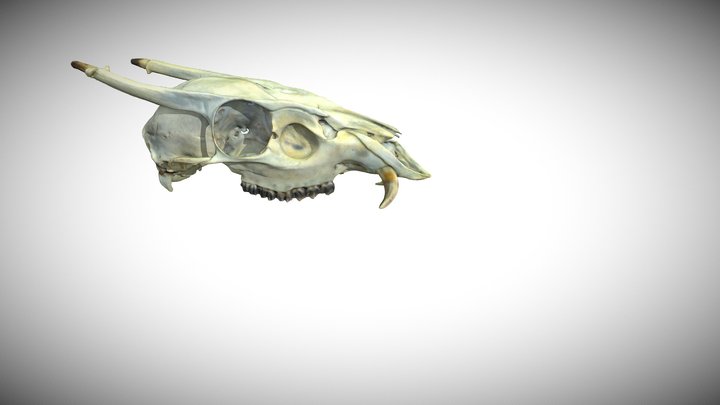
Structured light scan
- Source
- MorphoSource
- Licence
- In Copyright
- Commercial use
- cannot be read from the licence given — check the record
- Specimen
- Muntiacus sp. · nmv:mammalogy:C36742
The description on this site
- Source
- Wikipedia, “Muntjac”
- Licence
- CC BY-SA 4.0
This is what the site found, which is not the same as what exists.
Keep going
What may have been alongside itMuntiacini through timeFormations of the PleistoceneThe world it lived on
Occurrence data from the Paleobiology Database, CC BY 4.0. Rafinesque 1815