Rhombifera
Cystoidea was defined as a class of extinct paleozoic blastozoan echinoderms established to encompass stalked taxa that were neither crinoids nor blastoids. It was shown to be polyphyletic in the late 1960s but continues to be used even in recent literature to discuss both rhombiferans and diploporitans.

Ernst Haeckel · Public Domain · via Wikipedia/Commons. May be a photograph of a specimen, or an artist’s reconstruction — an interpretation of a skeleton, since colour and soft tissue are almost never preserved.
On record
Recorded, not inferred- Sits inside
- BlastozoaPBDB
- Diet
- suspension feederPBDB
- Life habit
- intermediate-level epifaunalPBDB
- Motility
- stationary, attachedPBDB
- Vision
- blindPBDB
- Environment
- marinePBDB, for Echinodermata
Time the record covers
At least 117 million years on record.
The record covers at least 499.5 Mya to 382.31 Mya. No occurrence read is dated outside 506.5 Mya to 358.86 Mya.
796 occurrences of Rhombifera on record, most of them in the Ordovician. The Paleobiology Database records this as a living group, and the chart stops with its fossils rather than at the present. Bar height is expected occurrences, not a count: each fossil is spread across the span it is dated to, so a tall narrow bar means tight dating and a low wide one means loose.
When
796 occurrences- Cambrianunder 1%
- Ordovician80%
- Silurian16%
- Devonian3%
These are dates about fossils, not the animal: the record can only begin after it arose and end before it died out, so either end may reach further. Shares are expected occurrences: a fossil dated to a span is counted partly in each period it straddles. More on what this infers.
Found in
237 formations
- Bromide Formation · Simpson Group41
- Dalby Limestone Formation36
- Denley Limestone Formation29
- Benbolt Formation22
- Dunleith Formation · Galena Group20
- Verulam Formation · Simcoe Group20
Loading coastlines…
The named rock units Rhombifera has been recovered from, largest first. Drawn where the rock is now, not where it formed. 213 further formations hold fewer occurrences each and are not listed. 49 occurrences have no formation on record, which is common for older literature.
Rhombifera and its relatives
OrdovicianWhere Rhombifera and its relatives were recorded in the Ordovician.
Found in the same rock
2,601 taxa- Eucalyptocrinites53 sites
- Bryozoa46 sites
- Carabocrinus44 sites
- Caryocrinites40 sites
- Favosites36 sites
- Platystrophia33 sites
- Dimerocrinites31 sites
- Rugosa30 sites
- Gastropoda29 sites
- Bumastus28 sites
- Cheirocrinus28 sites
- Dendrocrinus28 sites
- Girvanella28 sites
- Lecanocrinus28 sites
- Macrostylocrinus28 sites
- Atrypa27 sites
- Crinoidea26 sites
- Echinosphaerites26 sites
- Plectatrypa26 sites
- Nautiloidea25 sites
- Atrypa reticularis24 sites
- Eospirifer radiatus24 sites
- Fardenia (Coolinia)23 sites
- Graptodictya23 sites
The Paleobiology Database records 549 sites for Rhombifera, and this reads 240 of them. The number is how many of those sites it was catalogued from too. The 24 sharing the most are listed.
This is not a list of everything alive at the time. It is only what has come out of the same ground as this animal and been written down.
Entered from
193 references- Caradocian-Gedinnian echinoderm associations of Central and Eastern North America86
- Non-Crinoid Pelmatozoa from the Paleozoic of Sweden72
- Upper Mississippi Valley Champlainian and Cincinnatian echinoderms43
- Stratigraphy of the Lower Middle Ordovician of Tazewell County, Virginia28
- R. Titus unpublished collections26
- Echinodermata of the Ottawa Formation of the Ottawa-St. Lawrence lowland21
- Previous studies of Bromide echinoderms19
- The geology of the Baltic Republics15
- The biostratigraphy of the Ordovician of Bohemia15
- Taxonomy, Functional Morphology and Palaeoecology of the Ordovician Cystoid Family Hemicosmitidae13
- Sur quelques echinodermes (Cystoides et crinoides) de l' Ashgil d'Aragon (Espagne)13
- Swedish Late Ordovician marine benthic assemblages and their bearing on brachiopod biogeography13
Each of the 796 occurrences read was entered from one of these publications, ordered by how many each accounts for. This is not a search for papers mentioning the name. 181 further references are not listed. Entries link to doi.org where the Paleobiology Database holds an identifier, and to its own record where it does not. Relayed as the Paleobiology Database holds them, not checked against what they resolve to.
Media and terms
Media content1
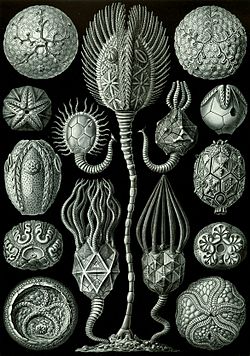
Picture of Rhombifera
- Source
- Wikipedia/Commons
- Credit
- Ernst Haeckel
- Licence
- Public Domain
- Commercial use
- the licence allows it
No 3D scan of Rhombifera was found in MorphoSource and Sketchfab.
Smithsonian Open Access was not reached for this taxon, so this list is what the others held rather than everything there is.
The description on this site
- Source
- Wikipedia, “Cystoidea”
- Licence
- CC BY-SA 4.0
This is what the site found, which is not the same as what exists.
Keep going
What may have been alongside itBlastozoa through timeFormations of the OrdovicianThe world it lived on
Occurrence data from the Paleobiology Database, CC BY 4.0. Zittel 1879