Sardinella
Sardinella is a genus of fish in the family Dorosomatidae found in the Atlantic, Indian and Pacific Oceans. They are abundant in warmer waters of the tropical and subtropical oceans. Adults are generally coastal, schooling, marine fish but juveniles are often found in lagoons and estuaries. These species are distinguished by their ranges and by specific body features, but they are often confused with one another. Fish of the genus have seven to 14 striped markings along the scales of the top of the head. The paddle-shaped supramaxilla bones are characteristic; they separate Sardinella from other genera and their shapes help distinguish species. They have paired predorsal scales and enlarged fin rays.

BEDO (Thailand) · CC BY-SA 4.0 · via Wikipedia/Commons. May be a photograph of a specimen, or an artist’s reconstruction — an interpretation of a skeleton, since colour and soft tissue are almost never preserved.
On record
Recorded, not inferred- Sits inside
- ClupeinaePBDB
- Diet
- carnivorePBDB, for Clupeiformes
- Life habit
- nektonicPBDB, for Clupeiformes
- Motility
- actively mobilePBDB, for Clupeiformes
Time the record covers
At least 24 million years on record.
The record covers at least 27.3 Mya to 2.58 Mya. No occurrence read is dated outside 33.9 Mya to 11.7 ka.
19 occurrences of Sardinella on record, most of them in the Miocene. The Paleobiology Database records this as a living group. Bar height is expected occurrences, not a count: each fossil is spread across the span it is dated to, so a tall narrow bar means tight dating and a low wide one means loose.
When
19 occurrences- Oligocene39%
- Miocene45%
- Pliocene5%
- Pleistocene11%
These are dates about fossils, not the animal: the record can only begin after it arose and end before it died out, so either end may reach further. Shares are expected occurrences: a fossil dated to a span is counted partly in each period it straddles. More on what this infers.
Found in
8 formations
- Menilite Formation2
- Tamiami Formation1
- Tonasa Formation1
- Iwami Formation · Tottori Group1
- Pshekha Horizon Formation1
- Lindos Bay Formation1
Loading coastlines…
The named rock units Sardinella has been recovered from, largest first. Drawn where the rock is now, not where it formed. 10 occurrences have no formation on record, which is common for older literature.
Sardinella and its relatives
MioceneWhere Sardinella and its relatives were recorded in the Miocene.
Found in the same rock
540 taxa- Carya3 sites
- Operculodinium3 sites
- Percoidei3 sites
- Pinus3 sites
- Spiniferites3 sites
- Systematophora3 sites
- Abadzekhia tarletskovi2 sites
- Anenchelum angustum2 sites
- Anenchelum glarisianum2 sites
- Apteodinium2 sites
- Batiacasphaera2 sites
- Carangidae2 sites
- Carcharias acutissimus2 sites
- Carcharias cuspidatus2 sites
- Cedrus2 sites
- Clupeidae2 sites
- Cymatiosphaera2 sites
- Deflandrea2 sites
- Distatodinium2 sites
- Engelhardia2 sites
- Ephedra2 sites
- Gadidae2 sites
- Glossanodon musceli2 sites
- Impagidinium2 sites
The Paleobiology Database records 17 sites for Sardinella, and this reads all of them. The number is how many of those sites it was catalogued from too. The 24 sharing the most are listed.
This is not a list of everything alive at the time. It is only what has come out of the same ground as this animal and been written down.
Entered from
13 references- Stratigraphy of the Maikop Group and Pteropoda Beds in Northern Azerbaijan4
- An annotated list of the Oligocene fish fauna from the Osíčko locality (Menilitic Fm.; Moravia, the Czech Republic)2
- Late Mesozoic and Cenozoic fish faunas of Japan2
- Fauna Fosila din Oligocenul de la Piatra Neamt2
- Reconstruction of the fossil marine bony fish fauna (Teleostei) from the Eocene to Pleistocene of New Zealand by means of otoliths. With studies of Recent congroid, morid and trachinoid otoliths1
- Pleistocene marine fish invasions and paleoenvironmental reconstructions in the eastern Mediterranean1
- The Rauenberg fossil Lagerstätte (Baden-Württemberg, Germany): A window into early Oligocene marine and coastal ecosystems of Central Europe1
- Volhynian (early Sarmatian sensu lato) fishes from Tsurevsky, North Caucasus, Russia1
- Sardinella miyanoshitaensis, a new clupeid fish from the middle Miocene Tottori Group, Tottori Prefecture, Japan1
- The list of marine fishes from Cenozoic (Upper Paleocene-Middle Miocene) localities in Southern European Russia and adjacent countries1
- Integrated taphonomy of an avian death assemblage in marine sediments from the late Pliocene of Florida1
- Les otolithes des téléostéens de l'oligo-miocène Belge1
Each of the 19 occurrences read was entered from one of these publications, ordered by how many each accounts for. This is not a search for papers mentioning the name. 1 further reference is not listed. Entries link to doi.org where the Paleobiology Database holds an identifier, and to its own record where it does not. Relayed as the Paleobiology Database holds them, not checked against what they resolve to.
Media and terms
Media content2

Picture of Sardinella
- Source
- Wikipedia/Commons
- Credit
- BEDO (Thailand)
- Licence
- CC BY-SA 4.0
- Commercial use
- the licence allows it
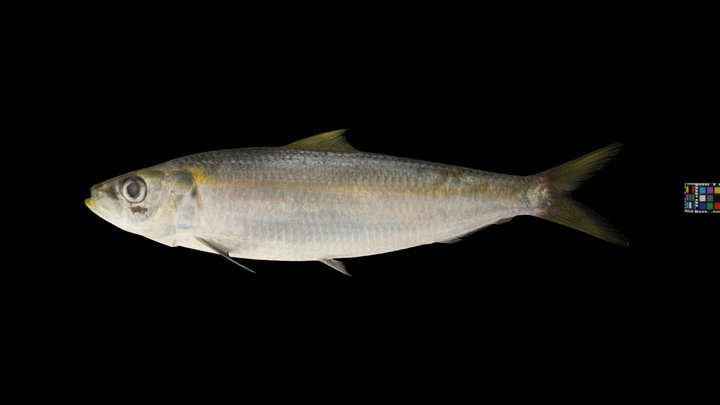
3D model
- Source
- Sketchfab
- Licence
- CC0 Public Domain
- Commercial use
- the licence allows it
Smithsonian Open Access and MorphoSource were not reached for this taxon, so this list is what the others held rather than everything there is.
The description on this site
- Source
- Wikipedia, “Sardinella”
- Licence
- CC BY-SA 4.0
This is what the site found, which is not the same as what exists.
Keep going
What may have been alongside itClupeinae through timeFormations of the MioceneThe world it lived on
Occurrence data from the Paleobiology Database, CC BY 4.0. (Cuvier and Valenciennes 1847)