Seriola
Seriola is a genus of ray-finned fish, with many species commonly known as amberjacks. Nine extant species are currently recognized, although these were formerly split into many more. Also, several species are currently placed in several other genera of the Carangidae that were originally described under Seriola. They are a large, carnivorous finfish popularly known for the firm texture and rich flavour of their flesh, which make them an ideal fish for aquaculture. Because specimens caught can weigh up to 100 kg (220 lb), and are powerful swimmers and hunters, they are also highly prized by sport fisherman.

NNPS photo - Bryan Harry · Public Domain · via Wikipedia/Commons. May be a photograph of a specimen, or an artist’s reconstruction — an interpretation of a skeleton, since colour and soft tissue are almost never preserved.
On record
Recorded, not inferred- Sits inside
- CarangidaePBDB
- Motility
- actively mobilePBDB, for Osteichthyes
Time the record covers
At least 48 million years on record.
The record covers at least 48.07 Mya to 11.7 ka. No occurrence read is dated outside 56 Mya to 0 Mya.
10 occurrences of Seriola on record, most of them in the Miocene. The Paleobiology Database records this as a living group. Bar height is expected occurrences, not a count: each fossil is spread across the span it is dated to, so a tall narrow bar means tight dating and a low wide one means loose.
When
10 occurrencesThese are dates about fossils, not the animal: the record can only begin after it arose and end before it died out, so either end may reach further. Shares are expected occurrences: a fossil dated to a span is counted partly in each period it straddles. More on what this infers.
Found in
4 formations
- Yorktown Formation · Chesapeake Group1
- Monterey Formation1
- Raz-el-Ain Formation1
- Dry Branch Formation1
Loading coastlines…
The named rock units Seriola has been recovered from, largest first. Drawn where the rock is now, not where it formed. 6 occurrences have no formation on record, which is common for older literature.
Seriola and its relatives
MioceneWhere Seriola and its relatives were recorded in the Miocene.
Found in the same rock
1,277 taxa- Epinephelus3 sites
- Isurus oxyrinchus3 sites
- Perciformes3 sites
- Alopias vulpinus2 sites
- Alosa elongata2 sites
- Anisotremus2 sites
- Ardenna tenuirostris2 sites
- Aves2 sites
- Bolivina2 sites
- Box roulei2 sites
- Carangidae2 sites
- Caranx (Decapterus) prorusselli2 sites
- Carcharhinidae2 sites
- Carcharias cuspidatus2 sites
- Carcharias taurus2 sites
- Carcharodon carcharias2 sites
- Carcharodon hastalis2 sites
- Chaetodon (Arambourgchaetodon) ficheuri2 sites
- Chama2 sites
- Cheloniidae2 sites
- Dasyatis2 sites
- Dentex barbarus2 sites
- Diplodus jomnitanus2 sites
- Epinephelus longispinis2 sites
The Paleobiology Database records 10 sites for Seriola, and this reads all of them. The number is how many of those sites it was catalogued from too. The 24 sharing the most are listed.
This is not a list of everything alive at the time. It is only what has come out of the same ground as this animal and been written down.
Entered from
10 references- Late Holocene hunting economies in coastal southeastern Australia: Insights from the archaeological fauna of Curracurrang 1 Rockshelter, Royal National Park1
- Late Eocene (Priabonian) elasmobranchs from the Dry Branch Formation (Barnwell Group) of Aiken County, South Carolina, USA1
- The systematic composition of the Eocene actinopterygian fish fauna from Monte Bolca, northern Italy, as known to date1
- Emergency excavation in the Grube (Unterfeld) Frauenweiler clay pit (Oligocene Rupelian; Baden-Wurttemberg, S Germany): New records and palaeoenvironmental informatino1
- Late Prehistoric Lucayan occupation and subsistence on Middle Caicos Island, northern West Indies1
- The Neogene sharks, rays, and bony fishes from Lee Creek Mine, Aurora, North Carolina1
- Messinian marine fish communities of the Mediterranean Sea1
- Otoliths and other fish remains from the Chumash Midden at Rincon Point (SBa-1) Santa Barbara-Ventura counties, California1
- Miocene Fishes of Southern California1
- Les Poissons fossiles d'Oran1
Each of the 10 occurrences read was entered from one of these publications, ordered by how many each accounts for. This is not a search for papers mentioning the name. Entries link to doi.org where the Paleobiology Database holds an identifier, and to its own record where it does not. Relayed as the Paleobiology Database holds them, not checked against what they resolve to.
Media and terms
Media content2

Picture of Seriola
- Source
- Wikipedia/Commons
- Credit
- NNPS photo - Bryan Harry
- Licence
- Public Domain
- Commercial use
- the licence allows it
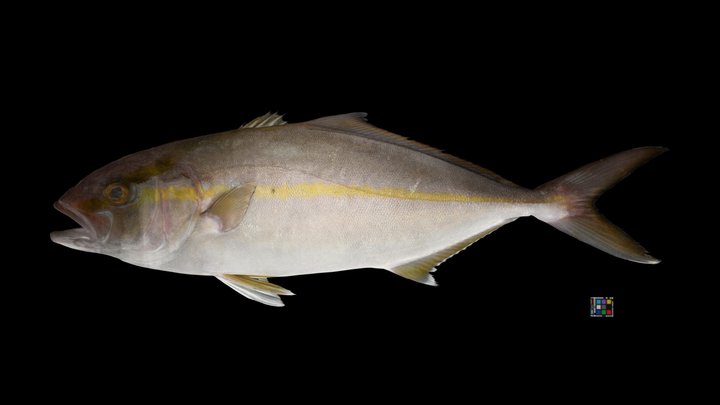
3D model
- Source
- Sketchfab
- Licence
- CC0 Public Domain
- Commercial use
- the licence allows it
Smithsonian Open Access and MorphoSource were not reached for this taxon, so this list is what the others held rather than everything there is.
The description on this site
- Source
- Wikipedia, “Seriola”
- Licence
- CC BY-SA 4.0
This is what the site found, which is not the same as what exists.
Keep going
What may have been alongside itCarangidae through timeFormations of the MioceneThe world it lived on
Occurrence data from the Paleobiology Database, CC BY 4.0. Cuvier 1817