Seymouriamorpha
Searched as Seymouria. The Paleobiology Database treats Seymouriamorpha as the accepted name.
Seymouria is an extinct genus of seymouriamorph from the Early Permian of North America and Europe. Although they were amphibians, Seymouria were well-adapted to life on land, with many reptilian features—so many, in fact, that Seymouria was first thought to be a primitive reptile. It is primarily known from two species, Seymouria baylorensis and Seymouria sanjuanensis. The type species, S. baylorensis, is more robust and specialized, though its fossils have only been found in Texas. On the other hand, S. sanjuanensis is more abundant and widespread. This smaller species is known from multiple well-preserved fossils, including a block of six skeletons found in the Cutler Formation of New Mexico, and a pair of fully grown skeletons from the Tambach Formation of Germany, which were fossilized lying next to each other.

Ryan Somma · CC BY-SA 2.0 · via Wikipedia/Commons. May be a photograph of a specimen, or an artist’s reconstruction — an interpretation of a skeleton, since colour and soft tissue are almost never preserved.
On record
Recorded, not inferred- Sits inside
- AmphibiosauriaPBDB
- Motility
- actively mobilePBDB, for Osteichthyes
- Environment
- brackish,freshwater,terrestrialPBDB, for Tetrapoda
Time the record covers
At least 47 million years on record.
The record covers at least 307 Mya to 259.857 Mya. No occurrence read is dated outside 315.2 Mya to 251.902 Mya.
104 occurrences of Seymouriamorpha on record, most of them in the Permian. Bar height is expected occurrences, not a count: each fossil is spread across the span it is dated to, so a tall narrow bar means tight dating and a low wide one means loose.
When
104 occurrences- Carboniferousunder 1%
- Permian99%
These are dates about fossils, not the animal: the record can only begin after it arose and end before it died out, so either end may reach further. Shares are expected occurrences: a fossil dated to a span is counted partly in each period it straddles. More on what this infers.
Found in
35 formations
- Arroyo Formation · Clear Fork Group7
- Poldarsa Formation7
- Vale Formation · Clear Fork Group5
- Kutulukskaya Formation4
- Malokinelskaya Formation4
- Middle Letovice Formation4
Loading coastlines…
The named rock units Seymouriamorpha has been recovered from, largest first. Drawn where the rock is now, not where it formed. 11 further formations hold fewer occurrences each and are not listed. 34 occurrences have no formation on record, which is common for older literature.
Seymouriamorpha and its relatives
PermianWhere Seymouriamorpha and its relatives were recorded in the Permian.
Found in the same rock
511 taxa- Discosauriscus austriacus10 sites
- Microphon exiguus10 sites
- Microphon9 sites
- Toyemia blumentalis9 sites
- Chroniosaurus dongusensis8 sites
- Isadia aristoviensis8 sites
- Karpinskiosaurus secundus8 sites
- Toyemia tverdochlebovi7 sites
- Captorhinus aguti6 sites
- Dvinosaurus primus6 sites
- Pareiasauridae6 sites
- Seymouria6 sites
- Diadectes5 sites
- Dimetrodon giganhomogenes5 sites
- Diplocaulus5 sites
- Isadia5 sites
- Karpinskiosaurus5 sites
- Prasuchonella5 sites
- Scutosaurus karpinskii5 sites
- Suchonellina5 sites
- Xenacanthus5 sites
- Archegosauroidea4 sites
- Brachydectes newberryi4 sites
- Captorhinus4 sites
The Paleobiology Database records 74 sites for Seymouriamorpha, and this reads all of them. The number is how many of those sites it was catalogued from too. The 24 sharing the most are listed.
This is not a list of everything alive at the time. It is only what has come out of the same ground as this animal and been written down.
Entered from
46 references- Evolution and systematics of seymouriamorph parareptiles28
- Permian and Triassic therocephals (Eutherapsida) of Eastern Europe9
- Type and reference sections of the Middle and Upper Permian of the Volga and Kama River Regions: A Field Guidebook of XVIII International Congress on Carboniferous and Permian5
- Upper Permian vertebrates and their sedimentological context in the South Urals, Russia4
- The cranial anatomy of Discosauriscus Kuhn, a seymouriamorph tetrapod from the Lower Permian of the Boskovice Furrow (Czech Republic)4
- On the fossil Amphibia from the Gas Coal of Nyrany and other deposits of Czechoslovakia4
- Seymouria grandis n. sp. (Batrachosauria: Amphibia) from the Middle Clear Fork (Permian) of Oklahoma and Texas3
- Type and reference sections of the Permian–Triassic continental sequences of the East European Platform: main isotope, magnetic, and biotic events2
- A new vertebrate Lagerstätte from the Lower Permian of France (Franchesse, Massif Central): palaeoenvironmental implications for the Bourbon-l’Archambault basin2
- The Vale Formation (Lower Permian): Its Vertebrates and Paleoecology2
- Seymouria from the Lower Permian of Southeastern Utah, and Possible Sexual Dimorphism in That Genus2
- Novoe mestonakhozhdenie permskikh seimuriamorfov v SSSR [A new locality of Permian seymouriamorphs in the USSR]2
Each of the 104 occurrences read was entered from one of these publications, ordered by how many each accounts for. This is not a search for papers mentioning the name. 34 further references are not listed. Entries link to doi.org where the Paleobiology Database holds an identifier, and to its own record where it does not. Relayed as the Paleobiology Database holds them, not checked against what they resolve to.
Media and terms
Media content3

Picture of Seymouriamorpha
- Source
- Wikipedia/Commons
- Credit
- Ryan Somma
- Licence
- CC BY-SA 2.0
- Commercial use
- the licence allows it
CT scan
- Source
- MorphoSource
- Licence
- not stated by the source
- Commercial use
- cannot be read from the licence given — check the record
- Specimen
- Seymouria sp. · omnh:vp:79343
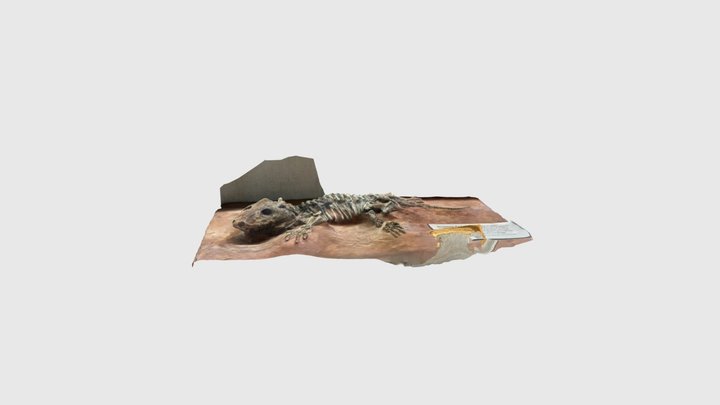
3D model
- Source
- Sketchfab
- Credit
- wildlifeandbones
- Licence
- CC Attribution-NonCommercial-ShareAlike
- Commercial use
- the licence does not allow it
The description on this site
- Source
- Wikipedia, “Seymouria”
- Licence
- CC BY-SA 4.0
This is what the site found, which is not the same as what exists.
Keep going
What may have been alongside itAmphibiosauria through timeFormations of the PermianThe world it lived on
Occurrence data from the Paleobiology Database, CC BY 4.0. (Watson 1917)