Stephanodus
Stephanodus is a form genus of extinct fossil ray-finned fish, referring to the hook-shaped pharyngeal teeth present on the branchial arch of pycnodonts.
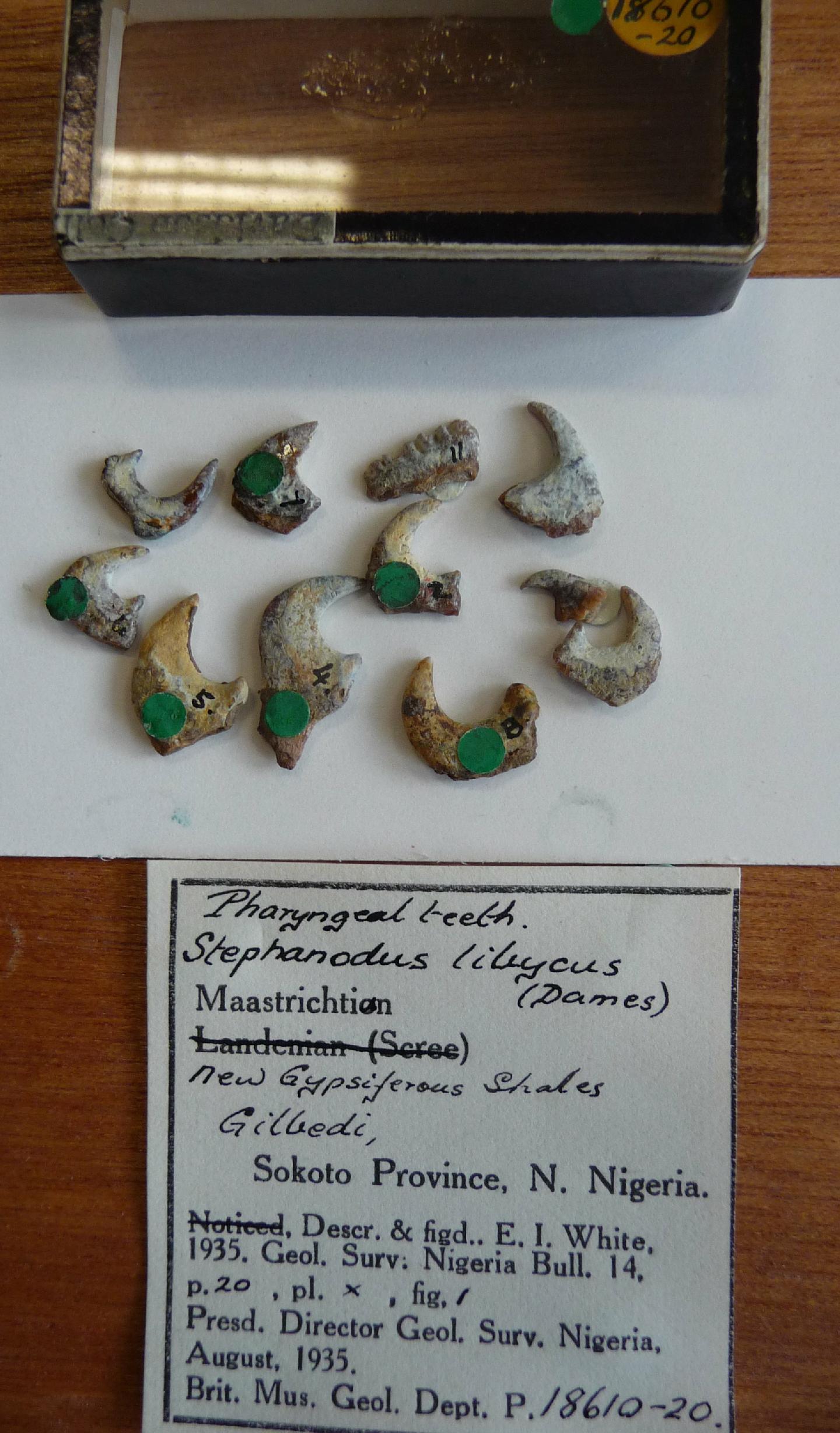
via GBIF · CC0 · via GBIF. May be a photograph of a specimen, or an artist’s reconstruction — an interpretation of a skeleton, since colour and soft tissue are almost never preserved.
Time the record covers
At least 106 million years on record.
The record covers at least 154.8 Mya to 48.07 Mya. No occurrence read is dated outside 157.9 Mya to 33.9 Mya.
60 occurrences of Stephanodus on record, most of them in the Late Cretaceous. Bar height is expected occurrences, not a count: each fossil is spread across the span it is dated to, so a tall narrow bar means tight dating and a low wide one means loose.
When
60 occurrences- Late Jurassic4%
- Early Cretaceous6%
- Late Cretaceous77%
- Paleoceneunder 1%
- Eocene13%
These are dates about fossils, not the animal: the record can only begin after it arose and end before it died out, so either end may reach further. Shares are expected occurrences: a fossil dated to a span is counted partly in each period it straddles. More on what this infers.
Found in
28 formations
- Subathu Formation4
- Mount Laurel Formation · Monmouth Group2
- Lameta Formation2
- Dukamaje Formation2
- Bahariya Formation2
- Vaals Greensand Formation2
Loading coastlines…
The named rock units Stephanodus has been recovered from, largest first. Drawn where the rock is now, not where it formed. 4 further formations hold fewer occurrences each and are not listed. 24 occurrences have no formation on record, which is common for older literature.
Stephanodus and its relatives
Late CretaceousWhere Stephanodus and its relatives were recorded in the Late Cretaceous.
Found in the same rock
735 taxa- Hybodus17 sites
- Squalicorax pristodontus14 sites
- Enchodus13 sites
- Pycnodontidae13 sites
- Rhinobatos12 sites
- Squalicorax kaupi12 sites
- Chelonioidea11 sites
- Crocodyliformes10 sites
- Elasmosauridae10 sites
- Rhombodus levis10 sites
- Anomoeodus phaseolus9 sites
- Brachyrhizodus wichitaensis9 sites
- Enchodus elegans9 sites
- Ischyrhiza mira9 sites
- Mosasauridae9 sites
- Squalicorax9 sites
- Stratodus apicalis9 sites
- Teleostei9 sites
- Anura8 sites
- Cretalamna appendiculata8 sites
- Cretalamna maroccana8 sites
- Crocodylia8 sites
- Lepisosteus indicus8 sites
- Plicatoscyllium8 sites
The Paleobiology Database records 58 sites for Stephanodus, and this reads all of them. The number is how many of those sites it was catalogued from too. The 24 sharing the most are listed.
This is not a list of everything alive at the time. It is only what has come out of the same ground as this animal and been written down.
Entered from
39 references- The marine vertebrate faunas from the Late Cretaceous phosphates of Syria6
- Vertebrate fauna from the infra- and inter-trappean beds of Andhra Pradesh: age implications5
- Eocene ichthyofauna from the Subathu Formation, Northwestern Himalaya, India4
- Nouveaux restes de Vertébrés du Jurassique terminal du Boulonnais (Nord de la France) [New vertebrate remains from the latest Jurassic of the Boulonnais (northern France)]3
- Stratigraphy and Paleobiology of the Upper Cretaceous - Lower Paleogene Sediments from the Trans-Saharan Seaway in Mali2
- Le Crétacé continental à vertébrés de la bordure sud du plateau de Tinhert: découvertes paléontologiques et considérations stratigraphiques [The continental Cretaceous vertebrates of the southern border of the Tinhert Plateau: paleontological discoveries and stratigraphic considerations]2
- Marine vertebrate faunas from the Maastrichtian phosphates of Benguérir (Ganntour Basin, Morocco): Biostratigraphy, palaeobiogeography and palaeoecology2
- Les poissons crétacés et tertiaires du bassin des Iullemmeden (République du Niger)2
- Eine Fischfauna aus der oberen Kreide von Aachen und neuere Fund von Fischresten aus dem Maestricht des angrenzenden belgisch-holländischen Raumes2
- Étude derestes de poissons du Crétacé saharien [Study of fish remains from the Saharan Cretaceous]2
- Ergebnisse der Forschungsreisen Prof. E. Stromers in den Wüsten Ägyptens II. Wirbeltierreste der Baharije-Stufe (unterstes Cenoman) 16. Neue Untersuchungen an den Fischresten2
- A Late Cretaceous (Campanian) marine vertebrate microfauna from the Aguja Formation of Chihuahua, Mexico1
Each of the 60 occurrences read was entered from one of these publications, ordered by how many each accounts for. This is not a search for papers mentioning the name. 27 further references are not listed. Entries link to doi.org where the Paleobiology Database holds an identifier, and to its own record where it does not. Relayed as the Paleobiology Database holds them, not checked against what they resolve to.
Media and terms
Media content1
Picture of Stephanodus
- Source
- GBIF
- Credit
- via GBIF
- Licence
- CC0
- Commercial use
- the licence allows it
No 3D scan was found. Smithsonian Open Access, MorphoSource and Sketchfab were all searched.
The description on this site
- Source
- Wikipedia, “Stephanodus”
- Licence
- CC BY-SA 4.0
This is what the site found, which is not the same as what exists.
Keep going
What may have been alongside itFormations of the Late CretaceousThe world it lived on
Occurrence data from the Paleobiology Database, CC BY 4.0.