Stegoceras
Stegoceras is a genus of pachycephalosaurid (dome-headed) dinosaur that lived in what is now North America during the Late Cretaceous period, about 77.5 to 74 million years ago (mya). The first specimens from Alberta, Canada, were described in 1902, and the type species Stegoceras validum was based on these remains. The generic name means "horn roof", and the specific name means "strong". Several other species have been assigned to the genus, but these have since been moved to other genera or deemed junior synonyms. The remaining assigned species, S. novomexicanum, named in 2011 from fossils found in New Mexico, has also been debated, and may not belong to Stegoceras.

Cherrysweetdeal · CC BY 2.0 · via Wikipedia/Commons. May be a photograph of a specimen, or an artist’s reconstruction — an interpretation of a skeleton, since colour and soft tissue are almost never preserved.
On record
Recorded, not inferred- Sits inside
- EupachycephalosauriaPBDB
- Diet
- herbivorePBDB, for Ornithischia
- Life habit
- ground dwelling, gregariousPBDB, for Ornithischia
- Motility
- actively mobilePBDB, for Ornithischia
- Environment
- terrestrialPBDB, for Ornithischia
- Length
- 2.4 mWikidata
Time the record covers
At most 18 million years on record.
Every occurrence read is dated to somewhere between 83.6 Mya and 66 Mya, and nothing in the dating separates them, so that window is what the record shows rather than a span.
46 occurrences of Stegoceras on record, most of them in the Late Cretaceous. Bar height is expected occurrences, not a count: each fossil is spread across the span it is dated to, so a tall narrow bar means tight dating and a low wide one means loose.
When
46 occurrences- Late Cretaceous100%
These are dates about fossils, not the animal: the record can only begin after it arose and end before it died out, so either end may reach further. Shares are expected occurrences: a fossil dated to a span is counted partly in each period it straddles. More on what this infers.
Found in
8 formations
- Judith River Formation · Montana Group14
- Dinosaur Park Formation · Belly River Group7
- Fruitland Formation4
- Hell Creek Formation · Montana Group2
- Kirtland Formation2
- Oldman Formation · Belly River Group2
Loading coastlines…
The named rock units Stegoceras has been recovered from, largest first. Drawn where the rock is now, not where it formed. 13 occurrences have no formation on record, which is common for older literature.
Stegoceras and its relatives
Late CretaceousWhere Stegoceras and its relatives were recorded in the Late Cretaceous.
Found in the same rock
120 taxa- Hadrosauridae8 sites
- Baenidae6 sites
- Alphadon halleyi4 sites
- Aspideretoides4 sites
- Trionychinae4 sites
- Adocus3 sites
- Boremys3 sites
- Ceratopsidae3 sites
- Champsosaurus3 sites
- Crocodylia3 sites
- Lepisosteus3 sites
- Mesodma3 sites
- Myledaphus3 sites
- Paralbula3 sites
- Testudines3 sites
- Theropoda3 sites
- Troodon formosus3 sites
- Turgidodon russelli3 sites
- Albanerpetontidae2 sites
- Ankylosauridae2 sites
- Anura2 sites
- Aves2 sites
- Basilemys2 sites
- Brachychampsa2 sites
The Paleobiology Database records 45 sites for Stegoceras, and this reads all of them. The number is how many of those sites it was catalogued from too. The 24 sharing the most are listed.
This is not a list of everything alive at the time. It is only what has come out of the same ground as this animal and been written down.
Entered from
15 references- Morphometric landmarks of pachycephalosaurid cranial material from the Judith River Formation of northcentral Montana8
- A study of the troödont dinosaurs with the description of a new genus and four new species8
- Re-evaluation of pachycephalosaurids from the Fruitland-Kirtland transition (Kirtlandian, late Campanian), San Juan Basin, New Mexico, with a description of a new species of Stegoceras and a reassessment of Texacephale langstoni6
- Revision of the dinosaur Stegoceras Lambe (Ornithischia, Pachycephalosauridae)4
- Notes on pachycephalosaurid dinosaurs (Reptilia: Ornithischia) from North America, with comments on their status as ornithopods4
- The Cretaceous genus Stegoceras typifying a new family referred provisionally to the Stegosauria4
- The vertebrate fauna from the Judith River Formation (Late Cretaceous) of Wheatland and Golden Valley counties, Montana3
- New data on pachycephalosaurid dinosaurs (Reptilia: Ornithischia) from North America2
- A rare ‘flat-headed’ pachycephalosaur (Dinosauria: Pachycephalosauridae) from West Texas, USA, with morphometric and heterochronic considerations1
- The pachycephalosaurid dinosaur Stegoceras validum from the Upper Cretaceous Fruitland Formation, San Juan Basin, New Mexico1
- Additions to the mammalian paleofauna of Saskatchewan1
- New occurrences of pachycephalosaurid dinosaurs from the Hell Creek Formation, Garfield County, Montana1
Each of the 46 occurrences read was entered from one of these publications, ordered by how many each accounts for. This is not a search for papers mentioning the name. 3 further references are not listed. Entries link to doi.org where the Paleobiology Database holds an identifier, and to its own record where it does not. Relayed as the Paleobiology Database holds them, not checked against what they resolve to.
Media and terms
Media content3

Picture of Stegoceras
- Source
- Wikipedia/Commons
- Credit
- Cherrysweetdeal
- Licence
- CC BY 2.0
- Commercial use
- the licence allows it
CT scan
- Source
- MorphoSource
- Licence
- not stated by the source
- Commercial use
- cannot be read from the licence given — check the record
- Specimen
- Stegoceras sp. · UCMP:V:130051
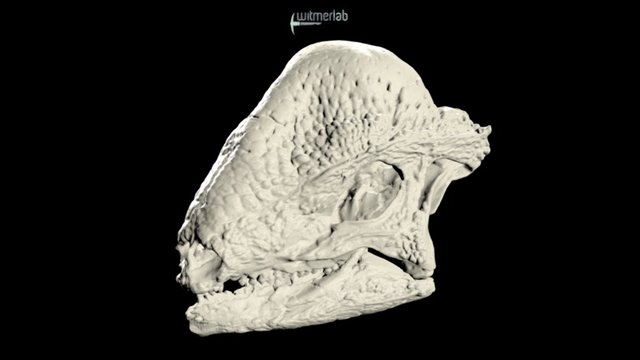
3D model
- Source
- Sketchfab
- Licence
- CC Attribution-NonCommercial
- Commercial use
- the licence does not allow it
Smithsonian Open Access was not reached for this taxon, so this list is what the others held rather than everything there is.
The description on this site
- Source
- Wikipedia, “Stegoceras”
- Licence
- CC BY-SA 4.0
This is what the site found, which is not the same as what exists.
Keep going
What may have been alongside itEupachycephalosauria through timeFormations of the Late CretaceousThe world it lived on
Occurrence data from the Paleobiology Database, CC BY 4.0. Lambe 1902